# Visual Studio Code
You can develop in your Coder workspace remotely with [VS Code](https://code.visualstudio.com/download).
We support connecting with the desktop client and VS Code in the browser with [code-server](https://github.com/coder/code-server).
Learn more about how VS Code Web and code-server compare in the [code-server doc](/beta-docs/@main/user-guides/workspace-access/code-server/).
## VS Code Desktop [#vs-code-desktop]
VS Code desktop is a default app for workspaces.
Select **VS Code Desktop** in the dashboard to one-click enter a workspace.
This automatically installs the [Coder Remote](https://github.com/coder/vscode-coder) extension, authenticates with Coder, and connects to the workspace.

The `VS Code Desktop` button can be hidden by enabling [Browser-only connections](/beta-docs/@main/admin/networking/#browser-only-connections).
### Manual Installation [#manual-installation]
You can install our extension manually in VS Code using the command palette.
Launch VS Code Quick Open (Ctrl+P), paste the following command, and press enter.
```txt
ext install coder.coder-remote
```
Alternatively, manually install the VSIX from the [latest release](https://github.com/coder/vscode-coder/releases/latest).
## Local telemetry [#local-telemetry]
The Coder Remote extension records local telemetry to help diagnose extension and workspace connection issues.
Telemetry is stored on your machine.
It is not sent to Coder unless you export it or include it in a support bundle and share that file.
Local telemetry is controlled by the VS Code setting `coder.telemetry.level`:
| Value | Behavior |
| ------- | ------------------------------------------------------------- |
| `off` | Disable extension telemetry collection. |
| `local` | Record telemetry events on this machine. This is the default. |
### Stored data [#stored-data]
Telemetry can include diagnostic details such as extension version, VS Code version, operating system, machine and session identifiers, deployment URL, workspace and agent names, command outcomes, connection state, request routes, timing, and error details.
It does not intentionally collect source code, terminal contents, tokens, or credentials.
### Tracked activity [#tracked-activity]
The exact events vary by extension version.
For a comprehensive list of current events, properties, and attributes, see the [extension event reference](https://github.com/coder/vscode-coder/blob/main/src/instrumentation/EVENTS.md).
The following categories summarize the diagnostic signals the extension may record:
| Area | Examples |
| ------------------------------ | -------------------------------------------------------------------------------------------- |
| Extension lifecycle | Activation, deployment initialization, and configuration loading. |
| Authentication and credentials | Sign-in state, token refresh, logout, credential storage, and deployment recovery. |
| Commands and diagnostics | Command outcomes, telemetry exports, support bundle creation, ping, and speed tests. |
| Workspace workflows | Workspace selection, open attempts, dev container handoff, start, and update prompts. |
| CLI and remote setup | CLI binary resolution, download, verification, configuration, and setup through SSH handoff. |
| Connection health | Workspace and agent state transitions, reconnects, SSH process health, and network samples. |
| HTTP diagnostics | Normalized routes, status classes, and latency rollups. |
### Storage and retention [#storage-and-retention]
The extension stores telemetry as JSON Lines files in its VS Code global storage under a `telemetry` directory.
Files rotate at 5 MiB, are kept for up to 30 days, and are capped at 100 MiB total by default.
You can tune local retention with the advanced `coder.telemetry.local` setting.
Most users should keep the default values.
### Diagnostics and support bundles [#diagnostics-and-support-bundles]
The extension includes commands for collecting diagnostics from VS Code:
* **Coder: Export Telemetry** exports only local telemetry.
Choose a date range and JSON or OTLP JSON zip format, then review the file before sharing it.
* **Coder: Create Support Bundle** runs `coder support bundle` and adds local extension logs, proxy and Remote-SSH logs, selected settings, and telemetry under `vscode-logs/`.
Only configured values for `coder.globalFlags`, `coder.headerCommand`, and `coder.tlsCertRefreshCommand` are masked; review other settings before sharing.
With Coder CLI version 2.36.0 or later and a reachable workspace agent that supports file collection, it also collects remote editor server logs under `agent/workspace_files/`.
Bundles created with the CLI alone don't include local VS Code diagnostics.
Follow the [VS Code support bundle procedure](/beta-docs/@main/support/support-bundle/#vs-code) to select a workspace, confirm collection, and save the archive.
* **Coder: View Logs** opens SSH proxy logs in VS Code.
Support bundles can contain sensitive diagnostic data.
Review the generated bundle before sharing it.
Learn more about [support bundles](/beta-docs/@main/support/support-bundle/).
## Connection timeouts and reconnects [#connection-timeouts-and-reconnects]
The Coder Remote extension sets SSH keepalive and Remote - SSH reconnection defaults for Coder workspaces.
If your connection drops while the workspace is under heavy load, such as memory pressure, you can relax these settings.
### SSH keepalives [#ssh-keepalives]
The extension writes these keepalive options to the SSH configuration it generates for Coder workspaces:
| Option | Default | Behavior |
| --------------------- | ------- | ------------------------------------------ |
| `ServerAliveInterval` | `10` | Sends a keepalive every 10 seconds. |
| `ServerAliveCountMax` | `3` | Disconnects after 3 unanswered keepalives. |
With these defaults, the SSH client disconnects after about 30 seconds without a response from the workspace.
To tolerate longer stalls, override the options in the `coder.sshConfig` VS Code setting:
```json
{
"coder.sshConfig": ["ServerAliveCountMax=30"]
}
```
This example disconnects after about 5 minutes without a response.
To remove a default option, set it to an empty value, such as `"ServerAliveCountMax="`.
The new values apply the next time you connect to the workspace.
If you're already connected, reload the window.
The extension merges SSH options from these sources, from highest to lowest precedence:
1. The `coder.sshConfig` VS Code setting.
2. Options passed to `coder config-ssh --ssh-option`.
3. Deployment-wide options that an administrator sets with [`CODER_SSH_CONFIG_OPTIONS`](/beta-docs/@main/reference/cli/server/#--ssh-config-options).
### Reconnection settings [#reconnection-settings]
When you connect to a workspace, the extension writes these `remote.SSH.*` settings, in seconds, to your user settings.
They apply to all SSH hosts, not only Coder workspaces.
| Purpose | Setting | Set on connect | Recommended |
| -------------------------------- | ------------------------------------------------------------------------------------ | ----------------------------- | ------------------- |
| Connection timeout | `connectTimeout` | Raised to at least `1800` | `1800` (30 minutes) |
| Server lifetime after disconnect | `reconnectionGraceTime` (VS Code, Devin Desktop) or `serverShutdownTimeout` (Cursor) | `28800` (8 hours), if unset | `86400` (24 hours) |
| Reconnection attempts | `maxReconnectionAttempts` (VS Code, Devin Desktop) | `null` (8 attempts), if unset | `null` (8 attempts) |
To apply the recommended values, run **Coder: Apply Recommended SSH Settings** from the Command Palette.
This command overwrites any values you set for these settings.
If you're connected to a workspace, reload the window to apply them.
On Devin Desktop, the extension writes the same values to the matching `remote.devinSSH.*` settings.
Antigravity has no equivalent settings.
`reconnectionGraceTime` only applies to Linux workspaces, and only after the remote server restarts.
These settings control how long your editor waits to connect, how long the remote server waits for you to reconnect, and how many times your editor retries.
They don't change when the SSH connection itself times out.
To adjust the SSH connection timeout, use `coder.sshConfig`.
## VS Code extensions [#vs-code-extensions]
There are multiple ways to add extensions to VS Code Desktop:
1. Using the [public extensions marketplaces](#use-the-public-extensions-marketplaces) with Code Web (code-server)
2. Adding [extensions to custom images](#add-extensions-to-custom-images)
3. Installing extensions [using its `vsix` file at the command line](#install-extensions-using-a-vsix-file-at-the-command-line)
4. Installing extensions [from a marketplace using the command line](#install-from-a-marketplace-at-the-command-line)
### Use the public extensions marketplaces [#use-the-public-extensions-marketplaces]
You can manually add an extension while you're working in the Code Web IDE.
The extensions can be from Coder's public marketplace, Eclipse Open VSX's public marketplace, or the Eclipse Open VSX *local* marketplace.
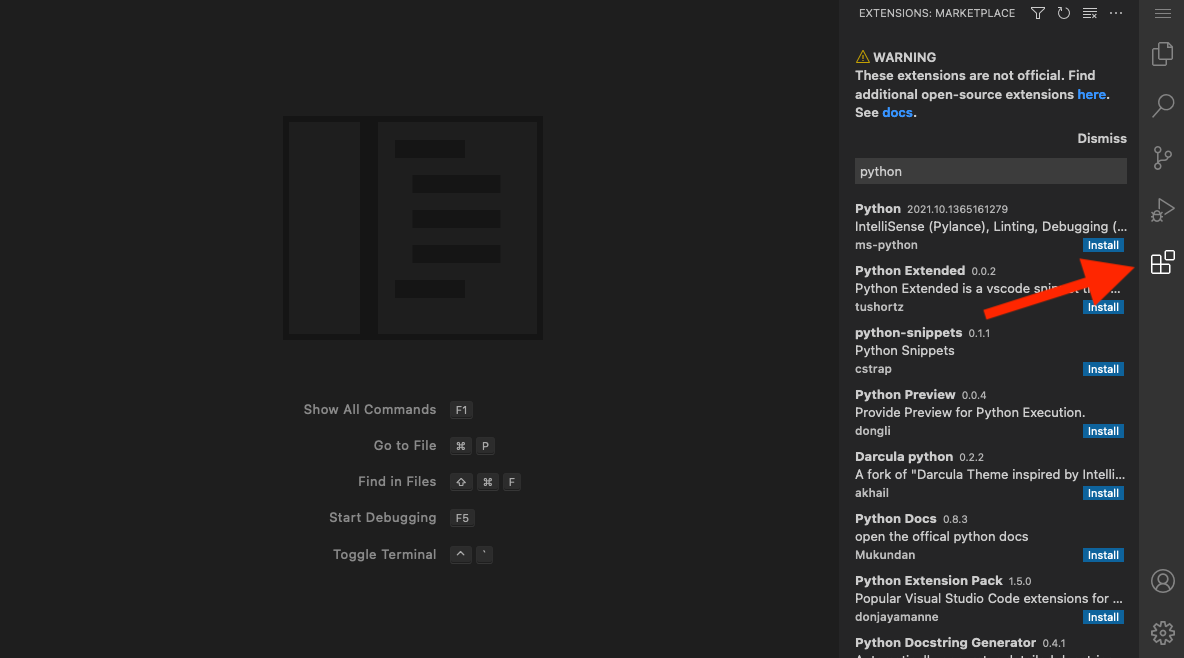
Microsoft does not allow any unofficial VS Code IDE to connect to the extension marketplace.
### Add extensions to custom images [#add-extensions-to-custom-images]
You can add extensions to a custom image and install them either through Code Web or using the workspace's terminal.
1. Download the extension(s) from the Microsoft public marketplace.
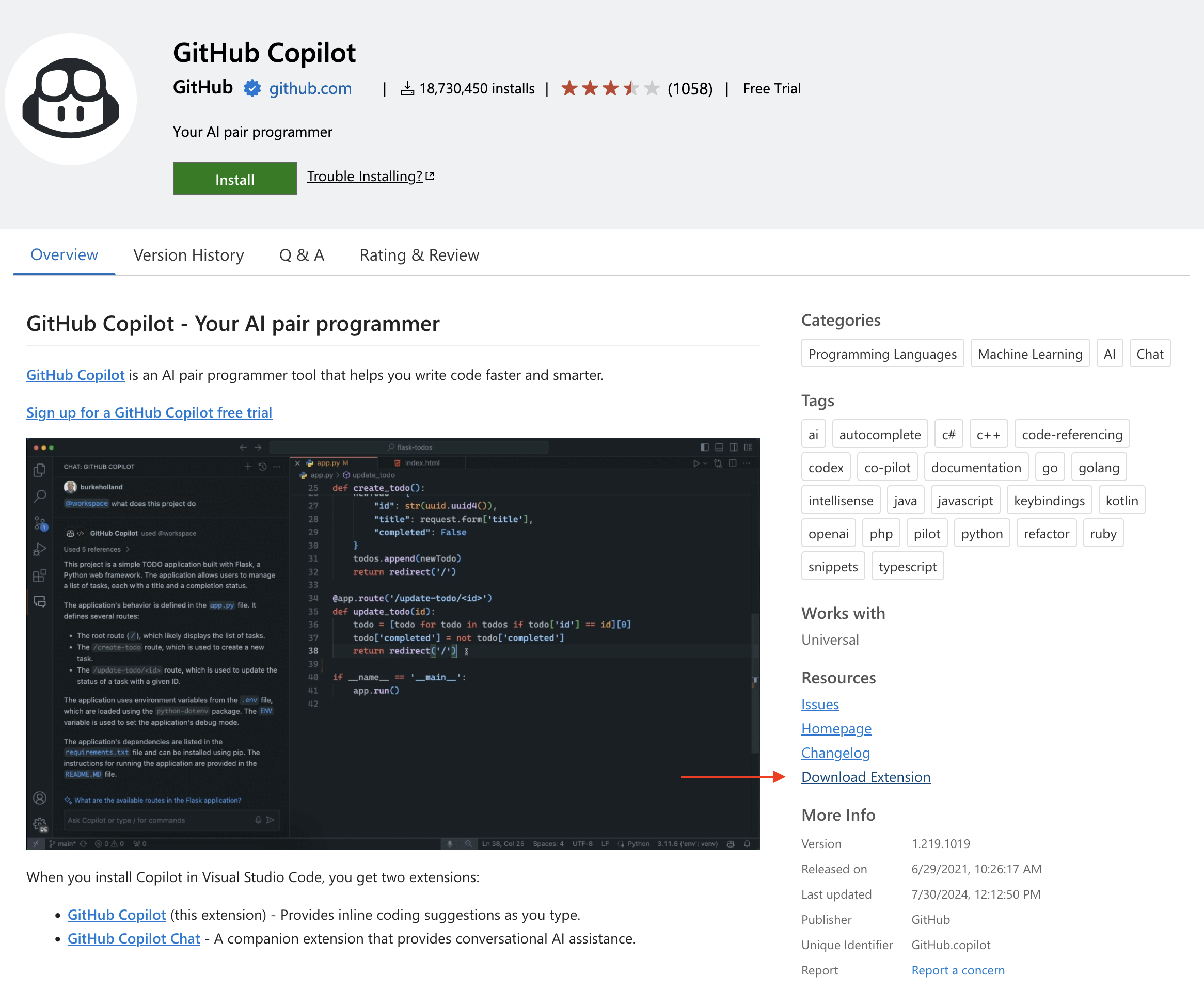
2. Add the `vsix` extension files to the same folder as your Dockerfile.
```sh
~/images/base
➜ ls -l
-rw-r--r-- 1 coder coder 0 Aug 1 19:23 Dockerfile
-rw-r--r-- 1 coder coder 8925314 Aug 1 19:40 GitHub.copilot.vsix
```
3. In the Dockerfile, add instructions to make a folder and to copy the `vsix` files into the newly created folder.
```dockerfile
FROM codercom/example-base:ubuntu
# Run below commands as root user
USER root
# Download and install VS Code extensions into the container
RUN mkdir -p /vsix
ADD ./GitHub.copilot.vsix /vsix
USER coder
```
4. Build the custom image, and push it to your image registry.
5. Pass in the image and below command into your template `startup_script` (be sure to update the filename below):
**Startup Script**
```tf
resource "coder_agent" "main" {
...
startup_script = "code-server --install-extension /vsix/GitHub.copilot.vsix"
}
```
**Image Definition**
```tf
resource "kubernetes_deployment" "main" {
spec {
template {
spec {
container {
name = "dev"
image = "registry.internal/image-name:tag"
}
}
}
}
}
```
6. Create a workspace using the template.
You will now have access to the extension in your workspace.
### Install extensions using a `vsix` file at the command line [#install-extensions-using-a-vsix-file-at-the-command-line]
Using the workspace's terminal or the terminal available inside `code-server`, you can install an extension whose files you've downloaded from a marketplace:
```console
/path/to/code-server --install-extension /vsix/GitHub.copilot.vsix
```
### Install from a marketplace at the command line [#install-from-a-marketplace-at-the-command-line]
Using the workspace's terminal or the terminal available inside Code Web (code server), run the following to install an extension (be sure to update the snippets with the name of the extension you want to install):
```console
SERVICE_URL=https://extensions.coder.com/api ITEM_URL=https://extensions.coder.com/item /path/to/code-server --install-extension GitHub.copilot
```
Alternatively, you can install an extension from Open VSX's public marketplace:
```console
SERVICE_URL=https://open-vsx.org/vscode/gallery ITEM_URL=https://open-vsx.org/vscode/item /path/to/code-server --install-extension GitHub.copilot
```
### Use VS Code Desktop [#use-vs-code-desktop]
For your local VS Code to pickup extension files in your Coder workspace, include this command in your `startup_script`, or run in manually in your workspace terminal:
```console
code --extensions-dir ~/.vscode-server/extensions --install-extension "$extension"
```