# Manage workspaces
A workspace is the environment where a developer or a coding agent works.
Developers and agents in a team each work from their own workspace and can use [multiple IDEs](/beta-docs/@main/user-guides/workspace-access/).
A developer creates a workspace from a [shared template](/beta-docs/@main/admin/templates/).
This lets an entire team work in environments that are identically configured and provisioned with the same resources.
## Create workspaces [#create-workspaces]
You can create a workspace in the UI.
Log in to your Coder instance, go to the **Templates** tab, find the template you need, and select **Create Workspace**.
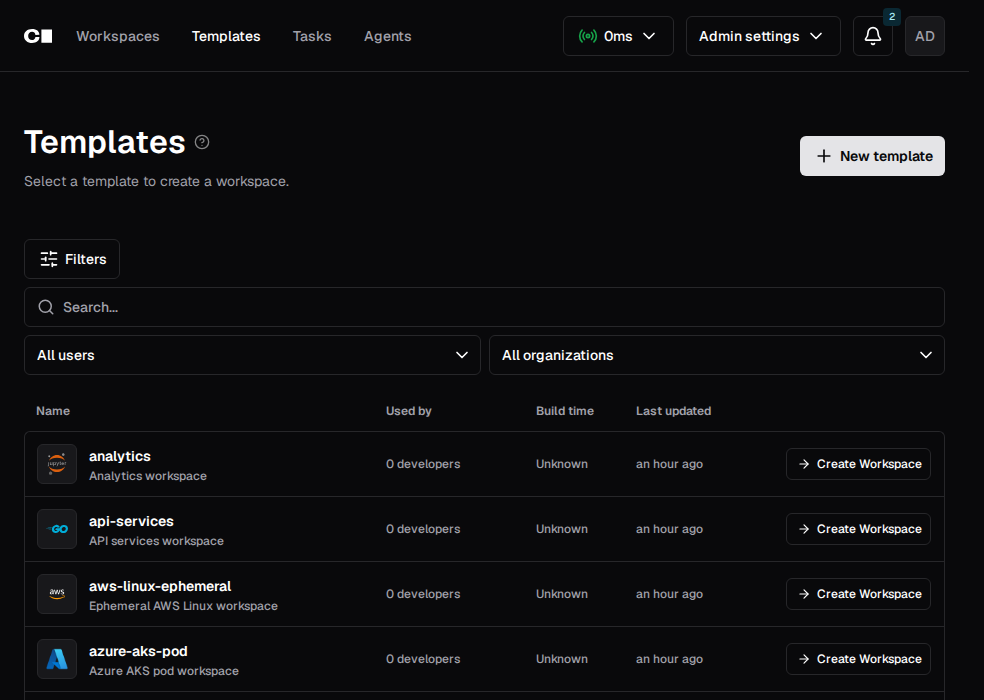
When you create a workspace, you will be prompted to give it a name.
You might also be prompted to set some parameters that the template provides.
You can manage your existing templates in the **Workspaces** tab.
You can also create a workspace from the command line:
Each Coder user has their own workspaces created from [templates](/beta-docs/@main/admin/templates/):
```sh
# create a workspace from the template; specify any variables
coder create --template=""
# show the resources behind the workspace and how to connect
coder show
```
### Workspace name rules and restrictions [#workspace-name-rules-and-restrictions]
| Constraint | Rule |
| ---------------- | ------------------------------------------ |
| Start/end with | Must start and end with a letter or number |
| Character types | Letters, numbers, and hyphens only |
| Length | 1-32 characters |
| Case sensitivity | Case-insensitive (lowercase recommended) |
| Reserved names | Cannot use `new` or `create` |
| Uniqueness | Must be unique within your workspaces |
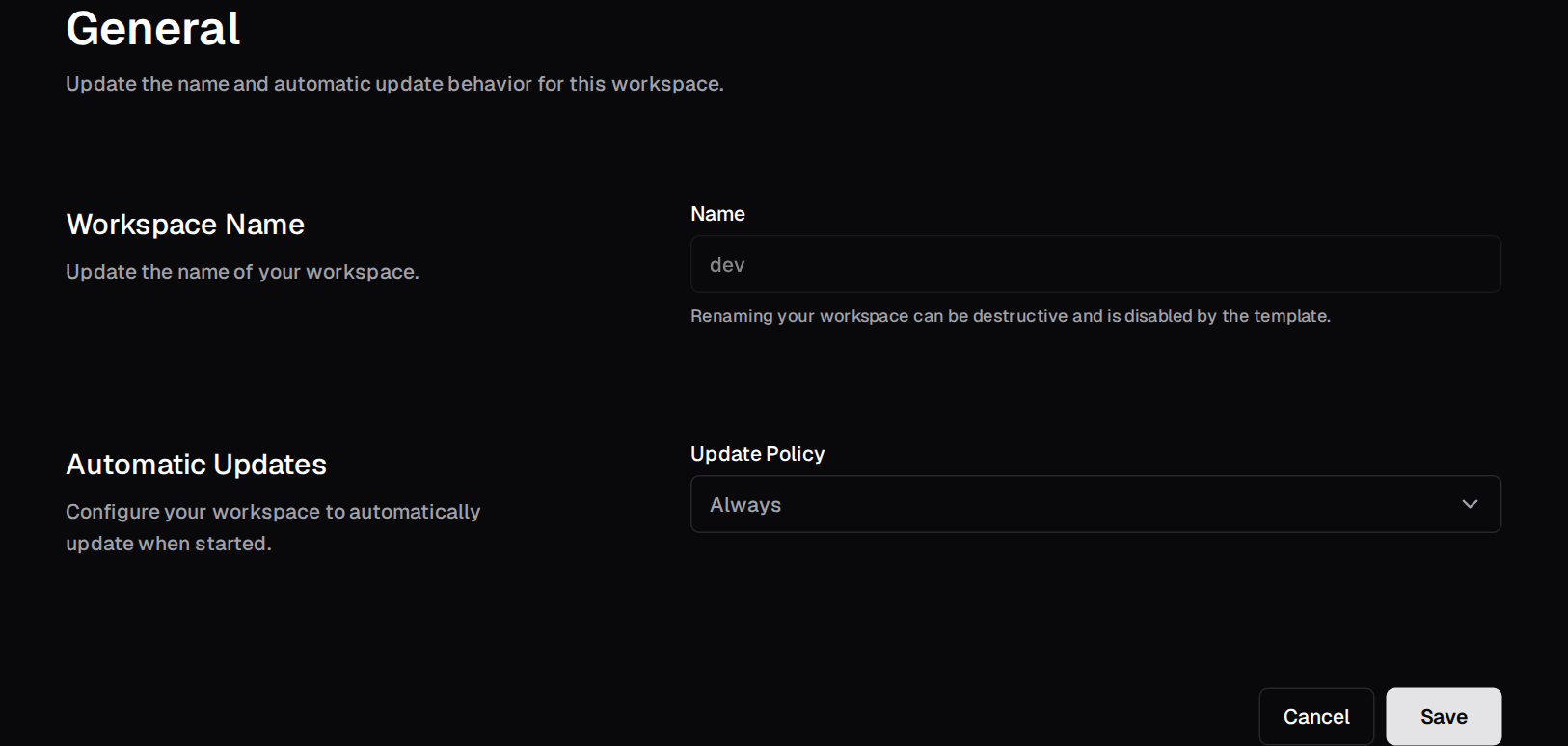
Renaming a workspace after you create it is off by default.
A template admin can allow it per template.
Refer to [Workspace renaming](/beta-docs/@main/admin/templates/managing-templates/#workspace-renaming).
## Workspace filtering [#workspace-filtering]
In the Coder UI, you can filter your workspaces using pre-defined filters or Coder's filter query.
Filters follow the pattern `[filter name]:[filter text]` and multiple filters can be specified separated by a space i.e `owner:me status:running`
The following filters are supported:
* `owner` - Represents the `username` of the owner.
You can also use `me` as a convenient alias for the logged-in user, e.g., `owner:me`
* `user` - Workspaces a user owns, plus workspaces shared with them directly or through a group they belong to.
Accepts a `username`, user ID, or `me`, e.g., `user:me`
* `name` - Name of the workspace.
* `template` - Name of the template.
* `status` - Indicates the status of the workspace, e.g, `status:failed` For a list of supported statuses, see [WorkspaceStatus documentation](https://pkg.go.dev/github.com/coder/coder/codersdk#WorkspaceStatus).
* `outdated` - Filters workspaces using an outdated template version, e.g, `outdated:true`
* `dormant` - Filters workspaces based on the dormant state, e.g `dormant:true`
* `has-agent` - Only applicable for workspaces in "start" transition.
Stopped and deleted workspaces don't have agents.
List of supported values `connecting|connected|timeout|disconnected`, e.g, `has-agent:connecting`
* `id` - Workspace UUID
* `healthy` - Only applicable for workspaces in "start" transition.
`healthy:false` is an alias for `has-agent:timeout,disconnected`, `healthy:true` is an alias for `has-agent:connected`.
* `include_agent_metadata` - Not a filter: expands each agent in the API response with the named agent metadata keys, e.g, `include_agent_metadata:cpu_usage`.
Repeat the key to request multiple metadata items.
Keys match case-insensitively.
## Update workspaces [#update-workspaces]
After updating the default version of the template that a workspace was created from, you can update the workspace.

If the workspace is running, Coder stops it, updates it, then starts the workspace again.
### Update with the CLI [#update-with-the-cli]
Update a workspace through the command line:
```sh
coder update
```
If the workspace is running, `coder update` asks for confirmation before it stops and updates the workspace.
To skip the prompt in scripts and other non-interactive use, add `-y`:
```sh
coder update -y
```
By default, `coder update` stops the workspace with its current template version and starts it on the active version.
To start on a specific version instead, use `--template-version` with the version name or ID.
To stop with a different version than the workspace's current one, use `--stop-template-version`:
```sh
coder update --template-version
coder update --stop-template-version --template-version
```
`--stop-template-version` only applies when `coder update` stops a started workspace.
To stop a workspace with a specific version on its own, use `coder stop --template-version`.
`coder start` and `coder stop` also accept `--template-version`.
Template permissions still apply, so if a template requires the active version, only template admins can start a workspace on another version.
### Automatic updates [#automatic-updates]
It can be tedious to manually update a workspace everytime an update is pushed to a template.
Users can choose to opt-in to automatic updates to update to the active template version whenever the workspace is started.
Note: If a template is updated such that new parameter inputs are required from the user, autostart will be disabled for the workspace until the user has manually updated the workspace.
## Bulk operations [#bulk-operations]
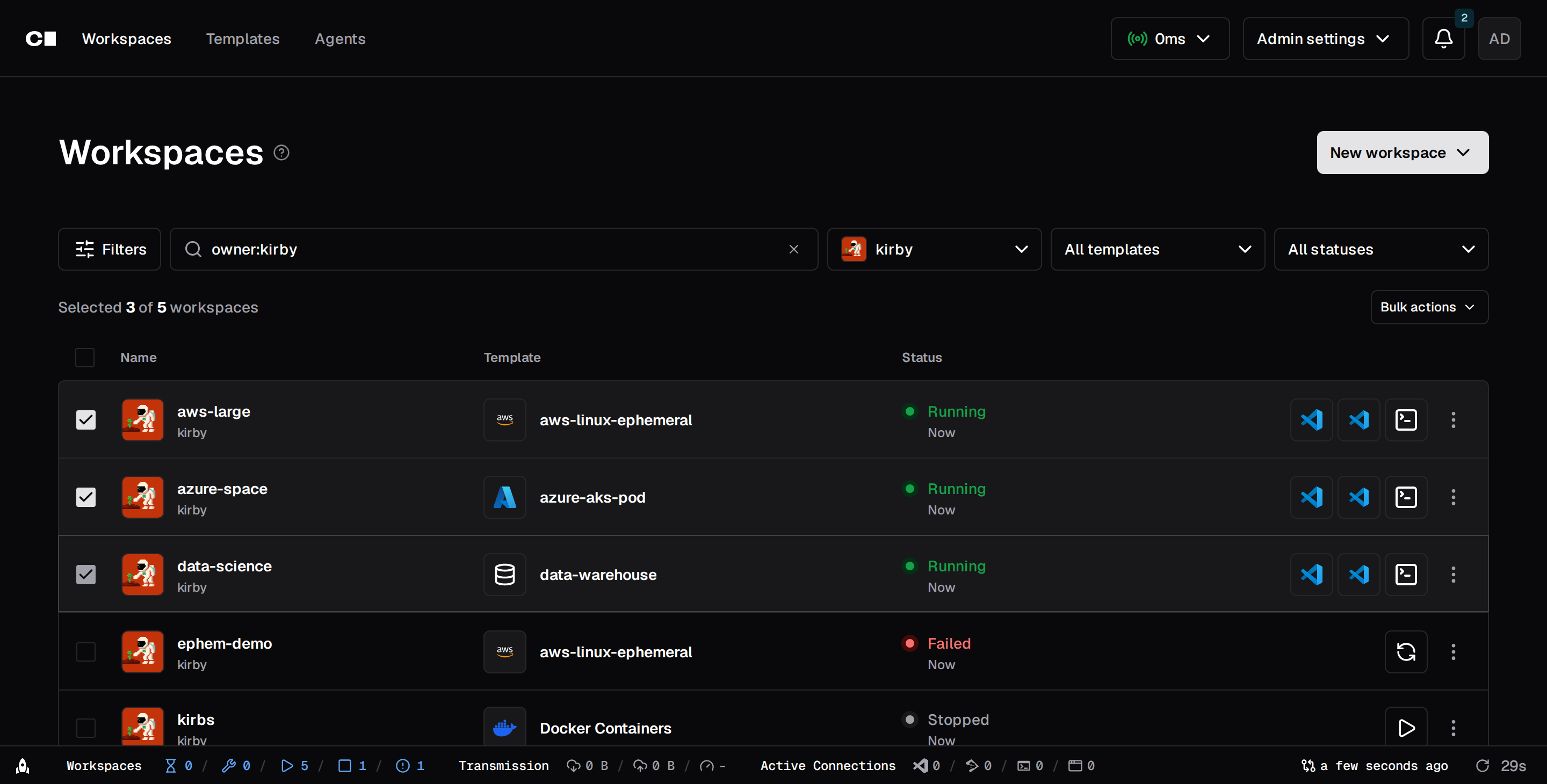
Admins may apply bulk operations (update, delete, start, stop) in the **Workspaces** tab.
Select the workspaces you'd like to modify with the checkboxes on the left, then use the top-right **Actions** dropdown to apply the operation.
The start and stop operations can be applied even when the selected workspaces are not all in the same state.
Bulk start will only apply to selected workspaces that are currently stopped, and bulk stop will only apply to selected workspaces that are currently running.
For update, delete, and stop, the user is prompted for confirmation before any action is taken.
## Start and stop workspaces [#start-and-stop-workspaces]
By default, you manually start and stop workspaces as you need.
You can also schedule a workspace to start and stop automatically.
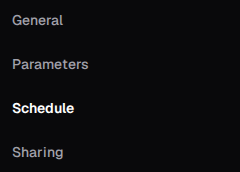
To set a workspace's schedule, go to the workspace, then **Settings** > **Schedule**.
Coder might also stop a workspace automatically if there is a [template update](/beta-docs/@main/admin/templates/managing-templates/#update-templates) available.
Learn more about [workspace lifecycle](/beta-docs/@main/user-guides/workspace-lifecycle/) and our [scheduling features](/beta-docs/@main/user-guides/workspace-scheduling/).
## Workspace resources [#workspace-resources]
Workspaces in Coder are started and stopped, often based on whether there was any activity or if there was a [template update](/beta-docs/@main/admin/templates/) available.
Resources are often destroyed and re-created when a workspace is restarted, though the exact behavior depends on the template.
For more information, see [Resource Persistence](/beta-docs/@main/admin/templates/extending-templates/resource-persistence/).
## Repair workspaces [#repair-workspaces]
Use the following command to re-enter template input variables in an existing workspace.
This command is useful when a workspace fails to build because its state is out of sync with the template.
```sh
coder update --always-prompt
```
First, try re-entering parameters from a workspace.
In the Coder UI, you can filter your workspaces using pre-defined filters or employing the Coder's filter query.
Take a look at the following examples to understand how to use the Coder's filter query:
* To find the workspaces that you own, use the filter `owner:me`.
* To find workspaces that are currently running, use the filter `status:running`.
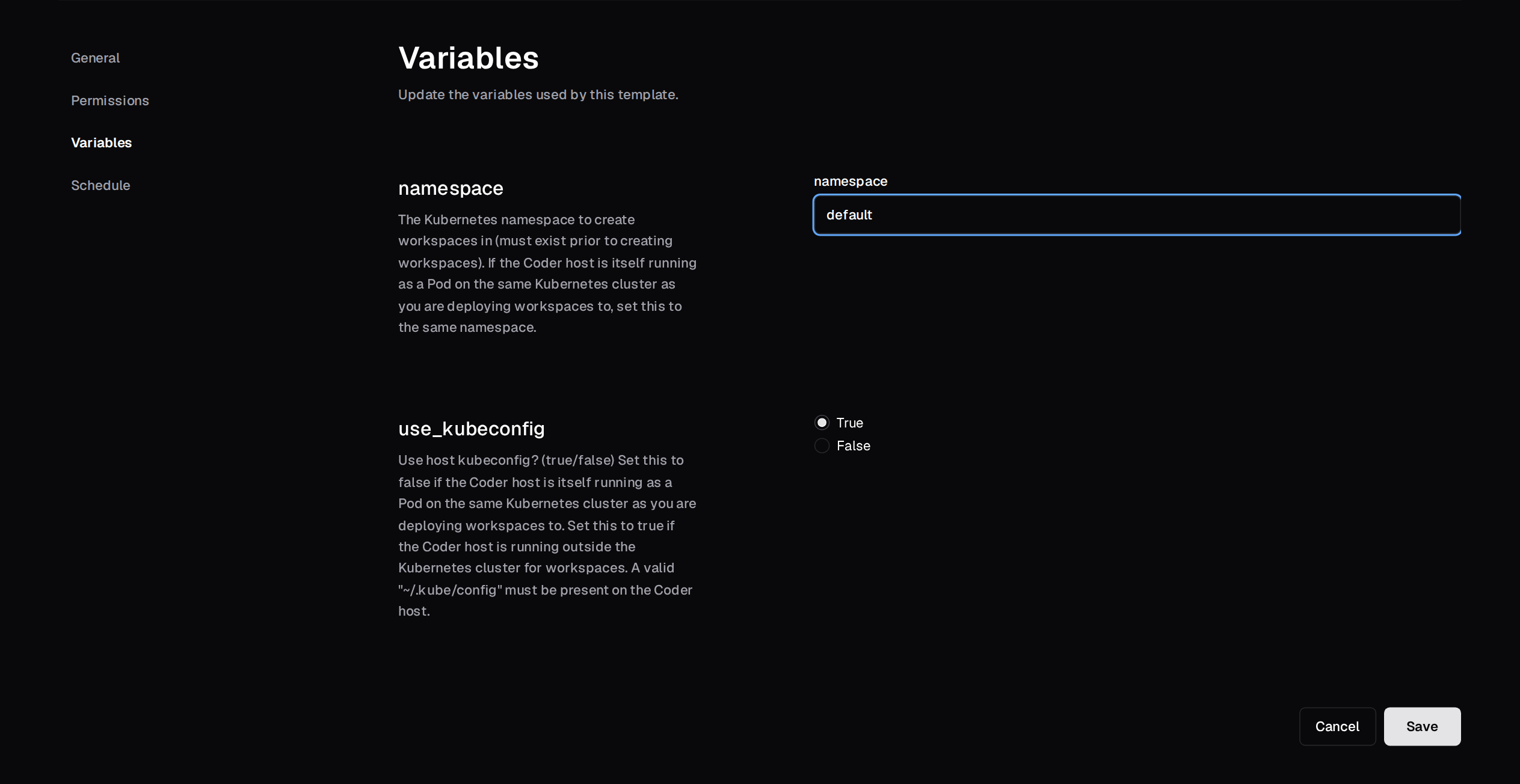
You can also do this in the CLI with the following command:
```sh
coder update --always-prompt
```
If that does not work, a Coder admin can manually push and pull the Terraform state for a given workspace.
This can lead to state corruption or deleted resources if you do not know what you are doing.
```sh
coder state pull /
# Make changes
coder state push /
```
## Logging [#logging]
Coder stores macOS and Linux logs at the following locations:
| Service | Location |
| ----------------- | -------------------------------- |
| `startup_script` | `/tmp/coder-startup-script.log` |
| `shutdown_script` | `/tmp/coder-shutdown-script.log` |
| Agent | `/tmp/coder-agent.log` |
Logs are truncated once they reach 5 MB in size.