# Setup
AI Gateway runs inside the Coder control plane (`coderd`), requiring no separate compute to deploy or scale. Once enabled, `coderd` runs the `aibridged` in-memory and brokers traffic to your configured AI providers on behalf of authenticated users.
**Required**:
1. The [AI Governance Add-On](https://coder.com/docs/ai-coder/ai-governance.md) license.
1. Feature must be [enabled](#activation) using the server flag
1. One or more [providers](#configure-providers) API key(s) must be configured
## Activation
You will need to enable AI Gateway explicitly:
```sh
export CODER_AIBRIDGE_ENABLED=true
coder server
# or
coder server --aibridge-enabled=true
```
## Configure Providers
AI Gateway proxies requests to upstream LLM APIs. Configure at least one provider before exposing AI Gateway to end users.
### OpenAI
Set the following when routing [OpenAI-compatible](https://coder.com/docs/reference/cli/server#--aibridge-openai-key) traffic through AI Gateway:
- `CODER_AIBRIDGE_OPENAI_KEY` or `--aibridge-openai-key`
- `CODER_AIBRIDGE_OPENAI_BASE_URL` or `--aibridge-openai-base-url`
The default base URL (`https://api.openai.com/v1/`) works for the native OpenAI service. Point the base URL at your preferred OpenAI-compatible endpoint (for example, a hosted proxy or LiteLLM deployment) when needed.
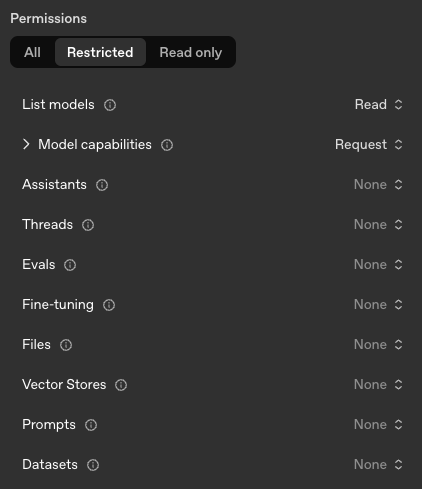
If you'd like to create an [OpenAI key](https://platform.openai.com/api-keys) with minimal privileges, this is the minimum required set:
### Anthropic
Set the following when routing [Anthropic-compatible](https://coder.com/docs/reference/cli/server#--aibridge-anthropic-key) traffic through AI Gateway:
- `CODER_AIBRIDGE_ANTHROPIC_KEY` or `--aibridge-anthropic-key`
- `CODER_AIBRIDGE_ANTHROPIC_BASE_URL` or `--aibridge-anthropic-base-url`
The default base URL (`https://api.anthropic.com/`) targets Anthropic's public API. Override it for Anthropic-compatible brokers.
Anthropic does not allow [API keys](https://console.anthropic.com/settings/keys) to have restricted permissions at the time of writing (Nov 2025).
### Amazon Bedrock
Set the following when routing [Amazon Bedrock](https://coder.com/docs/reference/cli/server#--aibridge-bedrock-region) traffic through AI Gateway:
**Required:**
- `CODER_AIBRIDGE_BEDROCK_REGION` or `--aibridge-bedrock-region`.
Alternatively, set `CODER_AIBRIDGE_BEDROCK_BASE_URL` or `--aibridge-bedrock-base-url` to a full URL (e.g., when routing through a proxy between AI Gateway and AWS Bedrock or using a non-standard endpoint that doesn't follow the `https://bedrock-runtime..amazonaws.com` format).
If both are set, `CODER_AIBRIDGE_BEDROCK_BASE_URL` takes precedence.
- `CODER_AIBRIDGE_BEDROCK_MODEL` or `--aibridge-bedrock-model`
- `CODER_AIBRIDGE_BEDROCK_SMALL_FAST_MODEL` or `--aibridge-bedrock-small-fast-model`
> [!NOTE]
> These Bedrock settings configure AI Gateway only. To configure Bedrock as an
> Agents provider, see [Configuring AWS Bedrock](https://coder.com/docs/ai-coder/agents/models.md#configuring-aws-bedrock).
**Optional:**
- `CODER_AIBRIDGE_BEDROCK_ACCESS_KEY` or `--aibridge-bedrock-access-key`
- `CODER_AIBRIDGE_BEDROCK_ACCESS_KEY_SECRET` or `--aibridge-bedrock-access-key-secret`
#### Authentication
AI Gateway supports two credential configuration paths:
##### AWS SDK default credential chain (recommended)
When no credentials are set in AI Gateway config, the AWS SDK resolves them automatically from the environment.
This includes IAM Roles (instance profiles, IRSA, ECS task roles), shared config files, environment variables, SSO, and more.
**IAM Roles are the recommended approach** when AI Gateway runs on AWS infrastructure.
Attach an IAM Role with Bedrock permissions to the compute running AI Gateway (EC2 instance, EKS pod via IRSA, or ECS task), no credentials need to be configured in AI Gateway itself.
The IAM Role must have permission to invoke the Bedrock models configured for AI Gateway (`bedrock:InvokeModel` and `bedrock:InvokeModelWithResponseStream`).
See [Amazon Bedrock identity-based policy examples](https://docs.aws.amazon.com/bedrock/latest/userguide/security_iam_id-based-policy-examples.html) for policy examples,
and [AWS IAM role creation](https://docs.aws.amazon.com/IAM/latest/UserGuide/id_roles_create_for-service.html) for general guidance on attaching roles to AWS services.
This aligns with [AWS best practices](https://docs.aws.amazon.com/IAM/latest/UserGuide/best-practices.html) for using temporary credentials instead of long-lived access keys.
##### Static credentials
For deployments when explicit credentials are preferred, provide an access key and secret for an IAM User:
1. **Choose a region** where you want to use Bedrock.
2. **Generate API keys** in the [AWS Bedrock console](https://us-east-1.console.aws.amazon.com/bedrock/home?region=us-east-1#/api-keys/long-term/create) (replace `us-east-1` in the URL with your chosen region):
- Choose an expiry period for the key.
- Click **Generate**.
- This creates an IAM user with strictly-scoped permissions for Bedrock access.
3. **Create an access key** for the IAM user:
- After generating the API key, click **"You can directly modify permissions for the IAM user associated"**.
- In the IAM user page, navigate to the **Security credentials** tab.
- Under **Access keys**, click **Create access key**.
- Select **"Application running outside AWS"** as the use case.
- Click **Next**.
- Add a description like "Coder AI Gateway token".
- Click **Create access key**.
- Save both the access key ID and secret access key securely.
4. **Configure your Coder deployment** with the credentials:
```sh
export CODER_AIBRIDGE_BEDROCK_REGION=us-east-1
export CODER_AIBRIDGE_BEDROCK_ACCESS_KEY=
export CODER_AIBRIDGE_BEDROCK_ACCESS_KEY_SECRET=
coder server
```
### GitHub Copilot
GitHub Copilot offers three plans — Individual, Business, and Enterprise —
each with its own API endpoint. Configure one or more `copilot` providers
using the [indexed provider format](#multiple-instances-of-the-same-provider)
depending on which plans your organization uses.
Copilot providers use OAuth app installations for authentication rather than
static API keys.
```sh
# GitHub Copilot (Individual)
export CODER_AIBRIDGE_PROVIDER_0_TYPE=copilot
export CODER_AIBRIDGE_PROVIDER_0_NAME=copilot
# GitHub Copilot Business
export CODER_AIBRIDGE_PROVIDER_1_TYPE=copilot
export CODER_AIBRIDGE_PROVIDER_1_NAME=copilot-business
export CODER_AIBRIDGE_PROVIDER_1_BASE_URL=https://api.business.githubcopilot.com
# GitHub Copilot Enterprise
export CODER_AIBRIDGE_PROVIDER_2_TYPE=copilot
export CODER_AIBRIDGE_PROVIDER_2_NAME=copilot-enterprise
export CODER_AIBRIDGE_PROVIDER_2_BASE_URL=https://api.enterprise.githubcopilot.com
```
The default base URL targets the individual Copilot API
(`api.individual.githubcopilot.com`). Override `CODER_AIBRIDGE_PROVIDER__BASE_URL`
for Business or Enterprise tiers as shown above.
For client-side setup (proxy, certificates, IDE configuration), see
[GitHub Copilot client configuration](https://coder.com/docs/ai-coder/ai-gateway/clients/copilot.md).
### ChatGPT
Configure a ChatGPT provider by creating an `openai`-typed instance with the
ChatGPT Codex base URL:
```sh
export CODER_AIBRIDGE_PROVIDER_0_TYPE=openai
export CODER_AIBRIDGE_PROVIDER_0_NAME=chatgpt
export CODER_AIBRIDGE_PROVIDER_0_BASE_URL=https://chatgpt.com/backend-api/codex
```
> [!NOTE]
> See the [Supported APIs](https://coder.com/docs/ai-coder/ai-gateway/reference.md#supported-apis) section below for precise endpoint coverage and interception behavior.
### Multiple instances of the same provider
You can configure multiple instances of the same provider type — for example, to
route different teams to separate API keys, use different base URLs per region, or
connect to both a direct API and a proxy simultaneously. Use indexed environment
variables following the pattern `CODER_AIBRIDGE_PROVIDER__`:
```sh
# Anthropic routed through a corporate proxy
export CODER_AIBRIDGE_PROVIDER_0_TYPE=anthropic
export CODER_AIBRIDGE_PROVIDER_0_NAME=anthropic-corp
export CODER_AIBRIDGE_PROVIDER_0_KEY=sk-ant-corp-xxx
export CODER_AIBRIDGE_PROVIDER_0_BASE_URL=https://llm-proxy.internal.example.com/anthropic
# Anthropic direct (for teams that need direct access)
export CODER_AIBRIDGE_PROVIDER_1_TYPE=anthropic
export CODER_AIBRIDGE_PROVIDER_1_NAME=anthropic-direct
export CODER_AIBRIDGE_PROVIDER_1_KEY=sk-ant-direct-yyy
# Azure-hosted OpenAI deployment
export CODER_AIBRIDGE_PROVIDER_2_TYPE=openai
export CODER_AIBRIDGE_PROVIDER_2_NAME=azure-openai
export CODER_AIBRIDGE_PROVIDER_2_KEY=azure-key-zzz
export CODER_AIBRIDGE_PROVIDER_2_BASE_URL=https://my-deployment.openai.azure.com/
# Anthropic via AWS Bedrock
export CODER_AIBRIDGE_PROVIDER_3_TYPE=anthropic
export CODER_AIBRIDGE_PROVIDER_3_NAME=anthropic-bedrock
export CODER_AIBRIDGE_PROVIDER_3_BEDROCK_REGION=us-west-2
export CODER_AIBRIDGE_PROVIDER_3_BEDROCK_ACCESS_KEY=AKIAIOSFODNN7EXAMPLE
export CODER_AIBRIDGE_PROVIDER_3_BEDROCK_ACCESS_KEY_SECRET=wJalrXUtnFEMI/K7MDENG/bPxRfiCYEXAMPLEKEY
coder server
```
Each provider instance gets a unique route based on its `NAME`. Clients send
requests to `/api/v2/aibridge//` to target a specific instance:
| Instance name | Route |
|---------------------|-----------------------------------------------------|
| `anthropic-corp` | `/api/v2/aibridge/anthropic-corp/v1/messages` |
| `anthropic-direct` | `/api/v2/aibridge/anthropic-direct/v1/messages` |
| `azure-openai` | `/api/v2/aibridge/azure-openai/v1/chat/completions` |
| `anthropic-bedrock` | `/api/v2/aibridge/anthropic-bedrock/v1/messages` |
**Supported keys per provider:**
| Key | Required | Description |
|------------|----------|-------------------------------------------------------|
| `TYPE` | Yes | Provider type: `openai`, `anthropic`, or `copilot` |
| `NAME` | No | Unique instance name for routing. Defaults to `TYPE` |
| `KEY` | No | API key for upstream authentication (alias: `KEYS`) |
| `BASE_URL` | No | Base URL of the upstream API |
| `DUMP_DIR` | No | Directory for provider API request and response dumps |
> [!WARNING]
> `DUMP_DIR` is not intended for regular use. Setting this option
> results in a high number of writes. Dump files contain raw request and
> response data, which may include proprietary or sensitive information
> (prompts, completions, tool inputs). Enable only briefly for diagnostic
> purposes and protect the target directory.
For `anthropic` providers using AWS Bedrock, the following keys are also
available: `BEDROCK_BASE_URL`, `BEDROCK_REGION`,
`BEDROCK_ACCESS_KEY` (alias: `BEDROCK_ACCESS_KEYS`),
`BEDROCK_ACCESS_KEY_SECRET` (alias: `BEDROCK_ACCESS_KEY_SECRETS`),
`BEDROCK_MODEL`, `BEDROCK_SMALL_FAST_MODEL`.
> [!NOTE]
> Indices must be contiguous and start at `0`. Each instance must have a unique
> `NAME` — if two instances of the same `TYPE` omit `NAME`, they will both
> default to the type name and fail with a duplicate name error.
>
> The legacy single-provider environment variables (`CODER_AIBRIDGE_OPENAI_KEY`,
> `CODER_AIBRIDGE_ANTHROPIC_KEY`, etc.) continue to work. However, setting both
> a legacy variable and an indexed provider with the same default name (e.g.
> `CODER_AIBRIDGE_OPENAI_KEY` and an indexed provider named `openai`) will
> produce a startup error — remove one or the other to resolve the conflict.
## Data Retention
AI Gateway records prompts, token usage, tool invocations, and model reasoning for auditing and
monitoring purposes. By default, this data is retained for **60 days**.
Configure retention using `--aibridge-retention` or `CODER_AIBRIDGE_RETENTION`:
```sh
coder server --aibridge-retention=90d
```
Or in YAML:
```yaml
aibridge:
retention: 90d
```
Set to `0` to retain data indefinitely.
For duration formats, how retention works, and best practices, see the
[Data Retention](https://coder.com/docs/admin/setup/data-retention.md) documentation.
## Structured Logging
AI Gateway can emit structured logs for every interception record, making it
straightforward to export data to external SIEM or observability platforms.
Enable with `--aibridge-structured-logging` or `CODER_AIBRIDGE_STRUCTURED_LOGGING`:
```sh
coder server --aibridge-structured-logging=true
```
Or in YAML:
```yaml
aibridge:
structured_logging: true
```
These logs are written to the same output stream as all other `coderd` logs,
using the format configured by
[`--log-human`](https://coder.com/docs/reference/cli/server.md#--log-human) (default, writes to
stderr) or [`--log-json`](https://coder.com/docs/reference/cli/server.md#--log-json). For machine
ingestion, set `--log-json` to a file path or `/dev/stderr` so that records are
emitted as JSON.
Filter for AI Gateway records in your logging pipeline by matching on the
`"interception log"` message. Each log line includes a `record_type` field that
indicates the kind of event captured:
| `record_type` | Description | Key fields |
|----------------------|-----------------------------------------|--------------------------------------------------------------------------------|
| `interception_start` | A new intercepted request begins. | `interception_id`, `initiator_id`, `provider`, `model`, `client`, `started_at` |
| `interception_end` | An intercepted request completes. | `interception_id`, `ended_at` |
| `token_usage` | Token consumption for a response. | `interception_id`, `input_tokens`, `output_tokens`, `created_at` |
| `prompt_usage` | The last user prompt in a request. | `interception_id`, `prompt`, `created_at` |
| `tool_usage` | A tool/function call made by the model. | `interception_id`, `tool`, `input`, `server_url`, `injected`, `created_at` |
| `model_thought` | Model reasoning or thinking content. | `interception_id`, `content`, `created_at` |