Extend templates
Extend your Coder templates with parameters, metadata, web IDEs, Docker, and more.
On this page
There are a variety of Coder-native features to extend the configuration of your development environments. Many of the following features are defined in your templates using the Coder Terraform provider. The provider docs will provide code examples for usage. Alternatively, you can view our example templates to get started.
Workspace agents
For users to connect to a workspace, the template must include a coder_agent.
The associated agent will facilitate workspace connections via SSH, port forwarding, and IDEs.
The agent may also display real-time workspace metadata like resource usage.
resource "coder_agent" "dev" {
  os   = "linux"
  arch = "amd64"
  dir  = "/workspace"
  display_apps {
    vscode = true
  }
}
You can also leverage resource metadata to display static resource information from your template.
Templates must include some computational resource to start the agent. All processes on the workspace are then spawned from the agent. It also provides all information displayed in the dashboard's workspace view.
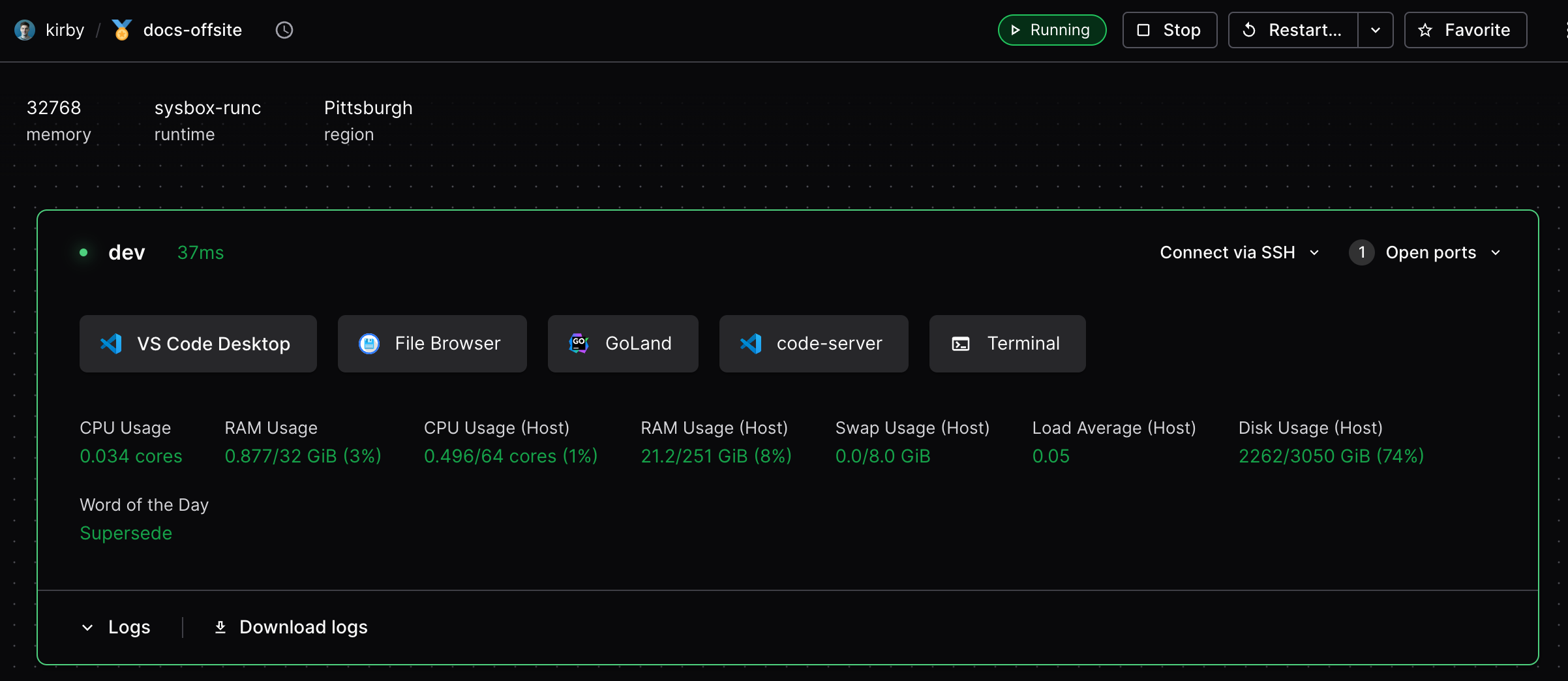
Multiple agents may be used in a single template or even a single resource. Each agent may have its own apps, startup script, and metadata. This can be used to associate multiple containers or VMs with a workspace.
Resource persistence
The resources you define in a template may be ephemeral or persistent. Persistent resources stay provisioned when workspaces are stopped, where as ephemeral resources are destroyed and recreated on restart. All resources are destroyed when a workspace is deleted.
You can read more about how resource behavior and workspace state in the workspace lifecycle documentation.
Template resources follow the behavior of Terraform resources and can be further configured using the lifecycle argument.
A common configuration is a template whose only persistent resource is the home directory. This allows the developer to retain their work while ensuring the rest of their environment is consistently up-to-date on each workspace restart.
When a workspace is deleted, the control plane essentially runs a terraform destroy to remove all resources associated with the workspace.
Tip
Terraform's prevent-destroy and ignore-changes meta-arguments can be used to prevent accidental data loss.
Coder apps
Additional IDEs, documentation, or services can be associated to your workspace using the coder_app resource.
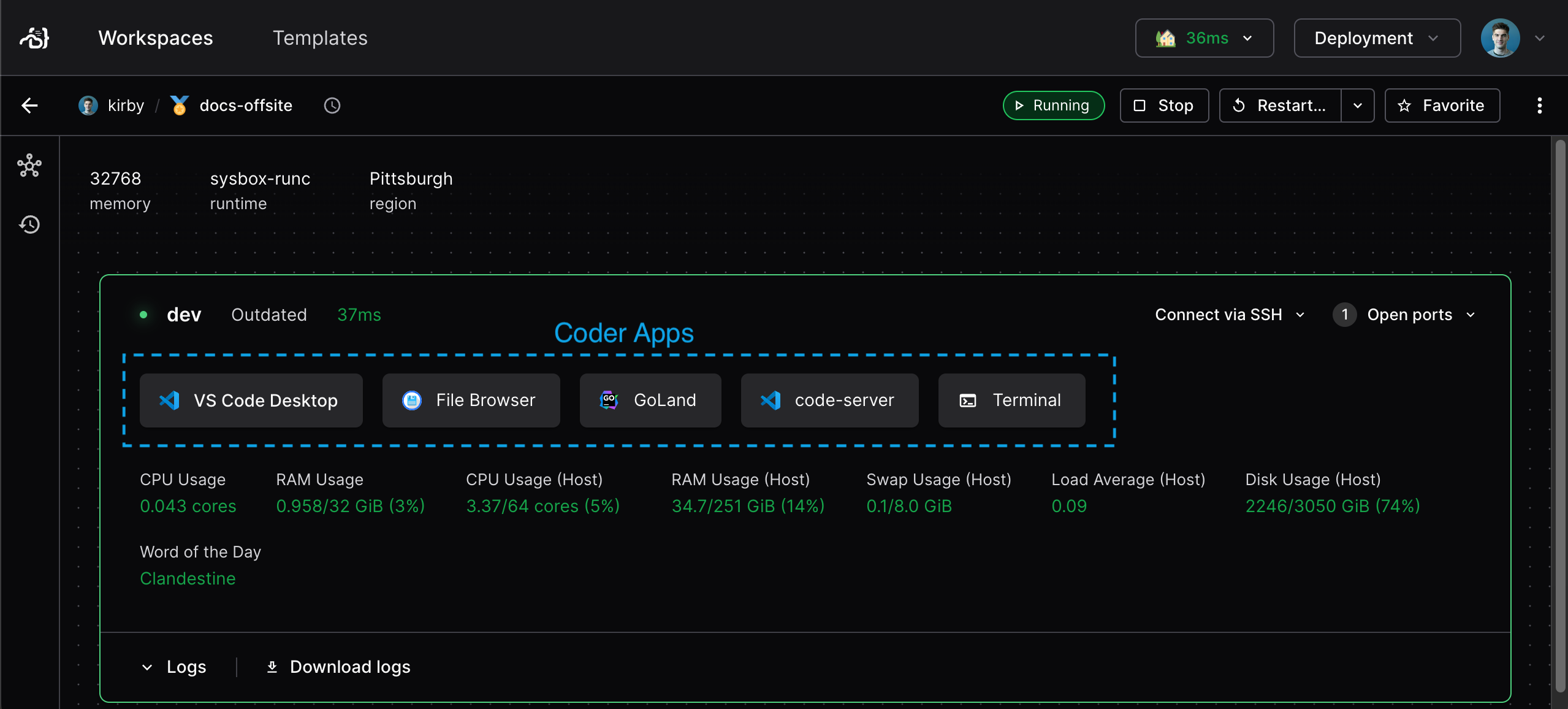
Note that some apps are associated to the agent by default as display_apps and can be hidden directly in the coder_agent resource.
You can arrange the display orientation of Coder apps in your template using resource ordering.
Coder app examples
You can use these examples to add new Coder apps:
resource "coder_app" "code-server" {
  agent_id     = coder_agent.main.id
  slug         = "code-server"
  display_name = "code-server"
  url          = "http://localhost:13337/?folder=/home/${local.username}"
  icon         = "/icon/code.svg"
  subdomain    = false
  share        = "owner"
}resource "coder_app" "filebrowser" {
agent_id = coder_agent.main.id
display_name = "file browser"
slug = "filebrowser"
url = "http://localhost:13339"
icon = "/icon/database.svg"
subdomain = true
share = "owner"
}resource "coder_app" "zed" {
agent_id = coder_agent.main.id
slug = "slug"
display_name = "Zed"
external = true
url = "zed://ssh/coder.${data.coder_workspace.me.name}"
icon = "/icon/zed.svg"
}Visit our module registry for additional Coder apps from the team and our OSS community.
Session tokens in external app links
An external app's url can include the $SESSION_TOKEN placeholder so a desktop IDE can sign in to Coder.
The dashboard and coder open app replace the placeholder with the user's session token only when all of these are true:
- The link opens a Coder IDE extension, such as
vscode://coder.coder-remote/openorjetbrains://gateway/com.coder.toolbox. - The link's
urlparameter is this deployment's URL, with no path. - The placeholder is the whole value of the link's
tokenparameter.
When a link with the placeholder doesn't meet these conditions, Coder doesn't add a token.
coder open app prints the link with a warning instead of opening it.
The dashboard shows the app as disabled, except for http and https links, which open with the placeholder left in place.
Links without the placeholder open as written.
Dev container apps never receive a session token.
Refer to Customizing dev containers for details.
Environment variables
Use the coder_env resource to inject environment variables into workspace agents.
Multiple resources can target the same variable using merge strategies like append and prepend, which is useful for building up PATH-style variables across modules.
See Environment variables for details.
Run scripts on workspace lifecycle events
The coder_script resource runs scripts during workspace lifecycle events like startup, stop, or on a scheduled basis.
It provides more control than the deprecated startup_script field in coder_agent.
When to use coder_script
- Initialization tasks: Install dependencies, clone repositories, configure services
- Cleanup tasks: Stop services gracefully on workspace stop
- Scheduled maintenance: Run periodic tasks via cron schedules
- Blocking startup: Wait for critical services before allowing user login
Basic example
resource "coder_script" "install_dependencies" {
  agent_id           = coder_agent.main.id
  display_name       = "Install Dependencies"
  icon               = "/icon/package.svg"
  script             = <<-EOF
    #!/bin/sh
    set -e
    apt-get update
    apt-get install -y git curl
  EOF
  run_on_start       = true
  start_blocks_login = true
}
Key features
- Lifecycle control:
Run on start (
run_on_start), stop (run_on_stop), or cron schedule (cron) - Login blocking:
Use
start_blocks_login = trueto ensure critical setup completes before user access - Timeouts:
Configure
timeoutfor long-running scripts - Custom icons:
Display meaningful icons with the
iconparameter - Log capture: Script output is automatically captured and visible in the workspace UI
Advanced patterns
Many Coder modules use coder_script internally.
For example:
git-clone: Clones repositories on startupdotfiles: Applies user dotfilescode-server: Installs and configures code-server (VS Code in the browser)
You can also reference external script files:
resource "coder_script" "init_docker" {
  agent_id     = coder_agent.main.id
  display_name = "Initialize Docker"
  script       = file("${path.module}/scripts/init-docker.sh")
  run_on_start = true
}
See the Coder Terraform provider documentation for complete reference.