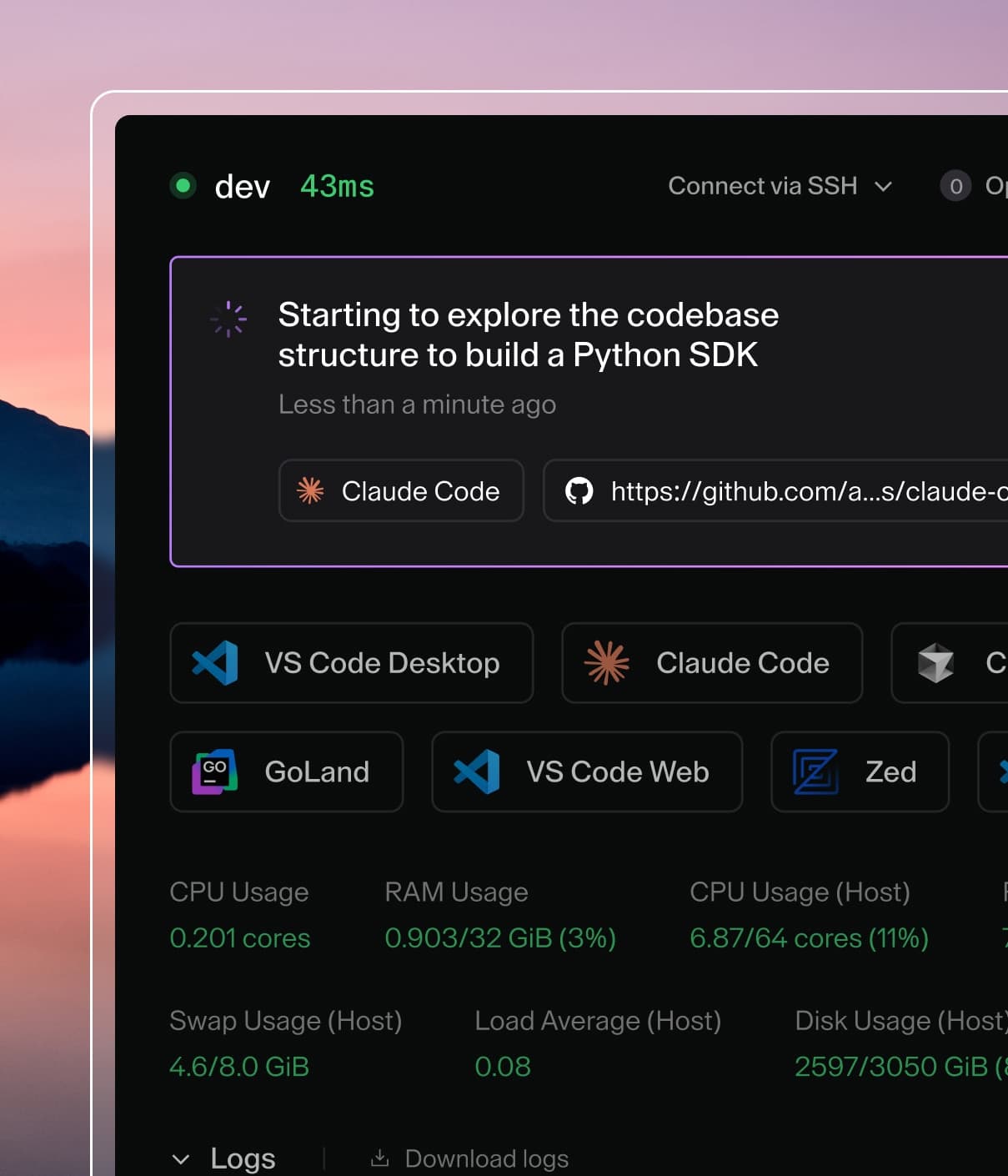
We recently co-hosted a hands-on workshop with AWS, where attendees got a look at how Coder can be deployed on AWS sandbox, including AI-driven development workflows using Amazon Q Developer and Claude Code through Bedrock.
What became clear across the session is that the conversation around cloud development environments has shifted. Teams are still adopting them to standardize where developers write code, but they're also increasingly building the infrastructure that makes agentic AI development possible without compromising security or governance.
Here's what that looks like in practice.
The local development problem hasn't gone away
44% of organizations say onboarding new developers takes more than two months. And across six multinational enterprises, new hires without AI tools took a median of 91 days to reach their 10th pull request.
The root cause is almost always the same: local environments that accumulate dependencies, version-specific configurations, and setup steps that live on individual machines and break constantly.
Cloud development environments solve this by moving development off the laptop and into governed cloud infrastructure. For example, with Coder on AWS, workspaces are defined through templates and provisioned on demand. Developers pick a template and get a working environment in minutes. No local setup, no version conflicts, and no weeks spent getting code to compile.
As Greg Hoelzer, Senior Partner Sales Engineer at Coder, put it during the workshop: "We don't necessarily change how you code. We change where you code — and then we can provide new capabilities in terms of how you code by enabling you to safely introduce agentic development into your workspace."
That second part (safely introducing agentic development) is where the real urgency is right now.
Why agents can't live on laptops
As organizations move from traditional development to coding assistants and eventually to autonomous multi-agent workflows, three things shift simultaneously: Security risks increase, compute costs rise as agents consume more resources, and productivity spikes dramatically.
The security risk deserves the most attention. Running an AI agent on a local machine creates what we call the lethal trifecta: access to private data, exposure to untrusted content, and the ability to communicate externally. When all three exist in one place, you risk data exfiltration through prompt injection or agent errors. An agent with broad credentials and internet access could leak sensitive information if it processes untrusted input — and on a developer's laptop, there's no clean way to prevent that.
This is especially pressing for regulated enterprises and government agencies. As Hoelzer described it: "A lot of folks, especially in regulated and larger enterprises, are saying that they want the value and productivity they may get from an AI agent, but they need something like Coder so that they can safely introduce these capabilities into their organization."
Cloud development environments address this by placing each agent in an isolated workspace with scoped credentials, controlled network access, and clear boundaries around what the agent can reach.
Template-defined workspaces as infrastructure
The foundation of this approach is template engineering: defining development environments as infrastructure-as-code that your platform team controls centrally.
For example, a single Coder deployment on AWS can support multiple workspace types, each tailored to a specific persona or project:
- Cloud-native development with relevant CLIs and toolkits pre-installed
- Serverless development targeting architectures that might not match a developer's local hardware
- Agentic development with AI coding agents configured and ready to run tasks autonomously
- Gen AI prototyping with supporting services like vector databases deployed alongside the workspace
Each template can be version-controlled in Git and deployed through a standard GitOps flow, giving platform teams full version history and audit trails. The result is that spinning up a new developer environment (or an agent environment) takes minutes instead of weeks. And every environment is consistent, reproducible, and governed by the same policies.
Scaling agentic development securely
Where this gets really interesting is when you combine template-defined workspaces with AI agents that can operate autonomously.
Consider a practical workflow where you use one AI agent to scaffold an application from a set of requirements. Then, you hand that codebase to a different agent in a separate workspace and ask it to review the architecture with a focus on security. That agent identifies issues, and instead of handing them back to a human, it spins up additional workspaces (each with its own agent) to address the findings and submit pull requests back to the original project.
This kind of parallel, self-spawning agent workflow is only practical when each agent runs in its own isolated cloud environment. On a local machine, multiple agents working on different approaches to the same codebase would conflict with each other, corrupt branches, and create more problems than they solve. In cloud development environments on AWS, each agent gets its own workspace, its own resources, and its own scoped permissions.
You can also mix and match agents and models. This way, the same environment can run a task against one model, switch to a different one for a lighter-weight evaluation, and test a third for speed. The cloud development environment becomes a place to evaluate which tools and models work best for specific tasks, without any impact on other developers or production systems.
From developer productivity to AI infrastructure
Organizations that have already made this shift are seeing the payoff:
- Palantir cut their time to first commit from 15 days to one hour.
- Skydio replaced a homegrown solution and slashed dev VM spend by 90%.
- A government agency moved all source code off 1,500 laptops into Coder, tightening security while improving the developer experience.
In each case, the initial investment was about developer productivity: faster onboarding, consistent environments, better security posture. But that same infrastructure is now what lets them scale agentic development: template-defined, isolated, cloud-hosted workspaces turn out to be exactly what you need to run AI agents securely and in parallel. The investment in developer productivity becomes AI infrastructure… without rebuilding anything.
As models get smarter and agents take on longer-horizon tasks, the teams that already have cloud development environments in place — with templates that define what agents can access, workspaces that isolate agent activity, and governance that scales alongside adoption — will be ready to move immediately.
To see the full webinar, check out the recording here.