AI copilots, modern IDEs, DevOps platforms… and still the same old bottlenecks
Over the past 18 months, I’ve spent the last year in conversations with CTOs, Heads of Platform, and VPs of Engineering across Singapore, India, Australia, Japan, and Southeast Asia. Different markets, different maturity levels - their opening line is almost always the same:
“We’ve invested heavily in tooling…”
“We use Cursor/Kiro/other modern IDE…”
“We’ve rolled out AI coding assistants…”
“Our DevOps stack is modern…”
On paper, their developer stack looks world-class. And then, usually a few minutes later:
“Onboarding still takes forever...”
“Developers are frustrated…”
“Productivity hasn’t really improved…”
“The platform team is overwhelmed with environment requests…”
“Cloud costs keep creeping up…”
According to IDC and OutSystems research, 68% of APAC enterprises are actively adopting modern development tools, and nearly 90% now operate in multi-cloud environments. On paper, APAC should be flying.
In reality, a lot of teams are still losing weeks just getting developers productive - and AI tools are making those gaps impossible to ignore.
And more specifically, it has a governance-shaped infrastructure problem.
In APAC more than anywhere, developer infrastructure isn’t designed in a vacuum. It’s shaped by:
- Data residency laws (PDPA in Singapore, localisation rules in India, evolving AI regulations across the region)
- Sector-specific regulations (MAS in Singapore, APRA in Australia, FSA in Japan, RBI in India, etc)
- Sovereignty requirements
- Internal risk and audit controls that are often conservative by design
In the US, teams often move fast and adjust governance later. In Europe, regulation is strong but relatively harmonised over regional regulations such as GDPR.
In APAC, you’re dealing with a far-less unified region with international power dynamics at the forefront, presenting multiple regulatory regimes, different maturity levels, cross-border delivery models, and sovereignty sensitivities - often inside the same organisation.
That makes the friction in APAC a lot more acute.
What looks like “developer friction” is often governance friction leaking into the workflow.
And just like most things, when governance is bolted on after the platform is built, infrastructure becomes fragile, slow, and expensive to operate.
When governance is embedded into the platform from the outset, developer experience improves fast - without weakening security.
That distinction matters far more in APAC than most global tooling vendors realise.
Many global tooling vendors build for US-first environments where developer autonomy is high, regulatory friction is lower, and local machines are the default.
In APAC, especially in financial services, telecom, and the public sector, the idea that source code lives freely on unmanaged laptops is simply not acceptable.
If your product assumes “governance is optional” - it breaks down quickly in APAC.
Talent is tight - so wasted time hurts more
APAC’s engineering talent market is unforgiving & brutally competitive.
This isn’t anecdotal. Regional hiring reports from LinkedIn and Michael Page consistently show:
- Persistent shortages of senior cloud and platform engineers
- Double-digit salary growth in key markets like Singapore & India
- High mobility of experienced engineers across regional hubs
In Singapore, competition for senior engineers from global tech firms, banks, and well-funded startups drives aggressive compensation and churn.
In India, while the talent pool is large, demand from global enterprises and hyperscalers has outpaced supply in specialised areas like platform engineering and AI infrastructure.
Good engineers have options, and replacing them isn’t easy.
Attrition is high. Senior talent is mobile. Replacement cycles are long.
That makes time to first commit a board-level issue, not just a developer gripe.
Yet GitLab’s latest research shows 44% of organisations still take more than two months to onboard developers to full productivity - largely due to environment setup, access delays, and fragmented workflows.
The pattern is predictable:
- Tool access is quick
- Environment access is slow
- Governance reviews happen late - and block progress
Distributed delivery models (offshore, nearshore, hybrid) amplify this pain. Every manual step compounds across regions and time zones.
There’s been no shortage of innovation at the tooling layer. IDEs are better. CI/CD is more mature. AI copilots are genuinely impressive.
OutSystems and IDC report that 25% of APAC enterprises now prioritise GenAI integration into developer workflows.
But here’s the catch: most of this tooling assumes the basics are already solved.
Consistent environments. Reliable access. Adequate compute. Sensible, enforceable security controls.
What many teams actually have:
- Local laptops as production infrastructure
- VPNs acting as control planes
- Manually provisioned cloud resources
- Policy enforced through tickets and exceptions
That gap is where productivity goes to die - not because developers lack tools, but because infrastructure was never designed to satisfy governance at scale.
Infrastructure maturity is uneven - regulation isn’t
Singapore and Japan operate at one end of the spectrum.
In Singapore, I regularly see mature platform teams running highly automated, policy-driven cloud environments aligned tighlty with MAS expectations. Developer environments are increasingly centralised. Access controls are automated. Audit trails are built in by default.
In Japan, large enterprises often have deep operational discipline and rigorous internal controls - but may be navigating legacy infrastructure alongside modern cloud platforms.
Contrast that with emerging Southeast Asian markets or regional Australia, where infrastructure maturity can vary significantly between organisations. Some are cloud-native. Others are mid-transition, balancing legacy systems with modern tooling.
The maturity varies.
Regulatory pressure does not.
Across the region, scrutiny is increasing:
- Stronger AI governance discussions
- Tighter financial oversight
- Rising expectations around data sovereignty
- Board-level concern about cyber resilience
IDC predicts that 50% of APAC enterprises will need to modernise cloud and infrastructure architectures by 2027 just to support efficiency and AI-driven workloads.
This isn’t a “nice to have”. It’s a response to cost pressure, audit demands, regulatory scrutiny, and geopolitical realities.
In APAC, policy often is the architecture.
Ignore that, and every developer workflow becomes brittle.
AI is simply exposing these weaknesses faster.
AI doesn’t fix broken foundations - it amplifies them
AI coding assistants and agentic workflows sound great. And they can be - if the environment supports them.
But AI assumes infrastructure is already sorted. In many environments both across APAC and the rest of the world, it simply isn’t.
And the things that repeatedly crop up:
- AI tools choking on large codebases because local machines can’t cope
- Security teams locking things down because source code lives on unmanaged endpoints
- Platform teams buried under environment requests and exceptions instead of improving the platform
AI raises expectations.
It also raises the cost of poor infrastructure decisions - especially when governance controls are reactive instead of embedded.
In regulated industries, this becomes existential: you can’t scale AI if every environment is a snowflake or a special case.
Multi-cloud without standardisation is painful
Nearly 90% of APAC enterprises run multi-cloud, often for valid reasons: data residency, resilience, regional delivery.
But without standardised developer environments, multi-cloud becomes a permanent tax with inconsistent developer experience, bespoke platform builds, poor cost visibility, and inconsistent policy enforcement.
Developers waste time dealing with differences between environments. Platform teams maintain one-off setups. FinOps teams struggle to see where money is actually going.
The most mature organisations I work with stopped asking “Which cloud?”
They ask “How do developers safely experience any cloud?”
That’s an infrastructure question - not a tooling one.
Productivity is really about time to first commit
Strong platform leaders don’t chase vanity velocity metrics. They obsess over how quickly a new developer can ship something real.
Because they know:
- Faster onboarding improves retention
- Consistent environments reduce defects
- Centralised infrastructure simplifies security, governance and FinOps
At that point, developer experience stops being a tooling conversation and becomes one about infrastructure designed for regulated scale.
So what’s actually working?
There’s no silver bullet, but there is a clear pattern among those moving faster.
Leading teams provide pre-configured, policy-controlled cloud development environments instead of bespoke local setups.
And the impact is immediate:
- New hires are productive within a couple of hours on day one
- “Works on my machine” disappears
- Governance enforced automatically
- Platform teams stop being a bottleneck
Gartner reports 59% of enterprises plan to reduce or eliminate local developer workstations in favour of cloud development environments to improve productivity and onboarding.
2. Move compute closer to the code
In APAC, device variability and latency are real. Cloud-hosted environments level the playing field.
Developers get consistent performance wherever they’re based. AI workloads run where the data already lives. And security teams are happier because source code stays inside governed perimeters.
This is non-negotiable in regulated markets.
3. Design for AI and governance from day one
AI-assisted development changes demand patterns:
- More compute
- More parallelism
- More automation
- More blast radius if isolation fails
Forward-looking teams use ephemeral, policy-controlled environments that safely support both human developers and AI agents - without weakening security or blowing up spend.
Governance only slows teams down when it’s an afterthought.
Unmanaged dev environments are a silent FinOps failure - especially in multi-cloud organisations. Idle resources, oversized machines, forgotten environments - it all adds up.
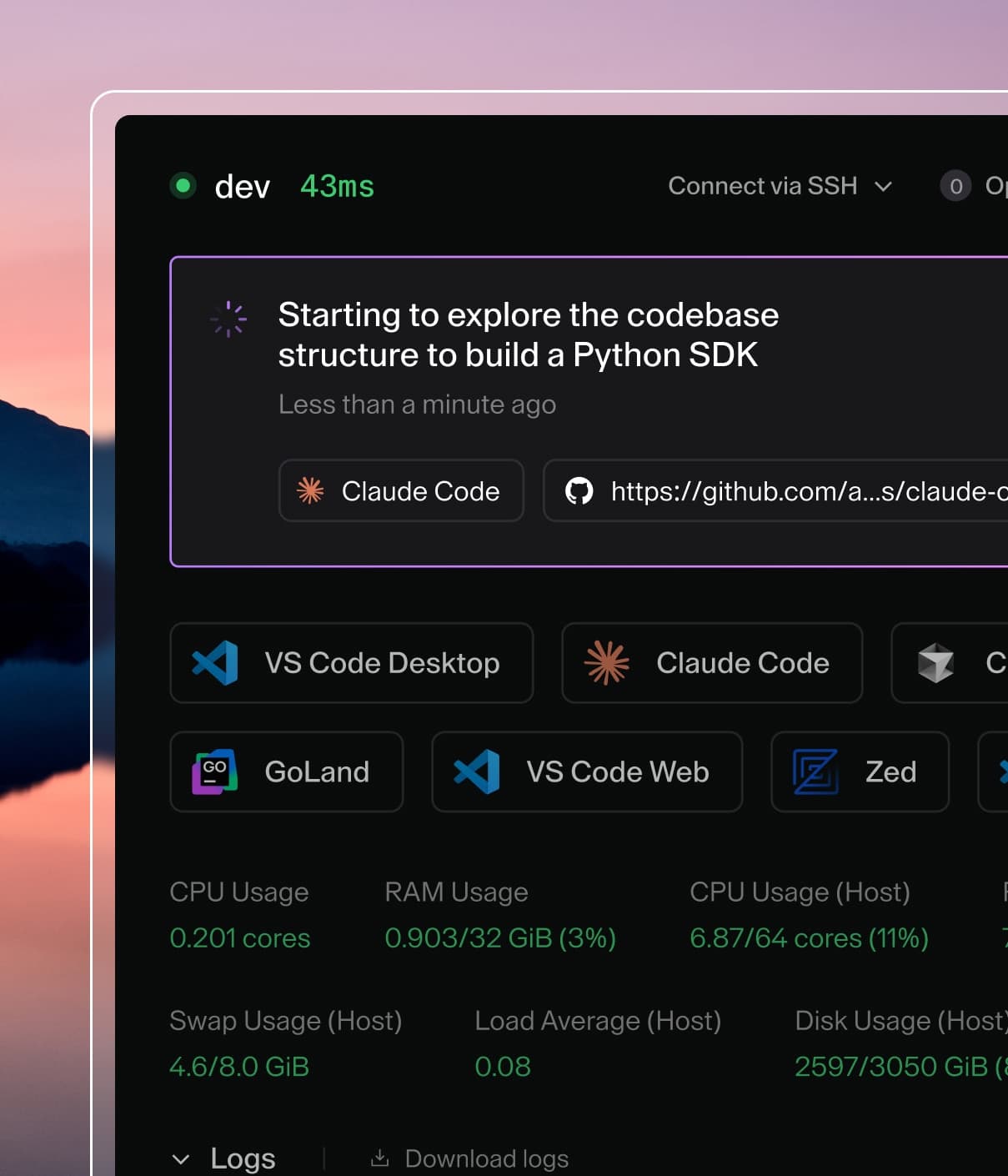
By centralising and scheduling environments, teams reduce waste and improve developer experience. That’s where modern Cloud Development Environment platforms like Coder fit naturally - as infrastructure that standardises, governs, and scales developer environments, rather than adding another shiny tool to the stack.
The question APAC leaders should be asking
If you’re leading engineering, platform, or AI initiatives in APAC, ask yourself:
Are we buying tools to look modern - or fixing the infrastructure and governance model that actually slows us down?
AI, DevOps tooling, and modern IDEs all matter. But without the right foundation, they’ll keep underdelivering.
The teams pulling ahead aren’t fighting regulation.
They’re embedding governance into the developer platform.
They’re treating developer environments as strategic infrastructure - not an afterthought.
That’s the difference between scaling AI safely - and stalling indefinitely.
If this resonates
If you’re navigating AI rollout, regulatory pressure, and talent scarcity at the same time, it’s worth seeing what a governed, standardised developer environment actually looks like in practice.
You can start a free trial of Coder and test what policy-controlled, cloud-based development environments feel like inside your own infrastructure.
And if you’ve made it this far, you can always follow both me and Coder on LinkedIn for more updates on modern Cloud Development Environments, and how they factor into global infrastructure and AI discussions.
Because, in APAC particularly, the future of developer productivity won’t be decided by better tools.
It’ll be decided by better foundations.