In our recent webinar with the team at Anthropic, the minds behind Claude Code told us that it will soon handle 30 minutes to an hour of autonomous work without supervision.
Not even six months later, today Claude Sonnet 4.5 has been shown to code for 30 hours straight.
This means that most development teams are building for the wrong future.
Right now, models need guidance, which is why the local interactive terminal interface works so well. You run Claude Code, watch what it does, course-correct when needed, and approve changes before they happen.
But the impending shift from interactive sessions to background agent work will change everything about your infrastructure requirements, which means most teams are optimizing for today's models, not tomorrow's.
The local development bottleneck
Most teams start with one Claude Code instance running locally. It works great; you get faster at writing boilerplate, debugging issues, and building small features. Then you want more… and why wouldn’t you? Why not run one agent fixing tests while another works on a feature?
But that's when the local setup falls apart. Agents conflict, your local branch becomes a mess, and managing the chaos takes more time than the automation saves.
The problem isn't the agents. It's trying to run multiple agents on infrastructure designed for one developer doing one thing at a time. And as models get smarter and increasingly work those long-horizon tasks for 30 minutes to an hour, locally managing worktrees and Docker containers becomes even more of a nightmare.
Suppose you want to run multiple Claude Code instances on different tasks — one refactoring a module, another fixing a CI issue, and a third building a prototype feature — and let them all run simultaneously while you focus on something else.
But on a local machine, this only creates chaos:
- Multi-repo access gets messy when you're constantly using --add-dir or managing folder structures
- Race conditions between multiple agents create conflicts and corrupted branches
- Files get overwritten as one agent's changes confuse another agent's trajectory
- Each agent needs isolation that your laptop wasn't meant to provide
These problems get worse as models improve: More autonomy means more risk without proper isolation.
For better or worse, your laptop wasn't designed to be a multi-agent orchestration platform.
The three scaling problems that remote environments solve
Running multiple Claude Code instances exposes three fundamental problems that local development can't solve cleanly.
Race conditions
When multiple agents run in the same local repository, they step on each other constantly. One agent edits a file while another agent reads it. Changes conflict. Git states become inconsistent. You end up with nothing more than corrupted branches and wasted work.
Remote environments eliminate this by giving each agent its own isolated workspace. Three agents can work on three different tasks in three separate environments.
No conflicts, no race conditions, and no agents confusing each other's trajectories.
Multi-repo context
Claude Code only knows what it can read in your codebase, what it fetches via MCP servers, and what you tell it. And when your work spans five different repositories, giving Claude that context locally means constant manual configuration. You either instantiate Claude in a folder above all five repos, or you repeatedly use --add-dir to expand access as you go. Both approaches are clunky and error-prone.
A remote environment, on the other hand, handles multi-repo configuration at the environment level. You specify which repositories belong together, and Claude walks into a workspace that's already set up correctly.
The context is there from the start.
Security isolation
Anthropic follows what they call the "lethal traffic" model for agent security. The rule is simple: never have all three of these in one place:
- Access to proprietary data
- Internet access
- Access to untrusted data
When all three exist together, you risk data exfiltration through prompt injection or agent errors. An agent with full credentials and internet access could accidentally leak sensitive information if it processes untrusted input.
Remote environments solve this through sandboxing and restricted credentials, to where each agent runs with limited permissions in an isolated space. So, for example, you can give an agent read-only access to Kubernetes logs without giving it the ability to modify production infrastructure.
This approach lets agents remain capable while staying safely constrained. The environment does the security work instead of relying on the agent to police itself.
How Anthropic engineers are already leveraging remote environments
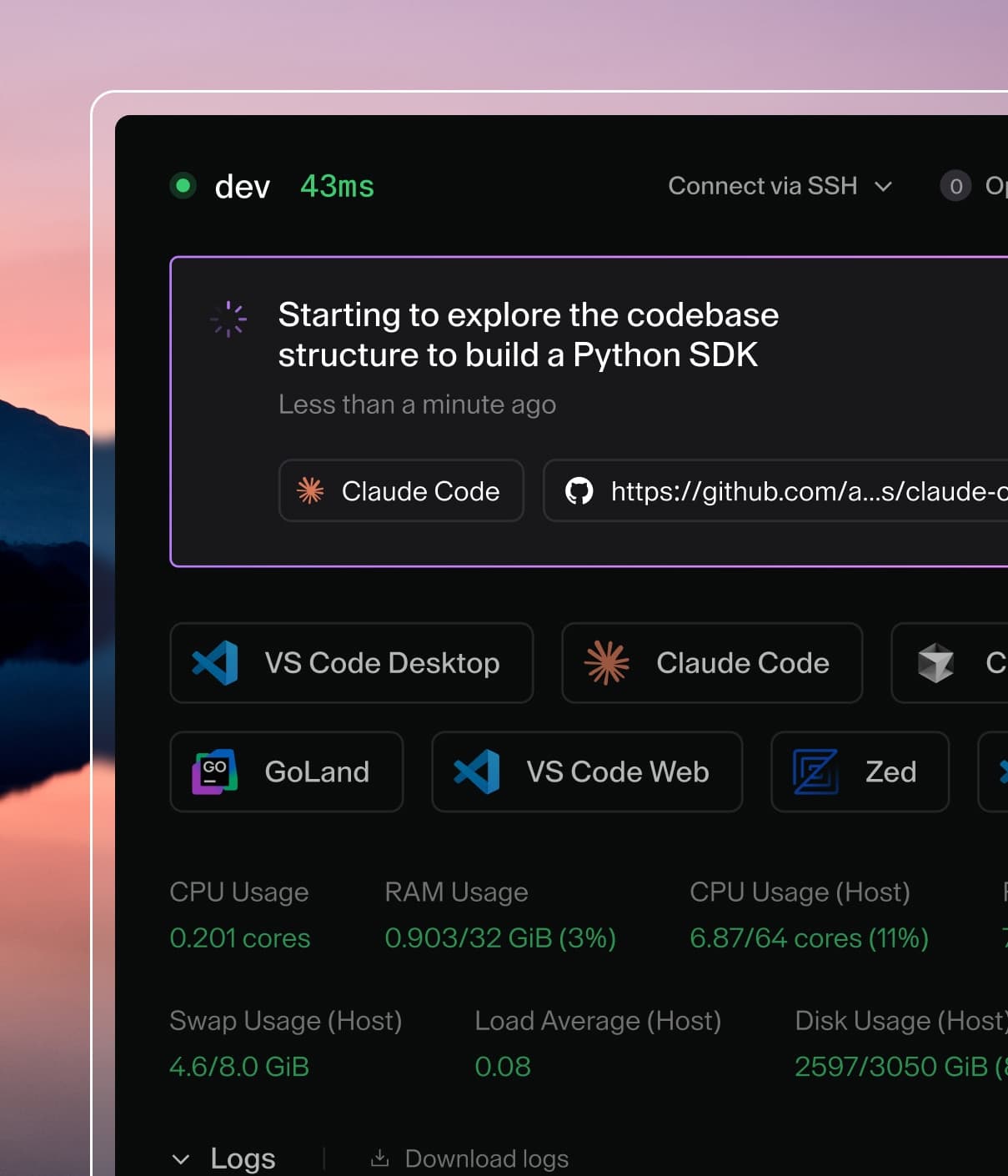
Anthropic engineers are already using Coder to run Claude Code remotely for multi-agent workflows. Not sequentially, not with constant babysitting — just agents working in parallel in isolated environments.
Multi-repo setups require specific configuration, and Coder handles this at the environment level. Instead of manually configuring access or repeatedly using --add-dir, you specify which repositories belong in an environment, and Claude walks into a workspace that's already set up correctly.
The result? No local bottlenecks. Engineers just kick off multiple runs on different tasks and let remote infrastructure handle the complexity.
Why you should build this infrastructure now
Anthropic sees remote environments like Coder as the future for longer-horizon agentic tasks.
With it, your engineers will immediately kick off multiple agent runs across different tasks. No scrambling, rebuilding your tooling, or discovering that your local development setup can't handle the load.
Teams that are prepared for this evolution will scale instantly as models improve. Teams that wait will be stuck managing Docker containers on laptops.
So set up your remote infrastructure now, configure your multi-repo environments, build your security model, and get your engineers comfortable with remote workflows. As models increasingly achieve these long-horizon tasks, you’ll be ready for it.
To hear more from Anthropic about how they’re building the future of Claude Code with Coder, check out the full webinar.