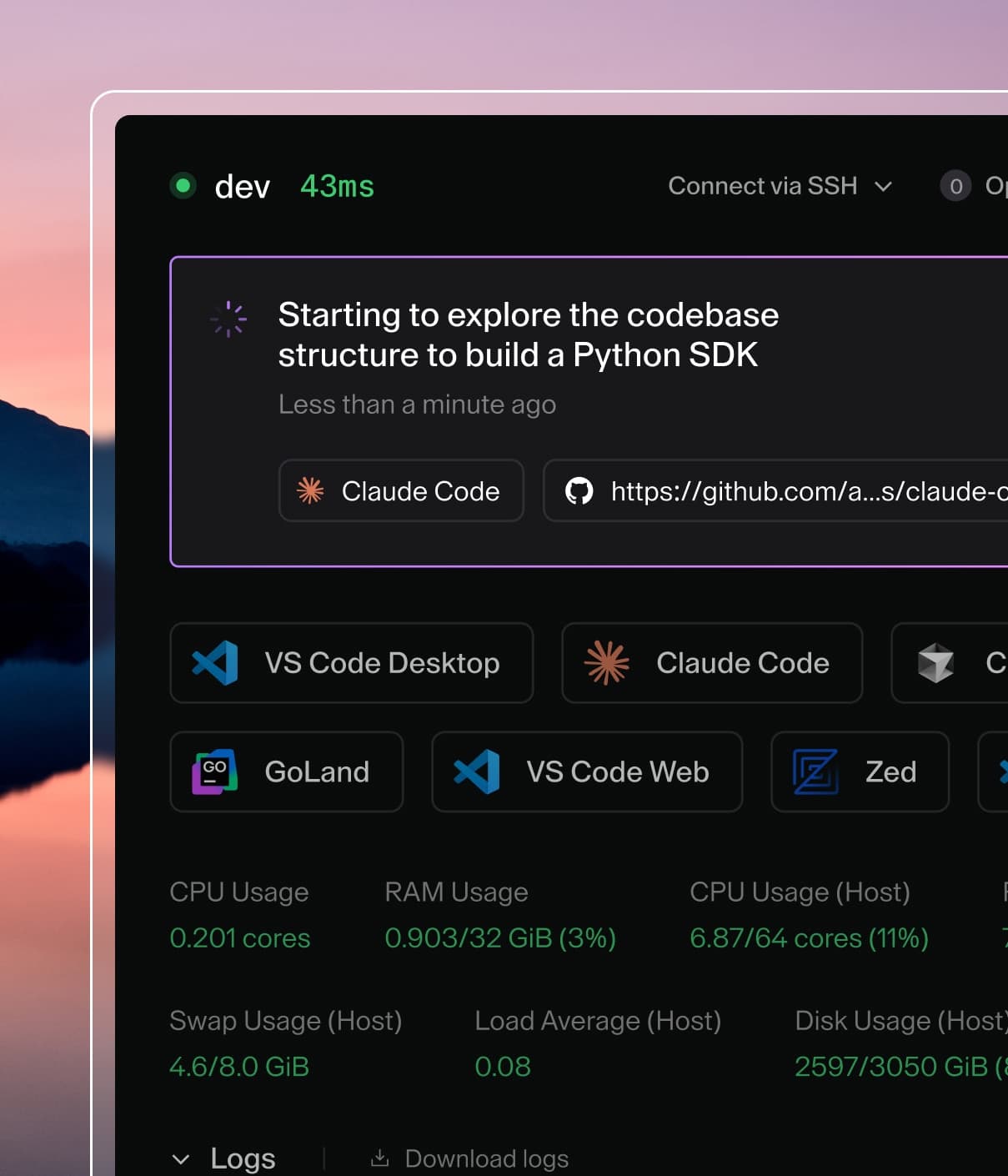
Coder powers secure, scalable development across key industries — automotive, finance, government, and technology — enabling faster builds, tighter compliance, and seamless AI adoption in enterprise-grade cloud environments.
Quantum computing promises to revolutionize fields from drug discovery to materials science, but here's what most people don't realize: quantum computers need software to be useful. And writing software for quantum computers is fundamentally different from anything developers have done before.
In our recent webinar, How PsiQuantum Accelerates Algorithm Research With Coder, Coder Product Manager Steven Kirby spoke with PsiQuantum’s Even Glemmestad and Ian Nanez about how they’re using Coder to build a development platform that enables the first useful, building-scale quantum computer. PsiQuantum, a leading quantum computing company, faced unique challenges when building their platform and in this webinar we explore how Coder provided a perfect solution.
What is quantum development?
Quantum development is the process of writing algorithms and software for quantum computers. Unlike classical computers that process information as binary bits (0s and 1s), quantum computers use quantum bits or "qubits" that can exist in multiple states simultaneously through a property called superposition.
This fundamental difference means quantum computers excel at specific types of problems where you have high connectivity between all elements, for example:
Chemistry and molecular simulation: Modeling how atoms and molecules interact
Drug discovery: Testing thousands of pharmaceutical candidates simultaneously
Material sciences: Designing new materials like room-temperature superconductors
Energy applications: More efficient solar panels and batteries
"Quantum computers are very good at solving nature's equations," explained Even Glemmestad, Head of Product at PsiQuantum. "Things like better drugs for diseases, corrosion-resistant materials, more effective solar panels. These are the applications we'll see first."
PsiQuantum has raised over $2 billion and recently broke ground on their quantum compute site in Chicago, with work on their Australian site soon to follow, to build million-qubit scale, fault-tolerant quantum computers. Not just five for proof-of-concept, but machines capable of solving real-world problems within the decade.
“Better drugs for diseases, corrosion-resistant materials, more effective solar panels. These are the applications we'll see first."
An image displaying the different applications of fault-tolerant quantum computing
Why don't traditional development environments work for quantum computing?
You can't just spin up a quantum computer on your laptop to test code. Early-stage quantum computers are massive machines that operate at temperatures near absolute zero. And even the world's largest supercomputers can only simulate quantum systems up to about 30 qubits before running out of memory.
According to research published in Physical Review X, the memory required to simulate quantum computers grows exponentially with the number of qubits. At 30 qubits, you've maxed out a typical supercomputer. At 31 qubits, you'd need two. By 50 qubits, there isn't enough classical computing power in the world to fully simulate it.
"Any little disturbance, someone clapping their hands across the room, could in theory be enough to cause the data to flip," explained Ian Nanez, Senior Product Manager at PsiQuantum, describing quantum errors. Early quantum computers can only perform a few hundred operations before these errors make calculations meaningless.
This creates a fundamental challenge: How do you develop and test quantum algorithms when you can't run them on real hardware yet, and simulation has strict limits?
The answer requires specialized development infrastructure that can:
Provide massive compute resources instantly when needed
Run securely on private infrastructure (quantum IP is under constant attack from nation-states)
Deliver pre-configured environments with complex, rapidly-evolving quantum libraries
Support multiple development modalities (VS Code, Jupyter notebooks, terminal access)
Scale from small simulations to metal GPU instances
How did PsiQuantum solve this challenge?
After trying web-based tools that couldn't scale and managed cloud services that didn't provide sufficient security control, PsiQuantum built Construct, their quantum development platform powered by Coder.
Coder solved PsiQuantum's critical challenges:
Security and Control: Self-hosted deployment on PsiQuantum's AWS infrastructure protects quantum IP from constant attacks by nation-states and competitors.
Instant Massive Compute: Researchers provision any size machine in 1-2 minutes, from standard instances to metal P3 GPU machines.
Pre-Configured Environments: Complex quantum libraries come already installed. Researchers click a button and start writing code immediately instead of spending hours on setup.
Flexible Access: VS Code, Jupyter notebooks, or terminal access, all through the browser with the same powerful infrastructure underneath.
Custom Integration: PsiQuantum uses Coder's API to build their own Construct interface while maintaining complete control over workflows and security policies.
The result? Both internal researchers and external partners get fully-configured Quantum Development Environments (QDEs) in under two minutes, with access to PsiQuantum's specialized tools like Workbench, a Python library for creating advanced fault tolerant algorithms that handles complex operations like automatic qubit allocation and quantum error management.
"We tried a few different approaches," Glemmestad said. "But we really needed to step this up. We needed it integrated, secure, and self-hosted. We can't just outsource this. It's too central to what we do."
"We had to come up with a secure solution that keeps IP safe. I'm happy Coder was the solution for that."
An image displaying PsiQuantum's Construct product and series of dashboards in it
Want to see quantum development in action?Watch the full webinar where the PsiQuantum team demonstrates Construct, walks through quantum algorithm development with Workbench, and answers questions about getting started in quantum computing.
Going deeper: Key challenges in quantum development
Why is quantum development so complex?
Early quantum researchers could draw algorithms gate-by-gate on whiteboards. That works for tens or hundreds of operations. It doesn't work for the billions of operations fault-tolerant quantum computers will perform.
In classical computers, bit flip errors are extremely rare. Quantum computers have two types of errors (bit flips and phase flips) that happen frequently. This is why early NISQ (Noisy Intermediate-Scale Quantum) systems could only do hundreds of operations before errors corrupted results.
Fault-tolerant quantum computing solves this through real-time error correction, enabling billions of operations. But now you need high-level programming abstractions, just as modern developers write in Python instead of manually managing memory addresses.
PsiQuantum's Workbench demonstrates this evolution. Quantum addition that would require manually managing dozens of qubits and gates becomes:
"In classical computing, automatic memory management is normal," Glemmestad noted. "But in quantum computing, this is not normal. You'd have to painstakingly manage qubits yourself. When you get to huge scales, it's critical."
How do you ensure security in quantum development?
Nation-states actively target quantum computing IP because of its potential to reshape cryptography, national security, and entire industries. The threat is already real: according to research reported in TechRadar, two-thirds of organizations are concerned about "harvest-now-decrypt-later" attacks, where adversaries collect encrypted data today with the intent to decrypt it once quantum computers become powerful enough.
Critical industries like defense, telecommunications, and infrastructure face particular risk from nation-state actors with the resources to exploit quantum breakthroughs for espionage or data theft.
For PsiQuantum, this security landscape made self-hosting non-negotiable. Managed cloud IDEs simply couldn't provide the control needed when developing technology with such profound implications. By self-hosting and using Coder, PsiQuantum gained complete data sovereignty on their own infrastructure, the ability to implement custom security policies, full audit trails for environment access, and seamless integration with their existing security systems.
What role does open source play in quantum development?
Despite intense security requirements, PsiQuantum contributes heavily to open source quantum development. They've released libraries including Bartik (for quantum resource analysis) and QREF (a common data interchange format for quantum systems), and offer a 90-day free trial of Construct with permanent free access for academics.
"Open source plays a critical role in quantum software development," Nanez emphasized. "All the different tools out there are exceptional, and we want to contribute to that ecosystem."
This balance between security and openness reflects a broader truth in quantum computing. A recent article in Nature Reviews Physics argues that open-source development could accelerate the field by reducing costs, improving benchmarks, and expanding the talent pool. The researchers found that while competitive open-source initiatives exist for high-level software like algorithm compilers, lower layers of the quantum stack remain largely proprietary but could improve interoperability and foster collaboration.
Coder shares this commitment to open source. Our core platform is open source, enabling organizations like PsiQuantum to build on a foundation they can inspect, modify, and control while contributing back to the developer community. Whether you're building quantum algorithms or traditional applications, open platforms provide the flexibility and transparency that cutting-edge development requires. You can secure your IP while still advancing the broader ecosystem.
"Open source plays a critical role in quantum software development."
Watch the full webinar
This article only scratches the surface of quantum development. In the full webinar, the PsiQuantum team demonstrates Construct in action, walks through quantum algorithm development with Workbench, explains resource profiling tools, and answers questions about getting started in quantum computing.
For another look at how Coder powers cutting-edge development, check out our conversation with Anthropic about their AI-first development approach. Read the Anthropic case study or watch that webinar.
Kodie is a content and comms professional focused on enterprise and developer tools. A passionate open source advocate, he's all-in on content engineering, using vibe coding workflows to craft stories at the speed developers ship code.