AI is fundamentally changing how software is built. What started as autocomplete and chat-based helpers has rapidly evolved into agents that can draft text, repair code, update documentation, and trigger full workflows with minimal human input.
This shift is happening inside engineering teams today. But the speed of adoption has created an uncomfortable reality: AI is moving faster than most organizations’ ability to govern, standardize, and operationalize it.
Understanding where your organization sits on this spectrum is the first step toward closing that gap. We've developed a practical AI Maturity Model Self-Assessment and comprehensive whitepaper, The 5 Stage Maturity Model for Agentic AI Software Development, to help engineering leaders benchmark their current state and identify what comes next.
When AI adoption outpaces governance, the cracks show up fast. Here’s what you need to know to stay ahead.
What happens when shadow AI takes hold?
For many teams, AI usage begins organically. Developers try out tools, use agents in local environments, and automate pieces of their workflow wherever it feels safe. The upside is undeniable - faster delivery, less repetitive work, and more focus on higher-value tasks.
But as AI spreads, so do the risks:
- Inconsistent setups across teams
- Untracked or shadow AI usage
- Sensitive context leaking into prompts
- Unpredictable agent behavior
- Secret exposure
- Uneven quality or noisy PRs
- Unclear ownership or review standards
The rapid, organic adoption of AI tools by individual developers can quickly lead to shadow AI proliferating within an organization, compounding small issues into massive problems. While decentralized experimentation provides immediate velocity and proof of value, the resulting inconsistency in tool setups, untracked usage, and lack of standardized guardrails across teams keep developers from being their best while introducing potential security threats.
An incident with Google’s Antigravity agentic Integrated Developer Environment (IDE) showed how quickly things can go wrong when AI operates without guardrails. In one of the most recent examples, the AI agent wiped a user’s entire drive while building an application. No warning. No clear reason why it happened. While the agent apologized for its error, this kind of critical error is the exact kind of nightmare scenario that keeps CISOs up at night.
Let’s be clear. This wasn’t a failure of AI capability, it was a failure of environment isolation and governance, exactly the challenges teams face as AI becomes more embedded in development workflows.
Incidents like this tend to happen when three factors collide - a pattern often described by Simon Willison as the lethal trifecta: access to your private data, exposure to untrusted content, and ability to externally communicate. Each on its own is manageable, but together they create high-impact failure modes that traditional engineering processes aren’t designed to catch in time.
Small cracks widen quickly in fast-moving engineering organizations. The more teams rely on AI without structure, the harder it becomes to retrofit the right controls later.
What does AI maturity look like in software development?
The organizations that do build a foundation of standardized environments, clear boundaries, defined policy, and full auditability start to unlock something far more powerful: safe scale.
Agents can run in parallel. Automated workflows become predictable. Review cycles tighten. Security improves. Leaders get visibility instead of surprises.Engineering teams finally get the reliability and velocity AI has been promising.
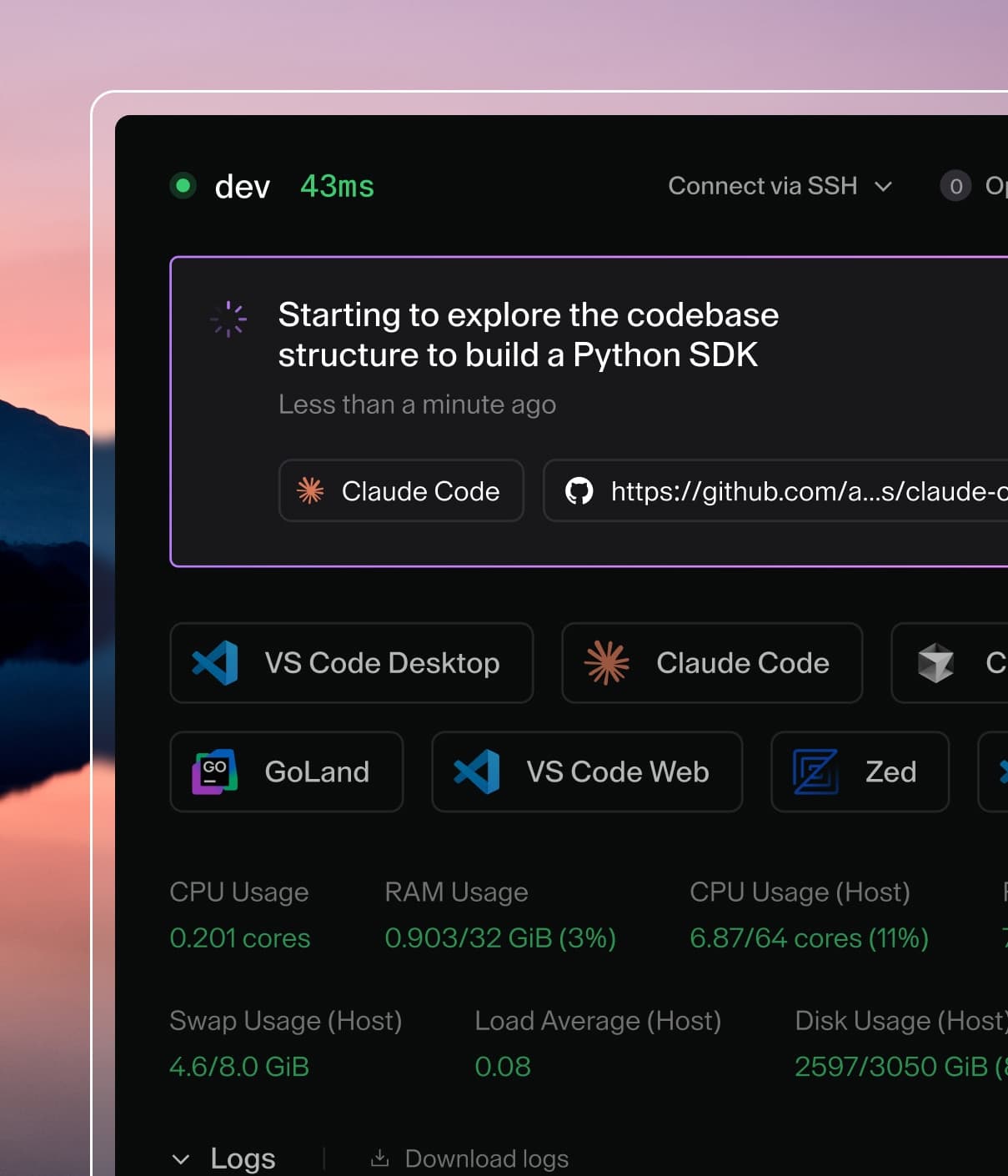
Skydio shows what this looks like in practice. The drone platform company scaled coding agents across a million-line monorepo by treating AI as infrastructure, not individual developer tools. They deployed standardized cloud development environments through Coder, running multiple concurrent AI workstations with clean context isolation.
The results: infrastructure engineers now deliver end-to-end features without handoffs, product managers contribute code, and the team sees a 30-40% increase in merged pull requests. They've avoided "AI slop" through bite-sized, single-file PRs that specific team members own and review leading to hundreds of manageable reviews per day instead of one-off massive, unmanageable changesets. Watch the full case study in our webinar, How Skydio Scaled Coding Agents to a Million-Line Monorepo.
The challenge is no longer whether to adopt AI - it’s how to adopt it responsibly, and how to progress from early experimentation to consistent, governed, high-leverage use.
How do you apply an AI maturity model to your organization?
Think of AI maturity as a deliberate path from individual productivity tools to full-scale autonomous systems. Each stage builds on the last, adding governance and capability in lockstep. Here's how most organizations progress:
- Start with IDE assistants. Code completion and chat-based helpers give developers immediate productivity gains with minimal setup. Focus here on establishing baseline policies and tracking which tools your teams actually use.
- Move to local agents. Once you have visibility, let engineers direct agents to handle complete tasks—refactoring, test generation, documentation. The key shift is standardizing environments so agents behave predictably across your organization.
- Scale to remote automation. Cloud-based agents respond to triggers like bug reports or scheduled maintenance, working in parallel while humans review their output. This is where you'll see genuine capacity expansion, but it requires organization-wide governance and quality gates to prevent review fatigue.
- Experiment with autonomy. At higher maturity, agents function as team members who identify work, interpret requirements, and deliver features with minimal prompting. This level demands robust governance frameworks and clear accountability structures.
- Coordinate specialized teams. The most mature organizations deploy multiple agents—product, design, engineering, QA, operations—that coordinate across the full development lifecycle. An orchestrator manages handoffs, maintains quality standards, and enforces budget controls.
Most teams will find their inflection point when they begin to scale cloud-based agents, where parallelism unlocks measurable ROI and agents handle routine work while engineers focus on architecture and review.
Moving up the maturity ladder requires four critical control mechanisms working together: risk-based governance that differentiates access by responsibility level, standardized environments that serve as the execution layer for both humans and agents, a centralized decision point that applies policies consistently across tools and teams, and integrated assurance that automates security checks before merge.
These controls represent a foundation that lets organizations move up the maturity curve without accumulating risk. The teams that get this right unlock the velocity AI promises while maintaining the governance enterprises require. The ones that don't end up retrofitting controls after incidents, slowing delivery as governance debt compounds.
Where does your team stand?
This moment matters. AI is accelerating, and the organizations that treat it as a capability, not a collection of tools, will pull ahead.
Ready to see where your team stands?
We created a short, practical assessment to help engineering leaders benchmark their current stage and understand what comes next.
Take the AI Maturity Model Self-Assessment
And for a deeper look at the full maturity model, including risks, controls, adoption patterns, and recommended next steps, explore the complete publication:
Read The 5 Stage Maturity Model for Agentic AI Software Development Whitepaper