Between November 21 and 23, 2025, attackers compromised hundreds of npm packages and over 25,000 GitHub repositories in a single weekend. They didn't breach a firewall. They didn't exploit a zero-day in production infrastructure. They poisoned trusted npm packages with preinstall scripts that harvested GitHub tokens, cloud credentials, and CI/CD secrets from developer workstations before any security scanner could run.
The attack, dubbed Shai-Hulud 2.0, was the most aggressive software supply chain compromise of 2025. Organizations including PostHog, Zapier, AsyncAPI, and Postman reported infected JavaScript SDK packages. The malware registered infected machines as rogue GitHub Actions runners, giving attackers persistent remote access to developer environments.
The organizations that contained the damage fastest had one thing in common: their developers were not building on local laptops.
The assumption that failed
Every organization hit by Shai-Hulud 2.0 had invested in security tooling. They had EDR agents, dependency scanners, network monitoring, and secret management policies. None of it mattered, because the attack exploited a structural assumption baked into modern development workflows: that developer workstations are trusted execution environments with persistent access to sensitive credentials and source code.
This assumption made developer endpoints the most valuable target on the network. A compromised developer machine provides immediate access to GitHub tokens, cloud provider keys, SSH keys, and direct access to source repositories. According to Sonatype's Q2 2025 Open Source Malware Index, the total volume of open source malware surged 188% year-over-year, with 55% of discovered threats specifically designed to steal sensitive information from developer environments.
The Shai-Hulud preinstall script executed before the package installation completed, which meant vulnerability scanners and Software Composition Analysis tools never had a chance to flag the payload. By the time security tooling could examine the package, credentials had already been harvested and exfiltrated. Detection-based approaches failed not because of misconfiguration, but because the attack ran inside a trusted operation: npm install.
From detection to architectural isolation
The organizations that recovered from Shai-Hulud 2.0 in hours instead of weeks shared an architectural pattern. They had already separated development environments from developer endpoints, moving code, credentials, and build artifacts into centralized, governed infrastructure.
This is the core shift: instead of trying to detect malicious behavior on endpoints that are structurally exposed, you eliminate the conditions that make the attack possible. No persistent credentials on the laptop means nothing to harvest. No source code on the local filesystem means nothing to exfiltrate. No long-lived environment state means no foothold for persistence.
Cloud development environments (CDEs) enforce this pattern by design. Workspaces operate in isolation from developer endpoints and from each other. Credentials are injected dynamically with defined TTLs through secrets management integration, not stored as files in ~/.aws or ~/.ssh. Network egress controls restrict which external services a workspace can reach, blocking the kind of arbitrary outbound connections Shai-Hulud relied on to exfiltrate data.
Dark Reading reported that supply chain worms in 2026 will be faster, broader, and harder to contain. The defensive response has to be structural, not incremental.
What architectural defense looks like in practice
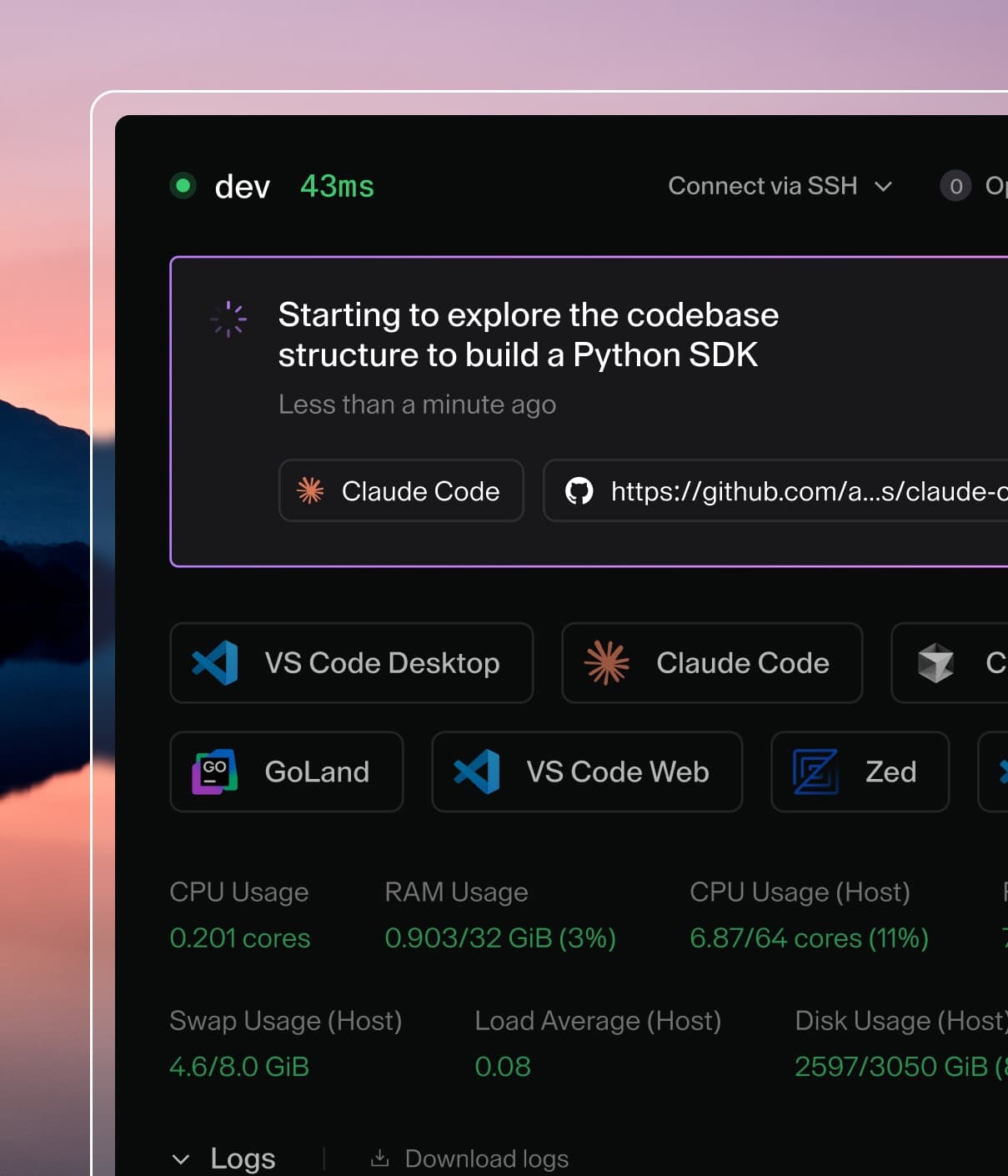
Coder's cloud development environment platform addresses each Shai-Hulud attack vector through infrastructure-level controls rather than endpoint-level detection. The approach follows a security best practices framework grounded in workspace isolation, controlled package sources, and dynamic credential management.
Workspace isolation eliminates persistence. Coder workspaces can be configured as ephemeral (destroyed after each session) or persistent with defined rebuild cycles. In either model, malware installed during a compromised npm install is confined to a single workspace. The rogue GitHub runner that Shai-Hulud used for persistence becomes ineffective because nothing survives workspace termination.
Controlled package sources block the initial attack vector. Workspace templates enforce network egress controls that block access to public registries like npmjs.org, mandating that all dependencies come from vetted internal mirrors such as Artifactory or Nexus. If the malicious package never reaches the workspace, the preinstall script never executes.
Dynamic credentials limit blast radius. Instead of long-lived tokens stored on disk, Coder integrates with secrets management platforms like HashiCorp Vault to inject credentials at workspace startup with 1-hour TTLs. Even if a workspace is compromised, the attacker gets credentials that expire within the hour rather than keys that persist until someone manually rotates them.
Infrastructure as Code ensures consistency. All workspace configurations are defined in Terraform templates maintained through GitOps review. This eliminates the snowflake machine problem where every developer laptop has a different security posture. Policy becomes engineering rather than documentation.
The proof: containment speed separates outcomes
The gap between organizations that contained Shai-Hulud 2.0 quickly and those that spent weeks auditing distributed machines came down to one factor: whether development environments were centrally managed. According to Microsoft's December 2025 guidance, the recommended response included rotating all developer credentials, auditing every GitHub App and OAuth application, and checking package-lock.json files across every project.
For organizations with developers on local laptops, that meant touching every machine individually. For organizations running centralized development infrastructure with defined security boundaries, it meant updating a template, triggering workspace rebuilds, and remediating the entire developer population in hours.
That gap between hours and weeks is not theoretical in a supply chain attach scenario. When a compromised dependency surfaces, organizations running Coder can remediate across the entire development fleet with a single template update, pushing security patches to all workspaces centrally in minutes. There is no laptop-by-laptop forensic exercise, no racing to determine which machines pulled the affected package. And because source code never lives on the endpoint, there is nothing for an attacker to exfiltrate even if a compromised dependency runs before the patch lands.
What this means for your next board conversation
Supply chain attacks will keep targeting developer endpoints because that is where the credentials live. The CISA alert on the original Shai-Hulud compromise and Microsoft's follow-up guidance both point in the same direction: the structural fix is to remove sensitive assets from the places attackers can reach them.
The question for security leaders is not whether to make this transition, but how quickly. The full technical analysis of Shai-Hulud 2.0 and Coder's defense architecture is in our whitepaper: Shai-Hulud 2.0: Defending the Software Supply Chain.