Company Overview
This Defense Intelligence organization operates at the intersection of national security and advanced technology development. As part of a broader Department of Defense network, the organization's mission depends on software engineers who can rapidly develop, test, and deploy intelligence analysis tools in highly classified environments.
Development infrastructure for this organization must satisfy requirements that go far beyond typical enterprise needs. The code must never leave government networks. Every action must be auditable. Onboarding new engineers or contractors needs to happen quickly without compromising security. The technical environment includes air-gapped networks, strict identity and access management, and compliance frameworks that make traditional cloud development tools unusable.
The organization's platform engineering team recognized that their development infrastructure had become a bottleneck. Manual setup processes, inconsistent local configurations, and limited oversight were slowing down critical projects while creating potential security gaps.
The Challenge
Environment setup as a barrier to mission velocity
For years, the organization's software engineers worked primarily on local development environments. Setting up a new developer could take days. Each engineer needed to manually configure their local machine, install dependencies, connect to internal services, and ensure their setup matched team standards. The process was documentation-heavy, error-prone, and required significant time from senior engineers who walked newcomers through the steps and from IT operations to approve the many tickets required for all the changes.
This approach created multiple problems. First, onboarding delays meant that contractors or new team members couldn't contribute quickly when urgent intelligence priorities emerged. In an environment where mission requirements can change rapidly, having developers sitting idle for days while waiting for environment access represented a real operational constraint.
Second, local development environments introduced inconsistencies. Despite detailed documentation, engineers ended up with slightly different configurations. Troubleshooting became difficult when code worked on one machine but failed on another. Reproducing bugs required extensive environment debugging before teams could even investigate the actual code issue.
Third, governance and security visibility remained limited. Leadership had no centralized way to understand who was working on what, which resources were being consumed, or whether development practices aligned with security policies. Audit trails existed primarily through manual documentation and access logs, making compliance verification labor-intensive.
Finally, the organization needed infrastructure that could work entirely within air-gapped networks. Cloud-based development tools used by commercial enterprises simply weren't an option. Any solution had to be self-hosted on Department of Defense infrastructure with no external dependencies.
The Solution
Self-hosted development infrastructure purpose-built for governed environments
The organization deployed Coder on AWS GovCloud, creating a fully air-gapped, self-hosted development platform that maintains complete data sovereignty while delivering the developer experience benefits typically associated with commercial cloud tools.
The implementation leveraged Coder's Infrastructure-as-Code approach using Terraform templates. Platform engineers defined standardized development environments that could be provisioned on-demand in minutes rather than days. These templates included all necessary dependencies, tools, and configurations, ensuring every developer worked in an identical, pre-approved environment.
With Coder, the organization gained:
Rapid, standardized provisioning
New developers or contractors now receive access to fully configured development workspaces in 3-5 minutes. Platform engineers create templates that define the exact environment needed for each project or team. When a developer needs to start work, they simply select the appropriate template and Coder provisions a complete workspace with all tools, dependencies, and access controls already in place.
Air-gapped deployment with full control
Coder runs entirely within the organization's air-gapped network on AWS GovCloud. No code, credentials, or metadata ever leaves government-controlled systems. The organization maintains complete ownership of the platform, can audit every component, and can modify configurations to meet evolving security requirements without depending on external vendors.
Unified developer experience across IDEs
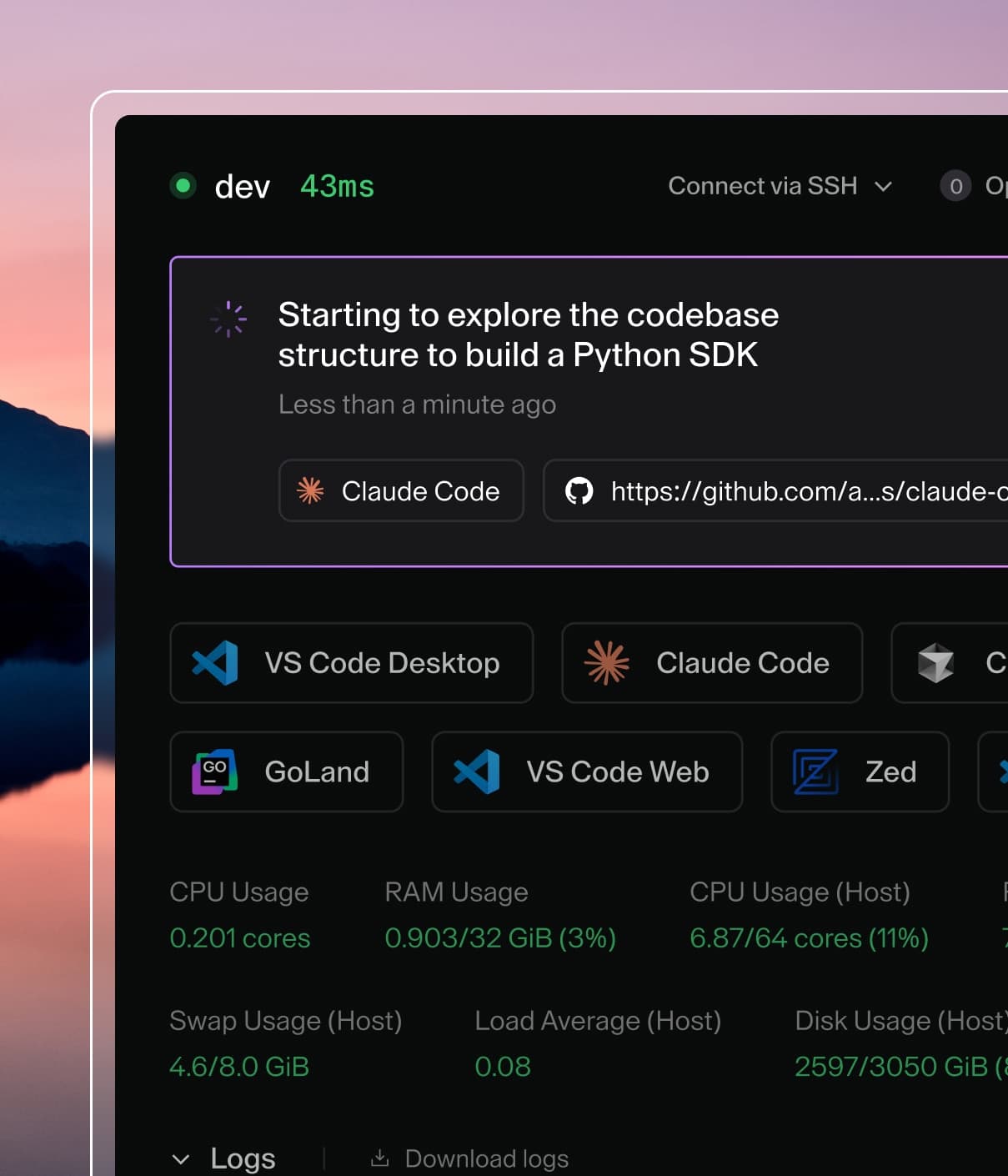
Engineers continue using their preferred development tools, including VS Code and JetBrains IDEs, connecting directly to Coder workspaces. This preserved existing workflows while adding the benefits of centralized infrastructure. Developers access the same familiar interface they've always used, but now backed by governed, auditable cloud resources.
Complete visibility and audit trails
Centralized visibility into all development activity allows organizations to see which workspaces are active, who is consuming which resources, and how infrastructure is being utilized across teams. Every workspace creation, modification, and deletion is logged, providing the audit trails required for compliance verification and security reviews.
Template-Based Governance
Platform engineers enforce policies through templates rather than documentation and manual review. If a project requires specific security controls, those controls are built into the template. If certain tools should be available or restricted, the template defines that access. This shifts governance from reactive oversight to proactive infrastructure design.
The Results
From bottleneck to force multiplier
The impact of adopting Coder has been transformative for both developer experience and operational efficiency. What began as a pilot with 10 engineers has expanded organically to 50 users, representing 500% growth driven entirely by developer satisfaction and demonstrated value.
Onboarding velocity and mission readiness
The most immediate impact came in onboarding time. What previously required days of manual setup now happens in 3-5 minutes. When the organization needs to bring on contractors for surge capacity or onboard new team members, those engineers can begin contributing to mission-critical projects almost immediately. This speed has real operational implications in an environment where intelligence priorities can shift rapidly and timelines are measured in days, not weeks.
Engineers no longer spend their first week troubleshooting environment issues or waiting for access to be configured. They receive a workspace link, connect through their preferred IDE, and immediately have everything they need to start coding. Senior engineers who previously spent hours walking newcomers through setup can now focus on architecture and code review instead.
Developer experience and satisfaction
Developer adoption tells the story clearly. The organization started with 10 seats in their initial pilot. Over the following years, as engineers experienced the benefits firsthand, they requested access for their teammates and other projects. The platform engineering team didn't have to push adoption; developers pulled it into new use cases because it made their work faster and less frustrating.
Engineers particularly value the consistency. Instead of debugging environment differences between team members, they know that if code works in one workspace, it will work in all of them. This eliminates entire categories of "works on my machine" problems that previously consumed debugging time.
The flexibility to use VS Code, JetBrains, or other preferred tools means developers didn't have to change their workflows. They kept their familiar shortcuts, plugins, and configurations while gaining the infrastructure benefits of centralized development environments.
Governance without developer friction
The organization achieved what often seems like a contradiction: stronger governance with better developer experience. By encoding security policies and compliance requirements into infrastructure templates, the platform team ensures that developers work within approved guardrails by default. Developers don't experience this as restriction, though, because they receive fully functional environments that just work.
Leadership gained the visibility needed for security reviews and compliance verification. They can demonstrate to auditors exactly what development infrastructure exists, who has access to what, and how resources are being consumed. The complete audit trails provide evidence of compliance without requiring developers to manually document their actions.
Because Coder runs on air-gapped AWS GovCloud, the organization maintains the data sovereignty and security posture required for classified work while still delivering modern development experiences to their engineers.
Scaling with mission seeds
The 500% growth in adoption demonstrates that the platform scaled successfully alongside the organization's expanding development needs. As new projects launched and additional teams required development infrastructure, the platform engineering team could provision new templates and workspaces without the linear scaling problems that plagued their previous approach.
This scalability means the organization can respond to urgent intelligence priorities by rapidly expanding development capacity. When a new mission requirement emerges, platform engineers can define appropriate templates and have engineers working within minutes rather than waiting days or weeks for environment setup.
Looking Ahead
With Coder established as the foundation for their development infrastructure, the organization is positioned to adopt emerging capabilities in AI-assisted development while maintaining the security and governance standards their mission requires. As AI coding agents and autonomous development tools mature, Coder's approach to governed, auditable execution environments will enable the organization to safely integrate these capabilities within their air-gapped infrastructure.
The platform engineering team continues refining templates to support new programming languages, frameworks, and toolchains as development needs evolve. The infrastructure they've built provides a durable foundation that can grow with changing technical requirements without compromising on security or developer experience.
Conclusion
For this Defense Intelligence organization, adopting Coder wasn't just about faster onboarding or better developer experience, although those benefits are significant. It was about building development infrastructure that meets the unique requirements of classified, mission-critical software development: complete data sovereignty, rigorous security controls, full auditability, and the ability to scale rapidly when national security priorities demand it.
By combining self-hosted deployment with modern development workflows, the organization proved that governance and developer experience don't have to be in tension. The right infrastructure makes both possible simultaneously. The 500% growth in adoption, measured onboarding improvements, and sustained developer satisfaction demonstrate that this approach delivers value that compounds over time, making the platform more valuable as more teams adopt it.