Company Overview
This organization is a global leader in payments and financial technology, serving thousands of financial institutions and millions of businesses and consumers worldwide. With over 15,000 engineers, they operate at a scale where developer productivity and platform governance directly impact the company's ability to innovate and serve its customers.
The VP of Platform Engineering leads the organization's efforts to modernize its internal developer platform. His team is responsible for building infrastructure that enables engineers to ship code faster while maintaining the security and compliance standards that financial services demands.
The Challenge
The platform engineering team faced a challenge familiar to large financial technology organizations: how do you enable 15,000+ engineers to move fast without compromising governance?
The most visible symptom was onboarding friction. New developers joining the organization couldn't contribute meaningful code for weeks after their start date. Environment setup, access provisioning, dependency management, and configuration consumed time that should have been spent building.
The goal was clear: allow new developers to commit code on day one instead of day 15 or 30.
That friction extended beyond onboarding. Experienced engineers dealt with environment drift, inconsistent tooling across teams, and the constant overhead of maintaining local development setups. Platform teams spent cycles troubleshooting environment issues rather than building capabilities that would accelerate the entire organization.
As AI coding assistants and autonomous agents became essential tools for developer productivity, the challenge intensified. Deploying these tools safely, with the governance and auditability that financial services regulators expect, required infrastructure that simply didn't exist in a laptop-centric development model. API keys were proliferating. Shadow AI experiments emerged faster than security could track. Compliance teams needed visibility into model usage, prompt logging, and agent behavior that fragmented local development couldn't provide.
The Solution
The organization selected Coder to modernize its internal developer platform, deploying self-hosted cloud development environments that would scale across its global engineering organization. The deployment runs on AWS, using Amazon EKS for the Kubernetes cluster and Amazon RDS for the database backend. The entire infrastructure is provisioned as code, allowing the platform team to manage deployments through a standardized promote-to-production process while integrating with the company's existing identity infrastructure for seamless SSO authentication.
The implementation started with cloud development environments for human developers and quickly evolved into a strategic partnership. Over twelve months, the Coder deployment doubled in active users. More telling than the growth rate was the commitment behind it: a multi-year agreement signaling that governed cloud development environments are foundational to their engineering future.
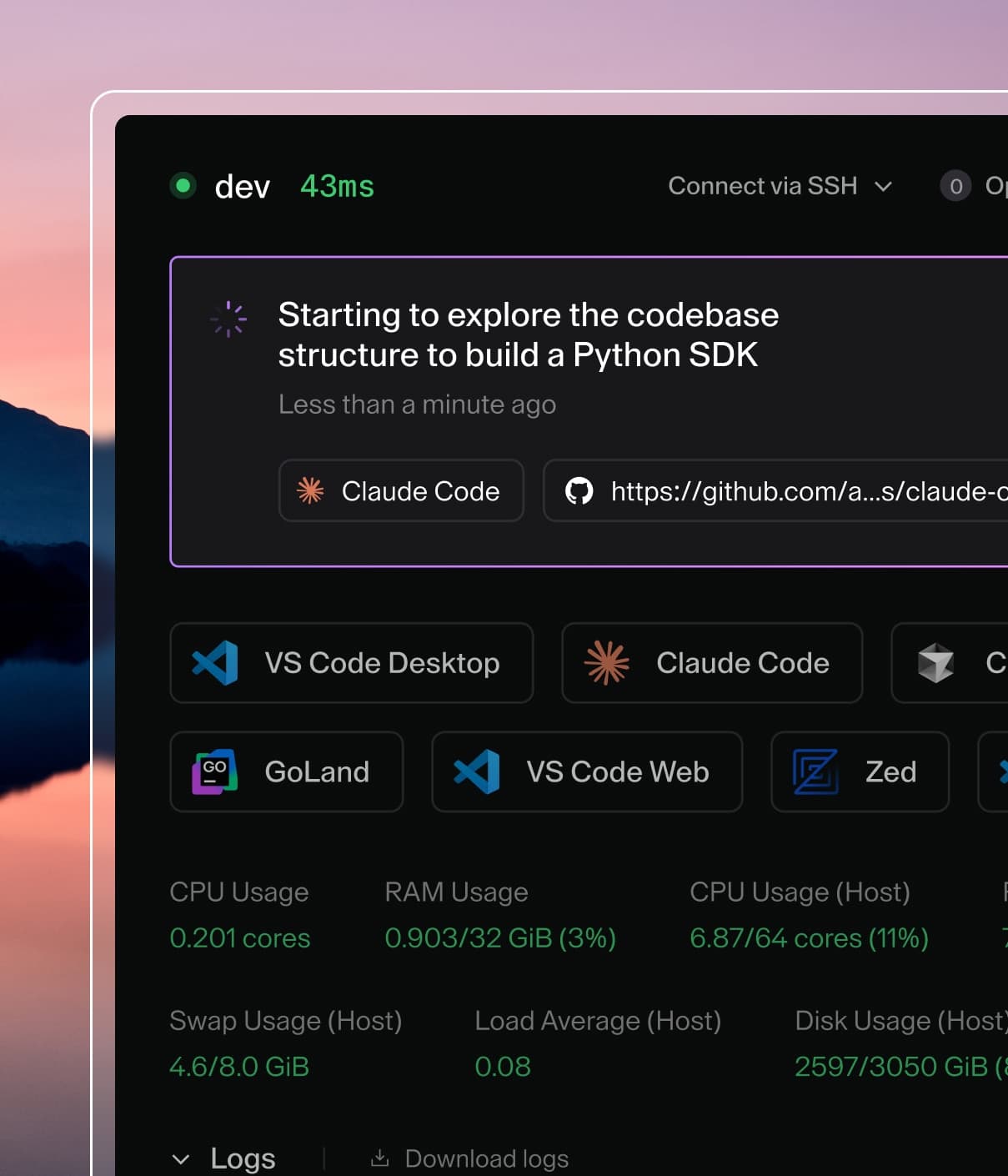
Accelerating developer onboarding. With Coder, the organization moved toward environment-as-code, where new developers receive pre-configured workspaces with all dependencies, tools, and access controls already in place. The goal: first commit on day one, not day thirty.
Standardizing environments at scale. Using Terraform-based provisioning, the platform team can define and deploy consistent development environments across thousands of engineers. Configuration drift becomes a solved problem. Updates to tooling or security policies propagate automatically.
Centralizing governance and security. Coder's self-hosted architecture keeps source code and development activity within controlled infrastructure. Access flows through existing SSO and RBAC systems. Every action is logged and auditable.
Building the foundation for AI adoption. Recognizing that AI governance would become critical, the organization joined Coder's design partnership program to co-develop four capabilities essential to their AI strategy:
- AI Gateway for compliance and governance observability, giving security teams visibility into all model interactions
- Agent Firewall for network isolation, ensuring autonomous agents can only access approved resources
- Coder Agents for background automation of build, test, and deployment workflows
- Custom integration to bring internal AI tools directly into governed workspaces
Exploring next-generation infrastructure. The organization is also testing deployment of Coder directly on mainframe infrastructure. By running workspaces on mainframes, they can leverage ultra-low compute costs to power build and test processes across both developers and agents. This approach meets critical systems where they already live rather than forcing migration to new platforms.
The Results
This organization's trajectory demonstrates what committed AI development infrastructure investment looks like at enterprise scale.
Rapid adoption and strategic commitment. User growth of 100% in twelve months reflects organic demand from engineering teams experiencing the benefits firsthand. The multi-year agreement and design partnership investment signal executive confidence that this infrastructure is strategic, not experimental.
Environment standardization. The platform engineering team now provisions consistent, pre-configured workspaces across their global engineering organization, eliminating the environment drift and "works on my machine" issues that previously consumed engineering time.
Security and compliance posture. With development activity centralized in governed cloud environments, security teams have visibility and control that laptop-based development could never provide. As AI tools enter the workflow, the same governance layer extends to model access, prompt logging, and agent behavior.
Foundation for AI-native development. The design partnership positions the organization to adopt AI coding assistants and autonomous agents safely. AI Gateway will provide the compliance observability regulators expect. Agent Firewall will enforce deterministic controls on what agents can access. Coder Agents will enable background automation with full auditability.
Looking Ahead
With governed cloud development environments in place and the design partnership underway, this organization is positioned to lead in AI-native software development. The four capabilities in development will enable their engineers to work alongside AI agents with the governance and compliance controls that financial services demands.
The mainframe exploration represents a broader principle: AI development infrastructure should meet organizations where their critical systems already live. For this fintech leader, that means leveraging decades of mainframe investment to power the next generation of developer and agent workflows at optimal cost.
Conclusion
For this organization, adopting Coder addresses more than onboarding friction. The platform provides the foundation for how 15,000+ engineers will build software in an era where AI agents work alongside human developers. The 100% user growth, multi-year strategic commitment, and design partnership investment reflect a clear conviction: solving governance at the infrastructure layer is the only way to adopt AI without compromise.
The ultimate goal remains what platform engineering leadership articulated from the start: developers committing code on day one. With Coder, that goal becomes achievable at enterprise scale, for humans and agents alike.
Coder is the leading platform for AI Development Infrastructure, enabling enterprises to securely run human and AI-driven development workflows in consistent, governed environments. Learn more at coder.com.