Company Overview
PsiQuantum is building the world's first utility-scale quantum computer, targeting complex problems that classical computing will never be capable of solving. With over $2 billion in funding (the highest in quantum computing history) plus millions in government grants, the company employs more than 500 people globally.
Unlike approaches limited to dozens of qubits, PsiQuantum's photonic quantum computing method leverages established chip fabrication facilities in their process of building fault-tolerant systems at genuine scale: millions of qubits capable of performing billions of operations with real-time error correction. The company has already broken ground on its first quantum computing site in Chicago, with their Australian site soon to follow..
Jim Lesko, Senior Director of Engineering, leads the Application Systems Engineering team responsible for the Construct platform, PsiQuantum's web-based environment that delivers quantum development tools to internal teams and external researchers. While the majority of PsiQuantum's workforce focuses on photonics, silicon, and materials science for quantum hardware, Lesko's team builds the software infrastructure that enables algorithm research.
The Challenge
Quantum computing sits at the frontier of computational science, and PsiQuantum's mission demands both breakthrough hardware and sophisticated software tools. The company's Gen1 target of one million physical qubits translating to hundreds of logical qubits requires hundreds or thousands of error-correcting qubits for meaningful computation. Applications span materials science and chemistry, addressing problems with potential impact ranging from clean ammonia for agricultural fertilizer to more efficient batteries.
For Lesko's team, the development environment challenge extended beyond internal needs. PsiQuantum needed to deliver their proprietary Fault Tolerant Quantum Computing (FTQC) programming framework—called Workbench—to external customers, academic researchers, and workshop participants. Each customer organization required secure, isolated environments with instant access to quantum development tools, but without exposing PsiQuantum's proprietary quantum libraries to potential exfiltration.
The complexity was multifaceted. Internally, new developers faced a week-long setup process, hunting down correct library versions, discovering internal repositories, and configuring tools before writing a single line of quantum code. Externally, customers needed the same "hit the ground running" experience, but with organization-specific project artifacts stored securely on PsiQuantum's hosted Git server and seamless authentication across both web interfaces and development environments.
Security requirements added another layer. Threats to quantum computing IP meant that PsiQuantum's internal security team required rigorous controls over any development infrastructure. Cloud-hosted solutions meant lengthy vendor audits and ongoing compliance overhead. Sharing zipped repositories with external collaborators created unacceptable risk of proprietary code leaving the organization.
The team tried GitHub Codespaces and built in-house web-based development environments, but neither met PsiQuantum's requirements for security, scalability, multi-tenancy and the seamless developer experience customers expected.
The Solution
When Lesko's team evaluated Coder, the self-hosted architecture immediately addressed their core security concerns. Running on PsiQuantum's own AWS infrastructure made it easier to meet compliance needs, eliminating the third-party vendor auditing that had slowed previous solutions. The team maintains full control over penetration testing and configuration management, with no external services handling sensitive quantum computing IP.
"Self-hosted deployment meant we could leverage our existing security processes instead of starting from scratch. It's the path of least resistance for protecting our quantum computing IP." — Jim Lesko, Senior Director of Engineering, PsiQuantum
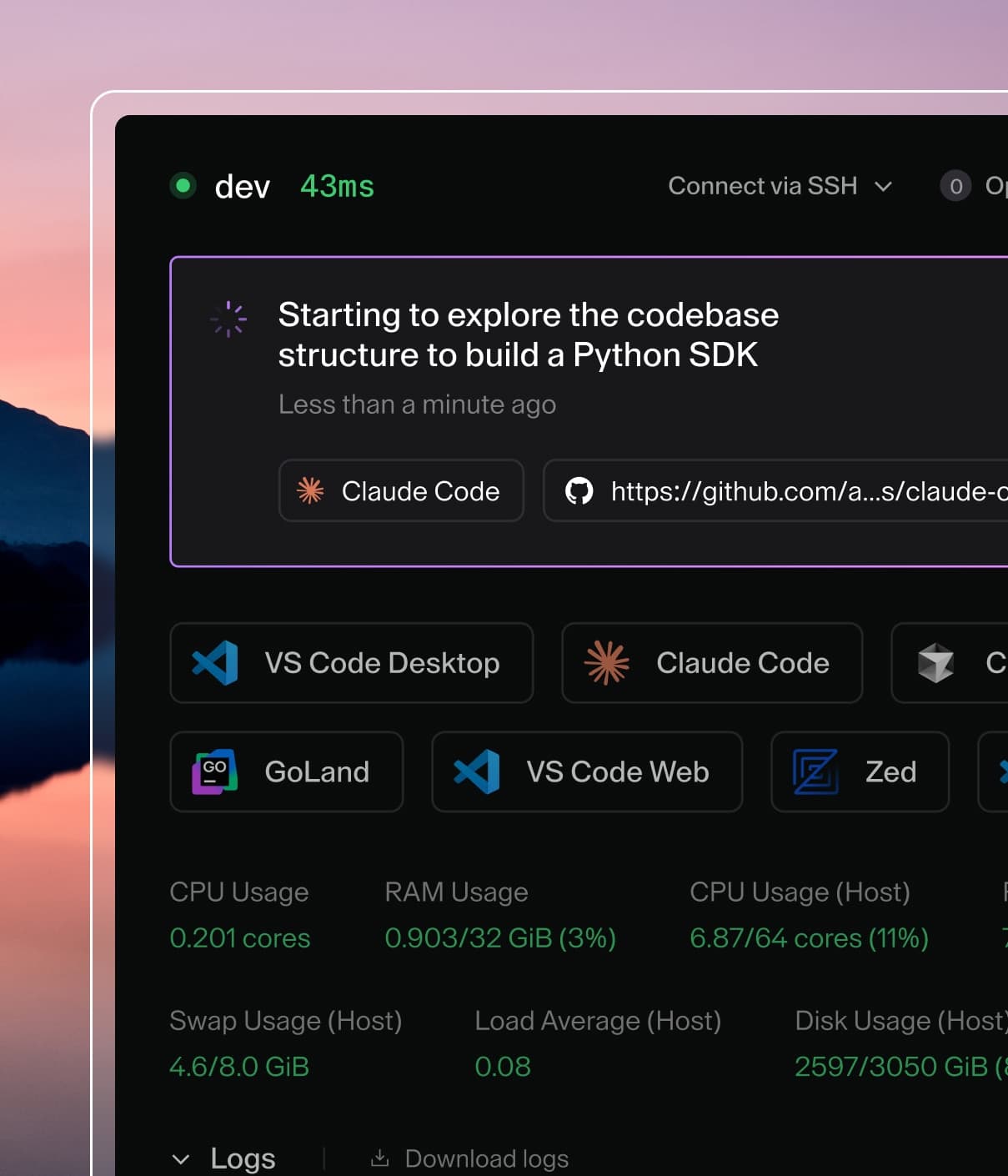
PsiQuantum built their Quantum Development Environment (QDE) within the Construct platform using Coder as the foundation. Construct is a comprehensive collection of tools—both visual and code-based—that researchers use to develop fault-tolerant quantum algorithms.The QDE delivers VS Code and Jupyter notebook options, pre-configured with quantum libraries, sample projects, and access to internal repositories.
For internal use, QDEs run on EC2 instances. For external customers and academic partners, QDEs deploy on Kubernetes pods, with Coder managing the infrastructure complexity behind a seamless user experience. Each QDE comes pre-configured with PsiQuantum's Workbench FTQC programming framework, quantum libraries, sample projects, and authenticated access to the organization's project artifacts on PsiQuantum's hosted Git server.
The platform's architecture supports both standard compute instances and metal P5 GPU instances, matching resources to the demands of quantum simulation workloads. Templates provision everything researchers need, whether they're PsiQuantum employees, academic collaborators, or customers at major institutions and organizations exploring quantum algorithms through the Construct platform
The API-heavy approach integrates fully with Construct’s custom frontend, while developer mode provides direct Coder access for users who need it. This flexibility means customers get a polished, branded experience while technical users retain the power of underlying Coder capabilities.
The Results
Since deploying Coder, PsiQuantum has transformed how researchers access quantum development tools.
"We needed development infrastructure that our security team would approve without months of audits, but that wouldn't slow down our researchers or customers. Coder gave us both. Self-hosted means we control everything, and both our own teams and external researchers get instant access to fully configured environments." — Jim Lesko, Senior Director of Engineering, PsiQuantum
Onboarding transformed
The week-long environment setup process disappeared entirely. New developers now log into Construct and gain instant access to a fully configured workspace. Every quantum library, every internal repository, every tool is ready from the first moment.
Workshop and customer success
The impact became visible during academic conferences and workshops when a room full of students went from zero to coding within minutes. Participants required no local setup and no prior configuration. The demonstration proved that Coder could support PsiQuantum's external engagement without compromising security.
For customers using Construct, the same instant-access experience scales to entire research teams. Whether an institution has five researchers or fifty, Coder provisions isolated, secure QDEs with organization-specific access to project artifacts, all managed through PsiQuantum's hosted Git server with seamless authentication.
Security without friction
Self-hosting on AWS eliminated the compliance overhead that had plagued previous approaches and allowed us to more easily integrate with strategic partners and customers. The security team approved the deployment through their standard process, with no special audits or vendor assessments required. PsiQuantum maintains full control over their quantum computing IP while still enabling external collaboration through the Construct platform.
Flexible infrastructure that scales
Coder's architecture handles PsiQuantum's heterogeneous infrastructure requirements seamlessly. Internal researchers get EC2 instances tailored to their workloads. External customers get Kubernetes pods that scale elastically with demand. The platform provisions everything from standard compute for algorithm development to metal P5 GPU instances for intensive classical simulation of quantum circuits—all through the same Coder templates and workflows.
Looking Ahead
With the QDE foundation in place, PsiQuantum plans to expand Coder's role in their development infrastructure. The team is implementing better logging and metrics to track usage patterns, engagement duration, and resource utilization. Automated testing within QDE environments will ensure production code runs with identical library configurations. AI capabilities integration is planned as quantum algorithms grow more sophisticated.
"As quantum algorithms grow more complex, we're exploring how AI capabilities can accelerate development within our QDE. Coder gives us the foundation to integrate those tools securely, on our own infrastructure, without rethinking our entire platform." — Jim Lesko, Senior Director of Engineering, PsiQuantum
Conclusion
For PsiQuantum, Coder delivers more than faster onboarding. It provides the secure, scalable foundation for building software tools that will help unlock quantum computing's potential to solve problems classical computers cannot touch. All while maintaining the same stringent security and compliance posture researchers and customers needs when exploring fault-tolerant quantum computing.
From material science breakthroughs to climate change solutions, the research enabled by instant-access development environments may one day transform industries. By eliminating week-long setup processes and satisfying nation-state-level security requirements, Coder lets PsiQuantum's researchers focus on what matters: developing the algorithms that will run on the world's first utility-scale quantum computer.
Whether you're a quantum researcher, a student in a lab, or a research team at a major institution using Construct, Coder ensures you spend less time configuring environments and more time advancing the frontier of quantum computing.