If you run a software organization inside a regulated enterprise, you've probably had some version of this conversation in the last six months: your engineering teams want to go all-in on AI-assisted development, your board wants to see the productivity gains, and your CISO wants to know how any of it gets governed before a single agent touches production code.
Everyone's right… and that's the problem.
The blockers are more than technical; they're also organizational, which comes down to two things: culture and cost.
On the culture side, leaders want to know how to preserve what makes their engineering organization effective as development becomes more agent-driven. Not just compliance rules, but the harder-to-define ways teams plan work and hold each other accountable — how sprint planning gets run, how pull requests get reviewed, how architectural decisions get documented and debated before anyone writes a line of code. Those practices took years to build, and no one wants to watch them dissolve because AI agents don't know they exist.
On the cost side, AI development introduces an entirely new spending category. Executives need to absorb it while maintaining financial discipline and managing risk — which is hard enough before you factor in the security team's concerns. CISOs aren't opposed to AI… they just can't approve what they can't govern. And development that lives on individual laptops can't be audited, can't enforce policy consistently, and can't prevent code or data from walking out the door.
Solving both of these problems requires something that sits beneath the tools themselves: infrastructure that gives security leaders and executives the answers they need to say “yes” without asking developers to slow down.
How Coder closes the gap
Coder is a self-hosted AI development infrastructure built on open source. It's not a SaaS product, and it doesn't sit outside your walls; it deploys as a service inside your own environment (AWS, Azure, on-prem, even mainframe), running on compute and networking you already own.
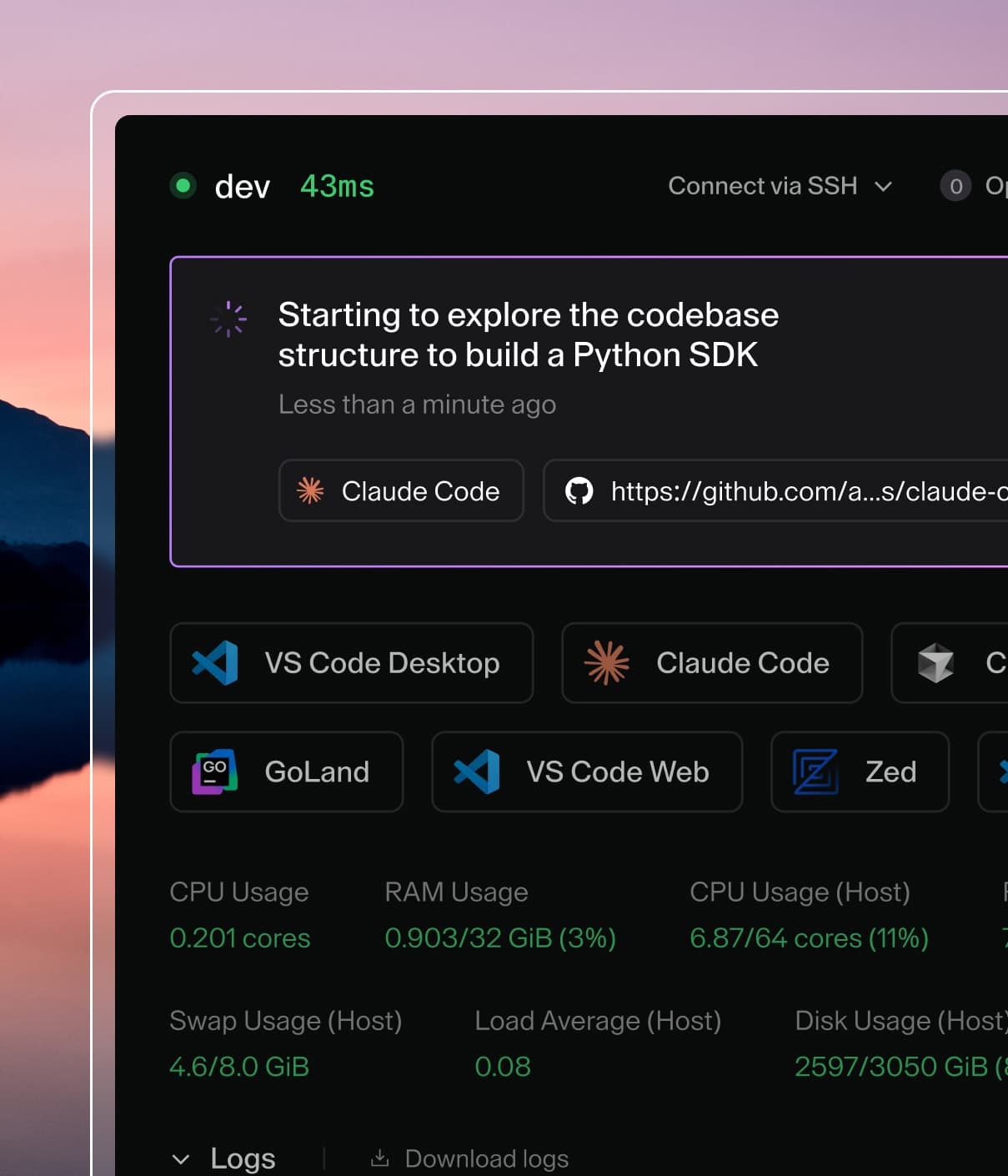
What it provides are pre-configured, isolated workspaces that give developers and AI agents instant access to the code, tools, data, and services they need for a given project. Each workspace is built from a fixed template, so every dependency, configuration, and piece of context is locked in before anyone opens it.
No environment drift. No setup delays. No "well, it works on my machine" problems.
For example, PsiQuantum’s new developers used to spend an entire week hunting down library versions and configuring repositories before writing a single line of code. After deploying Coder on their own AWS infrastructure, that onboarding process dropped to minutes — and their security team approved it through their standard process, with no special vendor audits required.
Migrate, Modernize, Multiply: Govern & Scale AI with Coder
What does this look like in practice? Most organizations start with three things:
- Faster onboarding: New developers and agents get productive in minutes, not days, because setup friction is eliminated before they ever log in.
- Securing development environments: Source code moves off individual laptops into centrally controlled infrastructure, removing the risk of code or data leaving the organization.
- Cleaning up tool sprawl: Twenty years of accumulated developer tools and access controls get rationalized into a governed, standardized stack.
Beyond these initial three use cases, organizations choose their own path: deploying agents at scale with full auditability, optimizing build-and-test cycles through better compute utilization, or replacing expensive virtual desktop infrastructure with modern container-based environments — a shift that can cut tens of millions in annual infrastructure costs.
This shift tends to follow a pattern we call Migrate, Modernize, Multiply. The migrate phase is moving development off laptops and into governed workspaces. From there, organizations modernize by layering in AI-assisted tools like Cursor and Copilot inside those workspaces, as we like to say, because guardrails need to exist before AI adoption takes off, not after. The most mature customers then multiply, deploying autonomous agents in governed workflows that amplify what their teams can ship.
Coder makes this all governable with a set of standards enforced across every workspace: consistent packaging of tools, dependencies, and source code so projects start fully assembled; a single control layer for placing workspaces across your infrastructure based on cost or technical needs; standardized workflows for humans and agents that let you swap AI models without breaking processes; and enforced policies, access controls, and a full audit trail of who did what, when, and why.
This is why even a CISO at a major financial institution can approve AI-assisted development through Coder: every workspace is auditable, every policy is enforced automatically, and every action has a paper trail.
Where the ROI shows up
Measuring returns on AI implementation is still a challenge for most organizations, with only 29% of executives confidently measuring ROI — even as 79% report seeing productivity gains. The gap between "we see value" and "we can prove value" usually comes down to governance, cost visibility, and whether AI tools are actually integrated into workflows or just bolted on top of them.
Across Coder's customer base, returns show up in time savings (faster onboarding, quicker shipping cycles), AI outcome quality (workspaces pre-loaded with organizational context so agents produce better work), and revenue impact (recovered time and money reinvested into core products). One area worth watching closely is token usage — as agents become embedded in workflows, consumption becomes a real line item. Unchecked agents burn through tokens on low-value tasks, and low developer adoption means you're paying for infrastructure nobody uses. Coder's workspace-level observability catches both.
But the area reshaping how enterprises think about AI development infrastructure is risk reduction. The ability to enforce security policies and reduce breach exposure has become so valuable that many Coder deployments now begin in the CISO's office. Remember the CISO who couldn't say yes? Coder gives them the governance, the audit trail, and the policy enforcement to finally move forward — and it's that governance value that unlocks everything else.
Control without compromise
Coder works because it strikes the balance most platforms miss: structured enough to give leadership a clear path forward, while being flexible enough to plug into whatever tools and processes are already in place. It runs on any operating system, on-prem or cloud. It's been tested with tens of thousands of developers and hundreds of thousands of agents on a single deployment. And a growing partner ecosystem means organizations can surround the platform with implementation services from firms they already trust.
To dig deeper and get a look at ROI benchmarks and real customer examples, watch our latest webinar on how to deploy AI agents without losing control.