I’m not seeing traditional venture rounds. As I talk to fellow CEOs, they report the same phenomenon: Customers coming off the investor sidelines and deploying their own capital into companies critical to their AI strategies. Why is that?
Vision and conviction.
Both worth more than any term sheet.
It’s why I’m proud to announce that Coder closed our $90 million Series C, led by one of our largest customers: KKR. Another large customer, QRT, participated. Uncork Capital (with us every round since the Seed!) and other existing investors rounded things out.
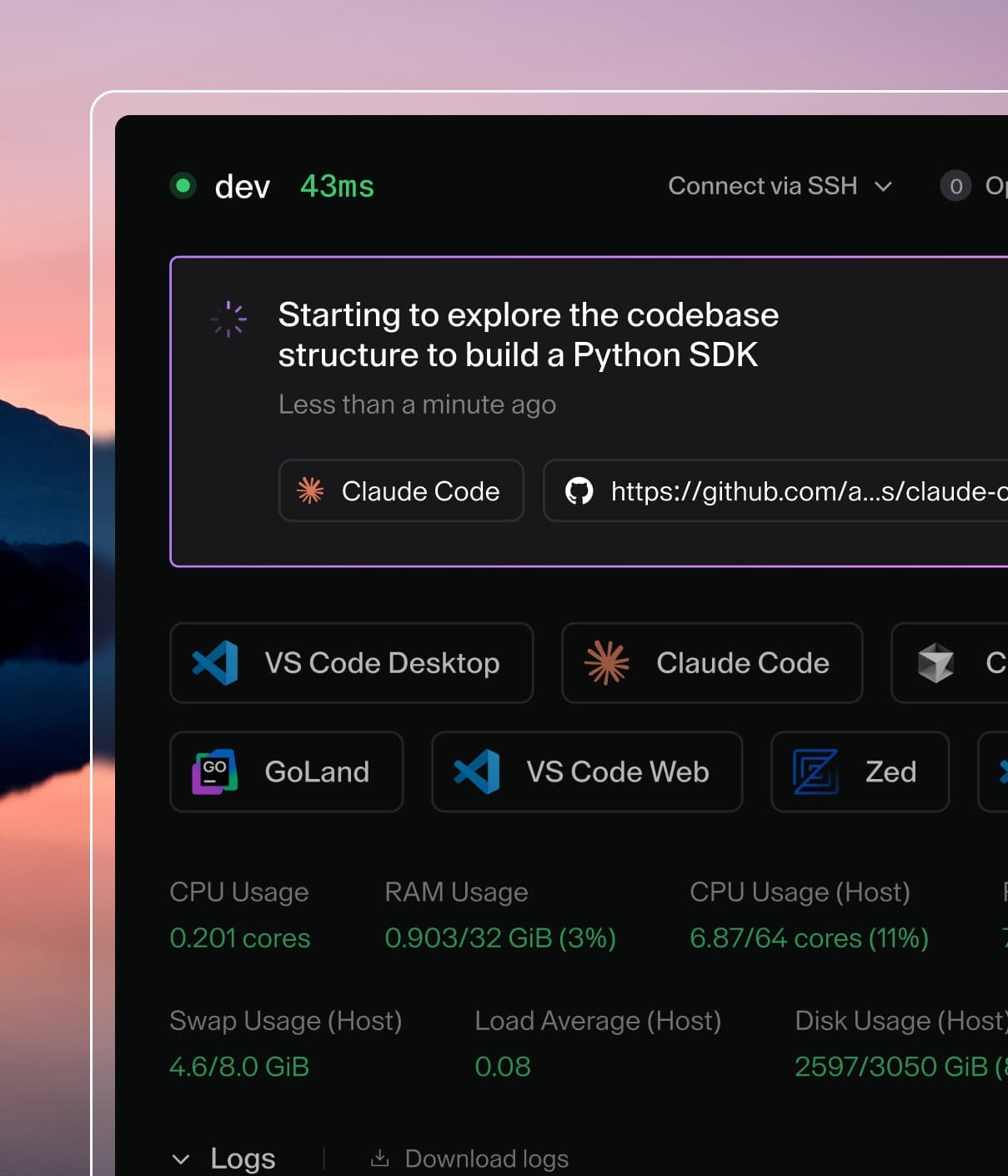
Sure, investors pitched me at tradeshows. I got the usual flurry of emails, calls, and LinkedIn messages. But KKR was different. Their CIO (that’s Chief Information Officer, not Investment) referred us to their Growth Equity team. Not because he'd heard good things. Because he’d seen our value firsthand. Coder runs across his engineering org, used by more than 500 engineers. And now they want to deploy coding agents to thousands of employees — analysts, developers, operators, and more.
The vision is to make AI agents accessible to all employees. The conviction is to do it with Coder.
The market signal investors are missing
Most venture capital firms I speak to chase the fastest-growing AI applications — companies compounding every quarter with ridiculous MRR growth. In my world, these vendors follow a similar pattern: Direct-to-developer SaaS with built-in generative AI (assistance or agents). The PLG dream! They’re rational bets in a moment like this. But it creates a selection bias: The VCs most excited about AI apps are often least interested in the infrastructure underneath them. Infrastructure doesn't 10x in a year. It compounds over decades.
The interesting signal in enterprise AI right now isn't coming from IDEs or vibe coding tools. It's coming from the engineering organizations actually deploying it — the ones asking not "which AI tool is hottest" but "what breaks in our compliance posture if we let agents run freely." Those are the companies stress-testing infrastructure. Those are our customers.
Coder is experiencing tremendous growth. Our bookings are up 300% from this time last year – and that’s in durable, self-hosted enterprise deployments. But one stat caught the eye of our new customer-investors: 184% net dollar retention (trailing 12 months). Coder customers aren't just deploying, they're expanding. The product becomes embedded, powering developer workflows while silently scaling and transparently governing. And this only accelerates in the AI-native era. Data sovereignty, control, and repatriation are the new norm.
Our customers saw that story before most investors. So when KKR and QRT offered to participate in the round, the answer was straightforward. They were looking at their own engineering organizations and asking: what breaks if this goes away? That's a more durable question — and a more durable answer. It’s mutually assured success.
What enterprise AI development actually requires
KKR has thousands of developers and tens of thousands of employees who want to use AI tools. Before Coder, their engineering organization was fragmented — every developer with a different setup, a different environment, a different configuration. It’s difficult to collaborate and manage when humans are the only ones writing code. The moment you introduce AI coding agents, it stops being manageable and starts being a liability. It spirals when you look to do so beyond the four walls of engineering.
KKR's VP of AI, Cloud and Data put it simply: "Coder is the safe mode for AI." If you want to run Claude Code, Cursor, or any autonomous coding agent inside a large enterprise, you need:
- Persistent, reproducible environments.
- Carefully curated tools, skills, and repositories.
- Audit trails, token tracking, and prompt observability.
- Isolation from internet, search, and production systems.
- Boundaries around what they can access and what they can do.
- Agent-level identities, privileges, read/write access, and permissions.
None of that exists on a developer's laptop. None of it exists in a lightweight agent sandbox built for simple file reads and writes.
QRT arrived at the same conclusion from a different angle. Quantitative trading operates under strict regulatory requirements in financial services. Moving fast and breaking things isn't an option for them. Moving fast with guardrails is. Coder gave them both: the speed to deploy AI workflows quickly, and the control to do it inside their own infrastructure. QRT keeps its trading analysts just as agile and safe as software engineers, using the same tools.
Both KKR and QRT are democratizing coding. Wild times we live in!
The definition of "developer" changes
Developers are people, right? Specifically, software engineers. Nope, not any more. Low- and no-code technology brought us citizen developers. AI expands that definition further. The new definition of a developer is any builder with an idea. It could be a person, an autonomous agent, or a human-agent pair collaborating.This is what we see in KKR and QRT, and it will soon become commonplace across all enterprises.
Software engineers call the process and tools for coding the “inner loop”. You can (usually) trust these engineers to configure and run this inner loop on their laptops, but it’s a huge productivity drain. That’s why Coder exists. You cannot trust citizen developers, vibe coders, and agents. They simply don’t have the knowledge and skillset.
The inner loop has to move off local machines and into governed workspaces. Not because the cloud is inherently better, but because non-engineers and agents can't run on laptops. Not successfully. They need the automation, performance, and governance of the cloud. And more importantly, they just need it to work. Asking every user to configure their own agentic environment is a recipe for failure at best and breaches at worst.
This is where Coder has built for years. We started as a developer productivity platform, giving engineering teams fast, consistent, self-hosted workspaces that run on any infrastructure, any cloud, any air-gapped environment. It’s exactly the right foundation for agentic development at scale. The same properties that make Coder great for people — reproducibility, governance, flexibility, self-hosting — are the properties that make it the right infrastructure layer for autonomous coding agents.
KKR calculated the total addressable market for this new layer and for this new audience. It’s 10 times what we'd modeled internally. When you understand that every enterprise will deploy AI coding agents to every employee, that math makes sense.
A heartfelt “thank you”
I sincerely appreciate every Coder employee – past and present – who got us here. Every customer, community member, and partner played a role. It’s all needed to support complex developer infrastructure in the biggest, gnarliest environments on the planet.
But when you raise a round, there is one population in your village that stands out. I want to thank Coder’s existing investors: Uncork Capital, Notable Capital, Redpoint Ventures, and Georgian Partners. They’ve shared our vision and conviction from the beginning. Adding KKR and QRT to the village only makes us stronger.
What comes next
Traditional VC firms will catch on. They will underwrite an entire cycle of AI development infrastructure rounds.
Until then, this round ensures our customers are ahead of that curve. It helps them build the next infrastructure stack that defines decades of competitive advantage.
AI development infrastructure defines the future of how software is built. We're grateful to KKR, QRT, and Uncork for sharing our vision and conviction.
Now it’s your turn. Join us.