2025 was the year of the AI agent. Claude Code, Codex, Gemini, and a wave of autonomous coding tools changed how software gets built. 2026 is the year teams find out whether all that speed is actually making them better.
At Coder, where we build self-hosted cloud development environments for humans and AI agents, the pattern across our customers is consistent - the teams that succeed with AI aren't generating the most code. They're redesigning their processes to handle what comes after.
Solve customer pain, not interests
AI has made it so that prototyping takes three hours instead of three weeks, and now more ideas look plausible. I often spin up a working demo, and am trying to show it to a customer as soon as possible. Because the cost of trying has dropped so dramatically, the question is shifting from “can we build this?" to "should we build this?" It was always important to answer the latter. It’s even more important now that the cost of trying is so dramatically lower.
A meta-analysis across 23 studies found that GenAI assisted programmers were 0.33 standard deviations better than the non-assisted group; a statistically significant effect, but not transformative resulting in 10x productivity. Developer productivity was found to be impacted the least in enterprise and open-source settings, scenarios that are real-world and what you and I actually work in.
My take here is that AI can and will help programmers. But assuming that “engineer + AI = more $$” is a fallacy. AI use, or common measures of it like token consumption, don’t automatically mean that you’re solving the right problems. Rather, that code was created and activity happened. You aren’t measuring real outcomes, and businesses live or die by solving customer pain and creating value.
Good planning in the AI development era demands clear problem statements, fast validation loops with real customers, and the discipline to distinguish between interesting problems and important ones.
Context must become infrastructure
Before AI, context moved between people through meetings, Slack threads, and institutional memory. An engineer knew how the team handles database outages because they'd been through three of them, having caused one of them. AI agents don’t start with that context or experience. Every new session starts from zero.
Most engineers know to start with `AGENTS.md` file. They start to add on top of their harness with plugins, skills, and hooks. They need to remember the tribal knowledge they’ve accumulated, and how to provide it to the agent. All the team decisions and “how we work” documents need to be provided to the agent. This context is important so that any coding agent can function as a member of your team, like an extension of you, rather than a new intern you need to teach every session.
You can think of this in context of the environment the agent will work in. Agents need to be provided the access to your applications, context, and controls that engineers have. But we’ve found that many organizations aren’t giving agents that necessary starting point. When Coder surveyed 100 engineering teams on AI maturity, we found that 70% of agents are running in infrastructure that was never designed to support them. When agents don’t have the same environments that human engineers have, they’ll produce subpar results.
AI accelerates implementation, but doesn't remove responsibility
Engineers are shifting from writing code to collaborating with agents. That changes how work gets done. It doesn't change who owns the outcome.
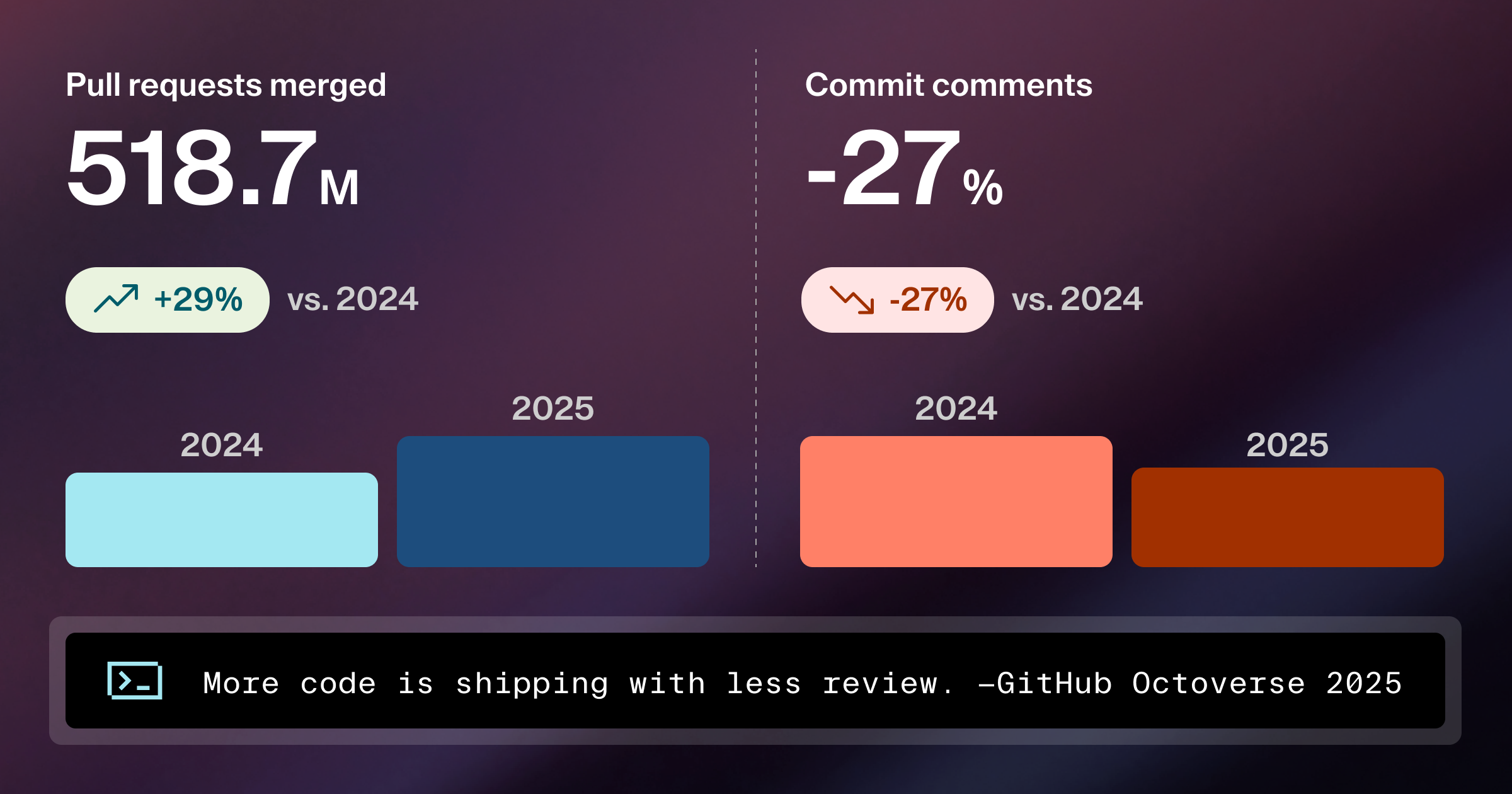
GitHub's Octoverse report shows developers merged a record 518.7 million pull requests in 2025, a 29% increase from 2024. At the same time, comments on commits dropped 27%. On the surface, it looks like more code is shipping with less review occurring.
This is something we’ve seen internally here at Coder. Since our team started using AI to write code, we’ve seen a dramatic increase in the number of PRs ready for review, engineers are spending more and more time reviewing code. We now use AI to perform first pass reviews on PRs, so that engineering time is spent on the more tedious and detail-oriented parts of code review. We also encourage follow-through and ownership of PRs. With non-engineers creating PRs, we actively encourage and remind them to take that PR to merge or close.
This is why process actually matters. Before AI, the code review process was optimized for human rates of development, and came with a set of assumptions about who wrote the code, how it was tested, and why it was made. That assumption is breaking. Engineers need to provide context on what the agent was asked to do and which parts require deeper human review, and if the change is even needed.
Remember that most people aren’t power users
AI adoption is uneven. Every organization has fast adopters, AI-skeptics, and roles where AI doesn't cleanly map to their work.
If you design your processes for AI power users at the forefront, you’ll accidentally optimize only for them and leave the rest of your team behind. The systems you build, the agent context files, the review processes, the contribution paths, need to work for someone on their second week with the tool, not just someone on their hundredth. Retrospectives should evaluate which AI workflows improve quality across the team, and not measure individual proficiency. The goal is to pull the entire organization forward.
Where all of this is heading
The teams getting this right recognize that responsible and successful AI use means rethinking your processes for how AI changes the flow of work. AI means development can occur faster. But that doesn’t mean the development process will cleanly scale with that speed.
Teams need to treat context as infrastructure, and not purely as reference documentation. If they do, they'll build review processes that scale with volume and create clear paths for non-engineers to contribute without shifting the burden to unprepared teams.
Development speed has become an assumption. Strategy and intention will make you ship better, not just more.
This post is adapted from Coder's webinar, "When AI Succeeds: Emerging Problems Teams Will Face," presented by David Fraley. Take the AI Maturity Self-Assessment to benchmark where your organization stands, or explore Coder's AI development infrastructure to see how enterprises build governed environments for humans and AI agents.