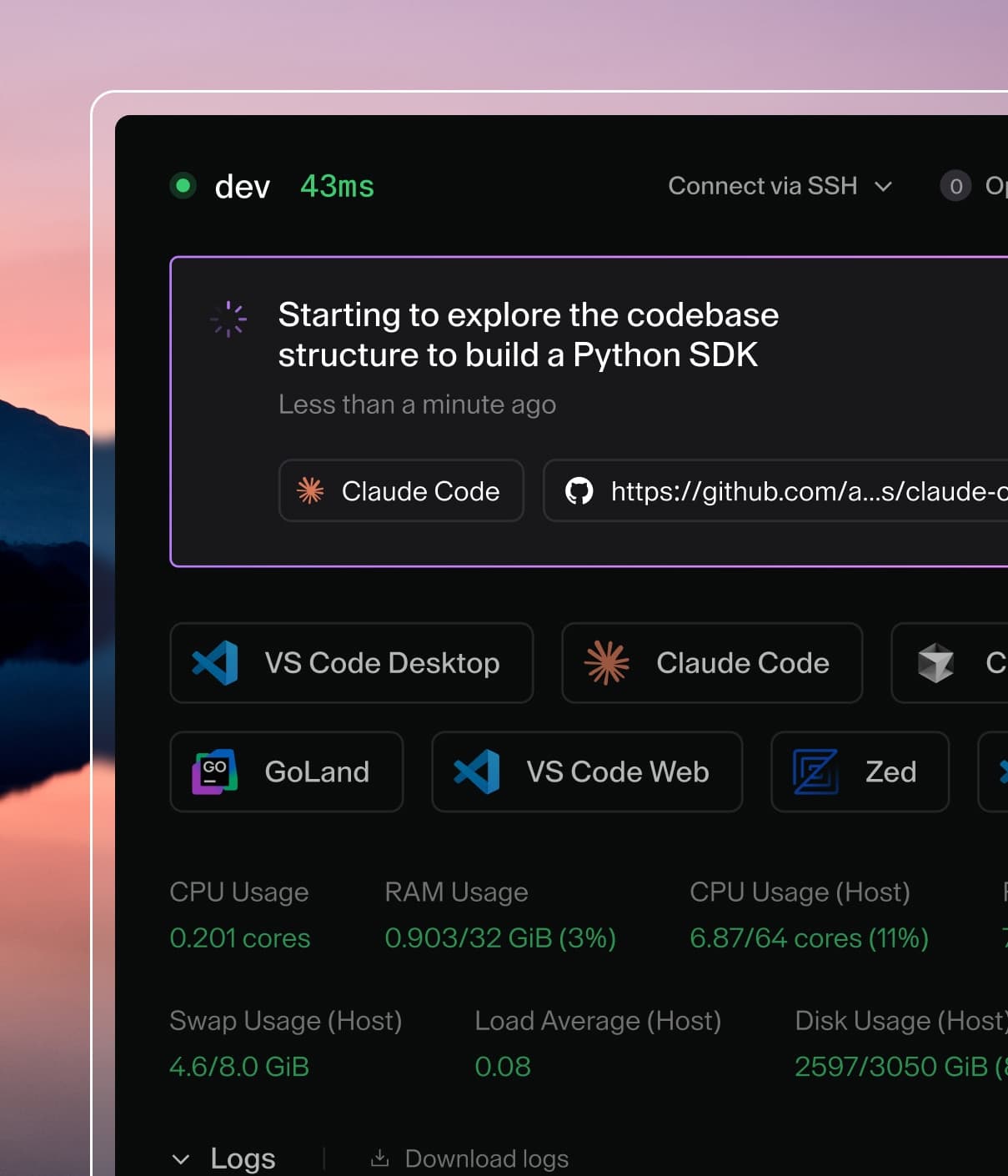
Coder powers secure, scalable development across key industries — automotive, finance, government, and technology — enabling faster builds, tighter compliance, and seamless AI adoption in enterprise-grade cloud environments.
You can preview what occurs during the install process:
curl -fsSL https://code-server.dev/install.sh | sh -s -- --dry-run
To install, run:
curl -fsSL https://code-server.dev/install.sh | sh
You can modify the installation process by including one or more of the
following flags:
--dry-run: echo the commands for the install process without running them.
--method: choose the installation method.
--method=detect: detect the package manager but fallback to
--method=standalone.
--method=standalone: install a standalone release archive into ~/.local.
--prefix=/usr/local: install a standalone release archive system-wide.
--version=X.X.X: install version X.X.X instead of latest version.
--help: see usage docs.
--edge: install the latest edge version (i.e. pre-release)
When done, the install script prints out instructions for running and starting
code-server.
If you're concerned about the install script's use of curl | sh and the
security implications, please see this blog
post
by sandstorm.io.
If you prefer to install code-server manually, despite the detection
references and --dry-run feature, then continue on for
information on how to do this. The install.sh script runs the
exact same commands presented in the rest of this document.
Detection reference
For Debian and Ubuntu, code-server will install the latest deb package.
For Fedora, CentOS, RHEL and openSUSE, code-server will install the latest RPM
package.
For Arch Linux, code-server will install the AUR package.
For any unrecognized Linux operating system, code-server will install the
latest standalone release into ~/.local.
Ensure that you add ~/.local/bin to your $PATH to run code-server.
For macOS, code-server will install the Homebrew package (if you don't have
Homebrew installed, code-server will install the latest standalone release
into ~/.local).
Ensure that you add ~/.local/bin to your $PATH to run code-server.
For FreeBSD, code-server will install the npm package with npm
If you're installing code-server onto architecture with no releases,
code-server will install the npm package with npm
We currently offer releases for amd64 and arm64.
The npm package builds the native modules on post-install.
npm
We recommend installing with npm when:
You aren't using a machine with amd64 or arm64.
You're on Linux with glibc < v2.28 or glibcxx < v3.4.21.
You're running Alpine Linux or are using a non-glibc libc. See
#1430
for more information.
Installing code-server with npm builds native modules on install.
This process requires C dependencies; see our guide on installing with npm for more information.
Standalone releases
We publish self-contained .tar.gz archives for every release on
GitHub. The archives bundle the
node binary and node modules.
We create the standalone releases using the npm package, and we
then create the remaining releases using the standalone version.
The only requirement to use the standalone release is glibc >= 2.28 and
glibcxx >= v3.4.21 on Linux (for macOS, there is no minimum system
requirement).
To use a standalone release:
Download the latest release archive for your system from
GitHub.
Unpack the release.
Run code-server by executing ./bin/code-server.
You can add ./bin/code-server to your $PATH so that you can execute
code-server without providing full path each time.
Here is a sample script for installing and using a standalone code-server
release on Linux:
mkdir -p ~/.local/lib ~/.local/bin
curl -fL https://github.com/coder/code-server/releases/download/v$VERSION/code-server-$VERSION-linux-amd64.tar.gz \
  | tar -C ~/.local/lib -xz
mv ~/.local/lib/code-server-$VERSION-linux-amd64 ~/.local/lib/code-server-$VERSION
ln -s ~/.local/lib/code-server-$VERSION/bin/code-server ~/.local/bin/code-server
PATH="~/.local/bin:$PATH"
code-server
# Now visit http://127.0.0.1:8080. Your password is in ~/.config/code-server/config.yaml
Debian, Ubuntu
The standalone arm64 .deb does not support Ubuntu 16.04 or earlier. Please
upgrade or build with npm.
curl -fOL https://github.com/coder/code-server/releases/download/v$VERSION/code-server_${VERSION}_amd64.deb
sudo dpkg -i code-server_${VERSION}_amd64.deb
sudo systemctl enable --now code-server@$USER
# Now visit http://127.0.0.1:8080. Your password is in ~/.config/code-server/config.yaml
Fedora, CentOS, RHEL, SUSE
The standalone arm64 .rpm does not support CentOS 7. Please upgrade or build
with npm.
curl -fOL https://github.com/coder/code-server/releases/download/v$VERSION/code-server-$VERSION-amd64.rpm
sudo rpm -i code-server-$VERSION-amd64.rpm
sudo systemctl enable --now code-server@$USER
# Now visit http://127.0.0.1:8080. Your password is in ~/.config/code-server/config.yaml
Arch Linux
# Install code-server from the AUR using yay.
yay -S code-server
sudo systemctl enable --now code-server@$USER
# Now visit http://127.0.0.1:8080. Your password is in ~/.config/code-server/config.yaml
# Install code-server from the AUR with plain makepkg.
git clone https://aur.archlinux.org/code-server.git
cd code-server
makepkg -si
sudo systemctl enable --now code-server@$USER
# Now visit http://127.0.0.1:8080. Your password is in ~/.config/code-server/config.yaml
Artix Linux
# Install code-server from the AUR
git clone https://aur.archlinux.org/code-server.git
cd code-server
makepkg -si
Save the file as code-server in /etc/init.d/ and make it executable with chmod +x code-server. Put your username in line 3.
#!/sbin/openrc-run
name=$RC_SVCNAME
description="$name - VS Code on a remote server"
user="" # your username here
homedir="/home/$user"
command="$(which code-server)"
# Just because you can do this does not mean you should. Use ~/.config/code-server/config.yaml instead
#command_args="--extensions-dir $homedir/.local/share/$name/extensions --user-data-dir $homedir/.local/share/$name --disable-telemetry"
command_user="$user:$user"
pidfile="/run/$name/$name.pid"
command_background="yes"
extra_commands="report"

depend() {
  use logger dns
  need net
}

start_pre() {
  checkpath --directory --owner $command_user --mode 0755 /run/$name /var/log/$name
}

start() {
  default_start
  report
}

stop() {
  default_stop
}

status() {
  default_status
  report
}

report() {
  # Report to the user
  einfo "Reading configuration from ~/.config/code-server/config.yaml"
}
Start on boot with default runlevel
rc-update add code-server default
Start the service immediately
rc-service code-server start
macOS
brew install code-server
brew services start code-server
# Now visit http://127.0.0.1:8080. Your password is in ~/.config/code-server/config.yaml
Docker
# This will start a code-server container and expose it at http://127.0.0.1:8080.
# It will also mount your current directory into the container as `/home/coder/project`
# and forward your UID/GID so that all file system operations occur as your user outside
# the container.
#
# Your $HOME/.config is mounted at $HOME/.config within the container to ensure you can
# easily access/modify your code-server config in $HOME/.config/code-server/config.json
# outside the container.
mkdir -p ~/.config
docker run -it --name code-server -p 127.0.0.1:8080:8080 \
  -v "$HOME/.local:/home/coder/.local" \
  -v "$HOME/.config:/home/coder/.config" \
  -v "$PWD:/home/coder/project" \
  -u "$(id -u):$(id -g)" \
  -e "DOCKER_USER=$USER" \
  codercom/code-server:latest