Company Overview
Deka is the securities house of the Sparkasse savings bank network, one of Germany's most widely used retail banking systems. Managing around five million custodian accounts for both institutional and retail clients, Deka operates as a wholly-owned subsidiary of Sparkasse under German public law. The institution employs approximately 5,500 people, including roughly 700 in IT and more than 500 external consultants. As one of a few systemically critical banks in Germany, Deka is regulated not just under EU frameworks like the Digital Operational Resilience Act (DORA) but directly by the European Central Bank.
Robin, Cloud Competence Architect and author of the Deka Group cloud strategy, led the initiative to transform developer infrastructure. Stefan, Platform Architect for Deka's strategic Finance Cloud Native (FCN) platform, designed and delivered the technical implementation. Together with the team at FITS, they operate a Kubernetes cluster running entirely on-premises across multiple data centres in Germany. The scale of Deka's development ambitions brought the inadequacy of the existing approach into sharp focus: the organisation is currently re-platforming its core banking custody account system from mainframe to cloud-native, with around 200 developers working on that project alone.
The Challenge
Deka's developer infrastructure problem had an image that Robin used to explain it to the board: an overloaded truck, piled impossibly high with cargo, trying to navigate a busy road. That truck was the corporate laptop. Well-specified for office work, it buckled under the weight of software development.
The root cause was structural. Deka issues standard client devices hardened to corporate security policy. Antivirus scanners, enterprise proxies, and certificate chains created an environment where even powerful hardware delivered poor effective performance. Anyone who has worked in a large corporate environment knows the experience: an IDE opens in the morning, the antivirus scanner starts indexing thousands of files, and everything slows to a crawl. The consequence at Deka was a steady accumulation of different hardware types as teams tried to outrun the problem with better specs. The organisation ended up supporting several dozen distinct laptop and workstation configurations, each with its own maintenance overhead.
Onboarding was the most visible cost. Getting a new developer productive, with the right tools, repository access, dependency configurations, and proxy workarounds in place, typically took two to three weeks. For a project with 200 developers, and for an organisation that needed to move developers flexibly between projects, that delay was a serious drag on delivery. Switching teams did not just mean a people change; it meant another full onboarding cycle for a new toolchain. Deployment was equally painful: releases on the legacy pipeline routinely took several hours, and developers spent significant time waiting for builds and deployments that should have been instant. The time lost to these infrastructure frictions was not incidental. It was built into the rhythm of every project.
I told the board: imagine our software development process is a road from Mainz to Berlin. The developer is the driver. Every time we have to stop to repair something because a package has fallen off, our time-to-market shifts.
Robin, Cloud Competence Architect, DekaBank
The Solution
Robin's vision was straightforward: replace the overloaded truck with a professionally managed fleet. Standardised containers, ordered on demand, with IT operating as the motorway and fleet manager rather than asking every developer to also be a mechanic.
The team selected Coder as the platform for cloud development environments and deployed it on the FCN, Deka's strategic on-premises Kubernetes cluster running across multiple data centres in Germany. The choice to keep everything on-premises was not incidental: as an ECB-regulated, systemically critical institution, Deka's security and data governance requirements made self-hosted infrastructure the only viable path. The Coder deployment gave the security team confidence from the start because it operated entirely within Deka's existing network perimeter.
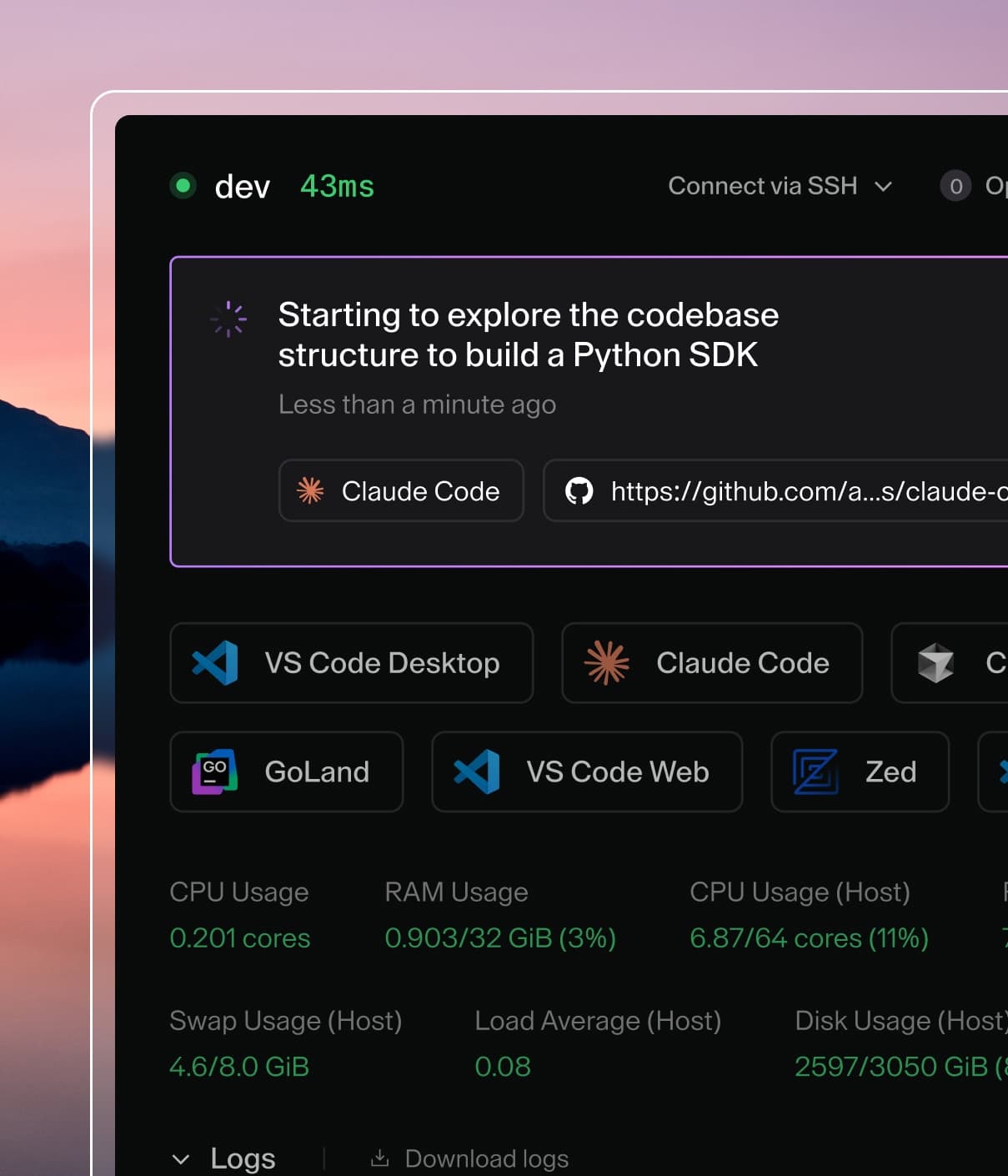
Workspaces are provisioned from templates built on a strongly parameterised Terraform configuration. Deka maintains a standard base image covering Java, Python, and JavaScript, with end-of-life dates tracked and managed centrally. Individual projects can extend that base image with their own tooling. Developers connect either through a web-based IDE or through VS Code and IntelliJ IDEA running locally, with the actual compute, storage, and dependency resolution happening in the cluster. Port forwarding is handled automatically, so frontend developers can view running applications in their local browser without manual configuration. GitLab integration is built in, with SSH keys provisioned by Coder so developers can check out repositories without any setup steps.
The go-live landed a quarter ahead of the committed board date, on 1 April. Within one month, 100 users had onboarded. The Coder deployment was accompanied by a parallel transformation of the CI/CD pipeline: Argo CD replaced the legacy deployment tooling for Kubernetes workloads, shifting from a push-based imperative model to a declarative, GitOps-driven approach that automatically detects and synchronises changes. For regulated production releases, manual approval and a formal change record remain in place, but on development environments the full cycle from code push to deployed change now completes in a matter of minutes.
I forgot for the last few hours that I wasn't working on my personal laptop. Everything just works.
Developer at DekaBank, on first using Coder
The Results
The impact of the Coder deployment was measured formally, with Deka engaging a consulting firm to quantify outcomes against the baseline from its large strategic project. The results validated the investment across every dimension the team had targeted.
Onboarding and developer velocity
Onboarding time fell to under 15% of what it had been. That does not mean it is instant: some permission workflows and access requests still require human steps. But the goal the team set was for a new developer to write and deploy code on the same day they join the organisation, and that goal is now met. The build process that previously took six to seven minutes on local machines running Windows Subsystem for Linux now completes in under a minute inside a Coder workspace.
Waiting time and deployment speed
Technically-caused waiting time across the project, including time spent waiting for deployments, dependency resolution, and environment issues, fell by 60%. Deployments that previously required several hours on the legacy system now complete in a few minutes. Argo CD detects changes automatically and synchronises them without manual intervention, removing one of the most consistent sources of friction in the development cycle.
Security and compliance
Deka's security architecture for Coder workspaces keeps development entirely within a dedicated network segment on the FCN. Developers access their workspaces via HTTPS into that segment; dependencies can only be fetched through JFrog Artifactory, whether proxied from the internet or sourced from internal packages and containers. This architecture meant the Information Security Management team could approve the deployment through standard processes without special audits. The laptop becomes a thin client: hardening software and antivirus scanners no longer touch build processes, because those run in the cluster. Sensitive code never leaves the controlled environment.
GPU workloads and data science
One capability that opened up through the Coder platform was GPU access for machine learning workloads. Deka trains its own LLMs on market data nightly, and timing matters: models that are not finished before the stock exchange opens have no value for that day's fund management decisions. H100 GPUs are now connected through the FCN and accessible from Coder workspaces, with network segmentation enabling access to production data from within a development workspace after a permission approval that takes minutes rather than days.
Looking Ahead
With the Coder foundation in place, Deka is now preparing to bring AI coding agents into the same governed environment. The initiative, internally named Gandalf, will pilot Claude Code via AWS Bedrock with a single well-established development team that has more than two years of tracked velocity data. The twelve-week pilot begins with a careful measurement framework: story points per FTE, token costs per additional story point, and quality metrics tracked in parallel. The board has already approved scaling Claude Code to the entire organisation after the pilot, contingent on the results.
The security architecture makes this possible. Coder's AI Governance gateway (previously called AI Bridge) provides an LLM proxy layer within the platform, giving Deka visibility into what the agent is doing, what API calls it is making, and how many tokens it is consuming, with guardrail controls available. Because the agent runs inside the same network-segmented Coder workspace, the risk of data exfiltration is contained by the same perimeter that governs all development activity. Information Security Management is on board. AWS Bedrock was selected in part because Anthropic's Claude infrastructure runs in Frankfurt, giving Deka the European data residency assurance it requires as an ECB-regulated institution.
Conclusion
For DekaBank, the shift to Coder was not just an infrastructure upgrade. It was a redefinition of the relationship between developers and the platforms they depend on. By removing the burden of environment management from individual engineers and placing it in the hands of a professional platform team, Deka freed its developers to focus on delivery rather than maintenance. The results, a 60% reduction in waiting time, same-day onboarding, and deployment cycles measured in minutes rather than hours, reflect what becomes possible when the infrastructure stops being an obstacle. With AI coding agents next in line to run on the same platform, Deka is building not just for today's development needs but for the ones that are coming.