Financial services stands at an inflection point. For decades, the industry has operated under a simple assumption: developers write code on their laptops, push it to repositories, and let pipelines handle the rest. Security teams built controls around this model. Compliance teams audited it. The entire regulatory apparatus assumed humans were the ones writing software.
That assumption is breaking down.
AI coding assistants like GitHub Copilot and Cursor have already changed how developers work. The next wave, autonomous AI agents that can execute multi-step workflows without human intervention, will change everything else. Gartner predicts that 15% of day-to-day work decisions will be made autonomously through agentic AI by 2028, up from effectively zero in 2024. For financial services, where a single compliance failure can trigger nine-figure fines, this transition demands more than new tools. It demands new infrastructure.
The governance gap
The challenge facing FinServ institutions today extends beyond adopting AI. The real problem is adopting AI in a way that satisfies regulators, protects sensitive data, and scales across thousands of developers and agents.
Traditional approaches are failing. When developers and AI agents run on local laptops, audit trails become fragmented. API keys proliferate across teams. Shadow AI experiments pop up faster than security teams can track them. Stanford HAI's 2025 AI Index documented a persistent gap between organizations recognizing responsible AI risks and actually mitigating them. In regulated industries, that gap becomes liability.
Gartner's prediction that over 40% of agentic AI projects will be canceled by 2027 reflects this reality. The failures won't come from bad models or insufficient compute. They'll come from inadequate risk controls, escalating costs without clear ROI, and governance structures that were never designed for autonomous agents.
At one global financial technology company with over 15,000 engineers, platform engineering leadership identified these pain points early. The goal was clear: allow new developers to commit code on day one instead of day 15 or 30. That kind of onboarding friction compounds when you add AI agents to the mix. If human developers struggle with environment setup, secret management, and access controls, autonomous agents operating at machine speed will expose every weakness in the system.
The evolution toward agent-ready infrastructure
The institutions solving this problem have recognized a fundamental shift in how software gets built. The inner loop of development, that rapid cycle of writing, testing, and iterating on code, can no longer live on local machines. It needs to move to governed cloud environments where both humans and agents operate under the same controls.
This evolution has three phases.
The first phase centered on cloud development environments for humans. Organizations moved developers off laptops and into standardized, pre-configured workspaces. This solved environment drift, accelerated onboarding, and gave platform teams visibility into how development resources were being used. Coder has led this category for years, trusted by enterprises that need secure, self-hosted infrastructure they fully control.
The second phase, happening now, extends those environments to support AI assistants. Developers using Copilot, Cursor, or Claude need access to the same governed infrastructure. Models need authentication. Prompts need logging. Costs need tracking. Put simply: every Cursor needs a Coder.
At a major investment bank, this challenge drove their adoption of Coder. Engineering teams needed a path of least resistance for centralizing model configuration as they rolled out AI coding tools across their organization. The specific pain points were familiar: slow feedback loops between analysts and traders, unreliable pipelines, environment inconsistencies. Coder gave them standardized environments where data scientists and analysts could use familiar tools like Jupyter Notebook while maintaining enterprise governance.
The third phase, emerging now, brings fully autonomous agents into production. These agents don't just assist developers. They execute tasks independently: fixing bugs, writing documentation, running test suites, responding to incidents. This phase demands capabilities that traditional development infrastructure was never designed to provide.
Building the governance layer
Autonomous agents require deterministic controls. An agent that can access your codebase, call external APIs, and execute commands needs boundaries that are enforced at the infrastructure level, not hoped for through careful prompting.
Coder's approach addresses this through three capabilities built specifically for the agentic era.
AI Bridge provides centralized governance for all model and agent access. Authentication flows through existing identity providers. Every prompt, every tool call, every model interaction gets logged and attributed. Cost visibility happens automatically. For compliance teams accustomed to auditing human actions, Bridge extends that auditability to AI.
Agent Boundaries enforces network isolation and access controls at the process level. Administrators define exactly which domains agents can reach, which tools they can invoke, which resources they can access. Everything else is blocked by default. When an agent encounters prompt injection or attempts to exfiltrate data, Boundaries stops it before damage occurs.
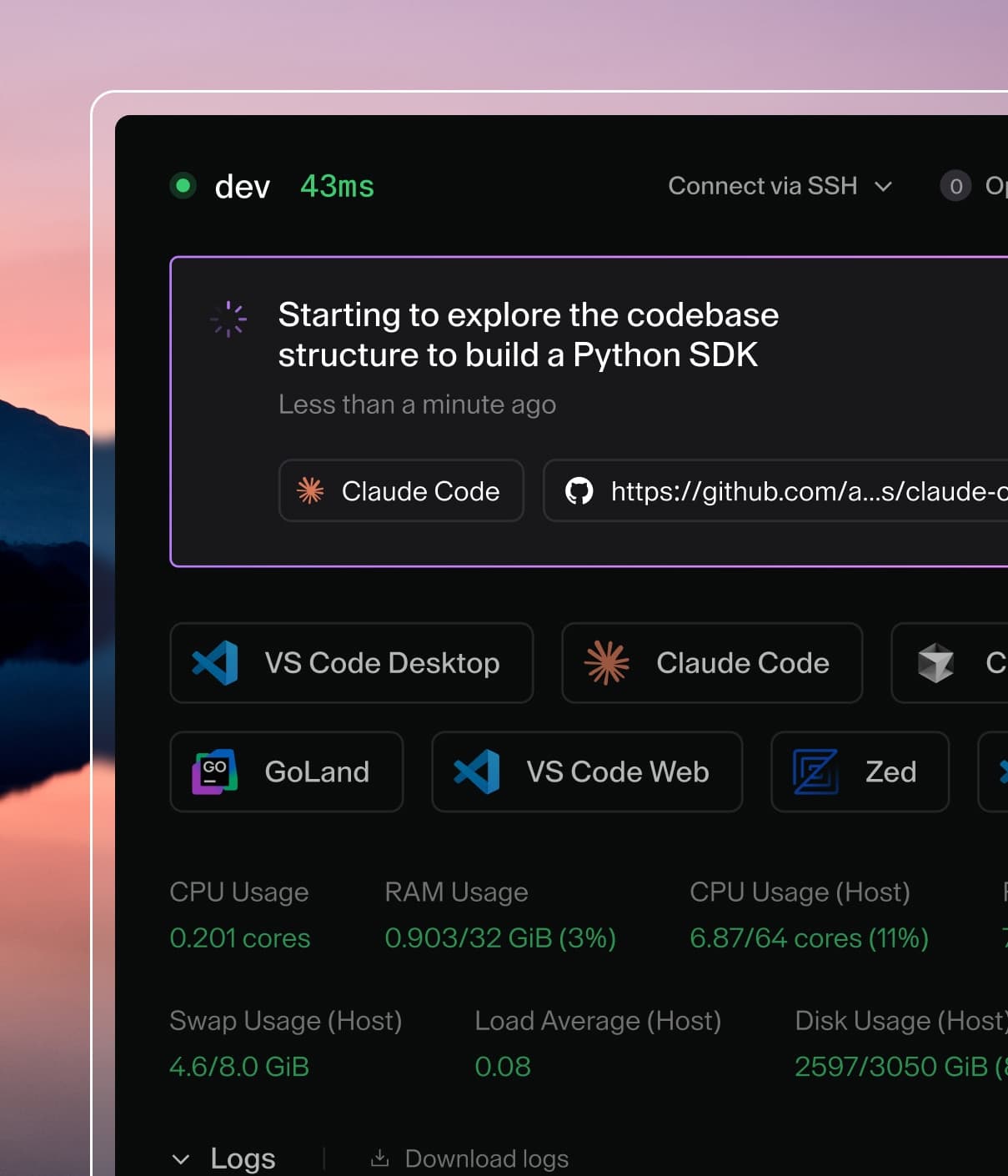
Coder Tasks enables long-running autonomous execution with full observability. Agents can work for hours on complex tasks, filing PRs, running test suites, iterating on solutions, while maintaining the governance controls that regulated industries require. Humans can inspect progress, intervene when needed, and review results before anything reaches production.
Read more about how Coder enables foundational infrastructure for AI development in our recent blog here.
What this looks like in practice
One global fintech's trajectory illustrates what committed AI infrastructure investment looks like at enterprise scale. Over the past twelve months, their Coder deployment doubled in active users. The organization made a multi-year strategic commitment that signals confidence in governed cloud development environments as foundational to their engineering future.
The partnership extends beyond expanded licensing. This institution joined Coder's design partnership program to co-develop four capabilities critical to their AI adoption strategy:
- AI Bridge will provide the compliance and governance observability their security teams require.
- Agent Boundaries will enforce network isolation for autonomous agents accessing sensitive financial data.
- Coder Tasks will enable background automation for build, test, and deployment workflows.
- A custom integration will bring their internal AI tools directly into governed workspaces.
Perhaps most striking is where this organization sees the next frontier: deploying Coder directly on mainframe infrastructure. By running workspaces on existing mainframe systems, they can leverage ultra-low compute costs to power build and test processes across both developers and agents. It's a reminder that AI development infrastructure isn't about forcing organizations onto new platforms. It's about meeting them where their critical systems already live.
A major investment bank's use case shows the second-phase evolution. Analysts ship new models directly to traders via shared ports in Coder. Removing fragile pipelines accelerates iteration and collaboration. The outcome: faster response to changing market conditions, with governance maintained throughout.
As these organizations move toward the third phase, the infrastructure they've built becomes the foundation for autonomous agent deployment. The same controls that govern human developers will govern AI agents. The same audit trails that satisfy regulators today will satisfy them tomorrow.
The path forward
The financial services industry has navigated technological transitions before. The move from trading floors to electronic markets. The shift from on-premises data centers to cloud infrastructure. Each transition required new governance frameworks, new compliance approaches, new ways of thinking about risk.
The transition to agentic AI development follows the same pattern. Organizations that build the right infrastructure now will capture the productivity gains while managing the risks. Those that bolt AI onto legacy governance structures will join the 40% of projects that Gartner predicts will fail.
Coder provides the foundation for this transition. Self-hosted to meet data sovereignty requirements. Open source for the auditability that regulated industries demand. Built for both humans and agents from the ground up.
The inner loop of software development has already started moving to the cloud. The question for financial services institutions is whether they'll lead that transition or react to it.
Coder is the leading platform for AI Development Infrastructure, enabling enterprises to securely run human and AI-driven development workflows in consistent, governed environments. Learn more at coder.com.