Coder powers secure, scalable development across key industries — automotive, finance, government, and technology — enabling faster builds, tighter compliance, and seamless AI adoption in enterprise-grade cloud environments.
Today, Coder is introducing Agent Relay, launching with Cursor as our first integration partner. (Update: Coder also announced an Agent Relay integration with Claude Code, built with support from the Claude Code team, on Sept. 15, 2026.) Agent Relay gives enterprises a new way to run cloud-hosted coding agents inside secure, self-hosted Coder workspaces instead of the agent vendor's cloud. It answers the question that stalls most enterprise agent rollouts: not whether the agent is good enough, but where it actually executes.
By default, a cloud-hosted coding agent reads your codebase, runs commands, and writes files inside infrastructure the vendor controls, not you. In a regulated industry, that disqualifies the agent regardless of capability, because source code, credentials, and customer data cannot leave the perimeter.
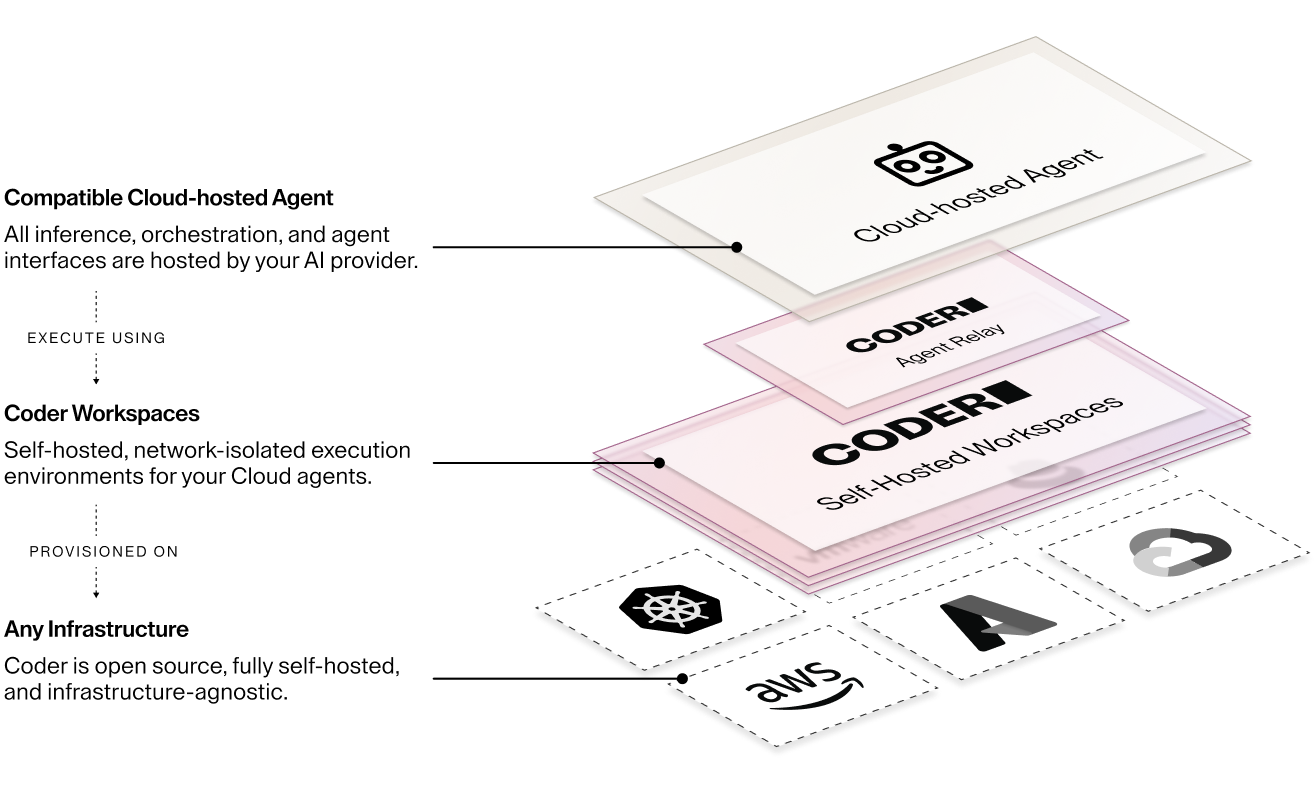
Agent Relay closes that gap. The coding agent a team has already chosen keeps running exactly as built. What changes is where it executes: inside a self-hosted Coder workspace, on infrastructure the enterprise already governs.
The agent landscape is fragmenting, not converging
Enterprises are no longer settling on one AI coding agent. They are running several, often from different vendors, because no single model or agent wins every use case. Gartner projects that 40% of enterprise applications will feature task-specific AI agents by the end of 2026, up from less than 5% in 2025.
Most organizations are still catching up to that multi-model reality. Standardizing infrastructure around one agent does not help once the next team adopts a different one, and rebuilding governance from scratch for every new agent does not scale. The infrastructure question needs an answer that works regardless of which agent a team picks.
Separating the agent from the execution environment
Our early work on self-hosted agent infrastructure used AgentAPI, an approach similar to today’s Agent Client protocol, to run agent CLIs inside Coder workspaces behind a common user interface. It worked, but it surfaced two problems: AgentAPI never gained traction as a standard, and wrapping CLI-based agents introduced friction when recreating their experience in a web app.
That led us down two paths, each serving a different need.
For teams that need a native, fully self-hosted agent experience, we built Coder Agents. Coder Agents runs its reasoning loop in the Coder control plane while keeping code, credentials, and execution inside the customer's infrastructure.
For teams already committed to a cloud-hosted agent ecosystem, Agent Relay lets them keep that experience while moving execution to self-hosted infrastructure they control. Agent Relay applies that same separation to cloud-hosted coding agents, not just our own, so agent choice does not have to mean giving up governance.
How Agent Relay works
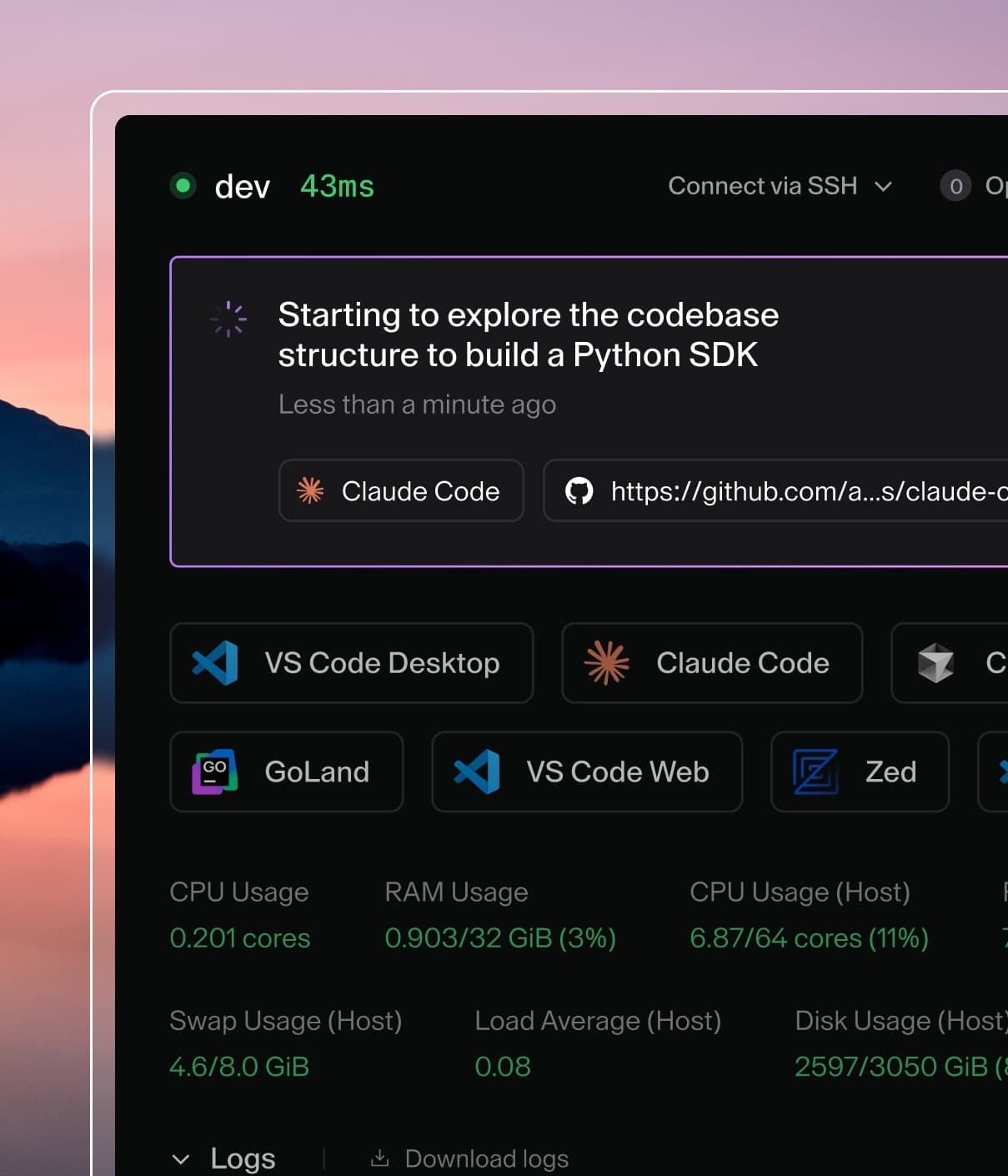
For developers, the experience stays the same. They continue using the cloud-hosted agent they already know, while Agent Relay handles the self-hosted execution environment behind the scenes, giving platform teams control over where and how that work runs.
Agent Relay connects the Coder control plane to an external cloud-hosted agent provider where the agent's reasoning loop actually runs. The agent provider lets an organization configure compute pools for where its agent work executes, and Coder registers itself as one of those pools.
When a developer starts a session, the agent provider sends a resource request, and Agent Relay launches a workspace, using prebuilt workspaces for a warm start, applies the correct template, and opens a secure connection between the agent provider's daemon inside the workspace and its external service. Because that work happens inside a Coder workspace, Agent Firewall, RBAC, and audit logging apply automatically. There is no separate security model to build for agent traffic.
Mapping the agent back to a person
A sandboxed workspace is only half of enterprise-grade governance. Coder's own AI Maturity Model assessment of 100 engineering organizations found that 70% are running AI agents in infrastructure that was never designed to support them, and only 31% have reached organization-wide AI governance, usually because nobody can say which human an agent's actions trace back to. Our new whitepaper, The AI Operating Layer, goes deeper on closing that gap at enterprise scale.
Without mapping an agent's actions to the human who requested them, an audit trail is unreadable and access controls have no scope to enforce. Agent Relay resolves each incoming request against the organization's existing identity provider, so an agent's commits, tool calls, and file access carry the same attribution as a human developer's.
One global financial institution using Coder's identity and audit controls cut its compliance audit resolution time from months to minutes. Agent Relay extends that same attribution model to a class of agent activity most organizations currently cannot attribute at all.
A regulated-industry walkthrough
Consider a bank that has already licensed a cloud-hosted agent for automated refactors and test generation. Security will not approve it, because the default deployment sends source code and credentials to the vendor's cloud, which violates the bank's data residency requirements for customer-facing systems.
With Agent Relay, the bank registers its Coder deployment as a compute pool and scopes a template to that work: Agent Firewall allows only the bank's internal git host and artifact registry, everything else blocked by default. The developer's workflow does not change. What changes is that code and secrets stay inside the bank's VPC, every tool call is logged and attributed, and the workspace is destroyed the moment the session ends.
What Agent Relay does not change
The agent provider still runs the reasoning loop, and LLM inference calls still route through the provider's infrastructure rather than through Coder's AI Gateway, a direct consequence of the agent loop executing in the provider's cloud rather than inside Coder.
Teams that need every layer, including model access, under their own governance should evaluate Coder’s fully self-hosted AI workflow infrastructure, Coder Agents. Agent Relay is built for the more common situation: the agent product is already chosen, and the job is making its execution governable.
Why now
Cloud-hosted agents have moved from experiment to procurement standard faster than most governance models have kept pace, and the organizations adopting them fastest have the least room to get this wrong. Separating where an agent thinks from where it executes closes that gap.
Agent Relay is in private preview with design partners today, and our documentation is available for teams evaluating the architecture ahead of broader access. Contact us to talk about early access.
Seth Shelnutt leads engineering strategy and execution for secure, scalable developer infrastructure. He guides AI governance within development environments, helping enterprises adopt AI with strong data controls and policy guardrails. Previously CTO at TileDB, Seth has deep expertise in distributed systems, data platforms, and database internals, with a background in Statistics from the University of Florida.