This post is part of Coder Launch Week (Dec 9–11, 2025). Each day, we’re sharing innovations that make secure, scalable cloud development easier. Follow along here.
Have you ever found yourself working on a product filled with small bugs, paper cuts, and minor imperfections? None of them are catastrophic on their own, but together they quietly drain your team’s time and energy. Before long, your development team is buried under the weight of constant maintenance work, leaving less room for creativity, innovation, and progress on what truly matters. This is especially true in products with large codebases.
As a product manager, I’ve found myself in this situation many times throughout my career.
And when that happens, the same question always comes up:
How can I make the team setup more efficient and improve productivity without hiring more people, without lowering quality, and without putting extra pressure on the team?
Today, I want to share a solution that’s already making a meaningful difference for us at Coder.
Choose your character: Background vs. foreground agents
Before we look at the solution, it’s worth understanding how coding agents can operate in foreground and background modes. Each has a distinct purpose and level of human interaction.
Foreground agents
Foreground agents work directly alongside humans, handling short, focused tasks where quick collaboration matters. Think of them as a paired-programming partner — you write a line of code, the agent helps with the next. The interaction is continuous and conversational, unfolding within the same environment, usually an IDE.
Foreground agents shine when you need real-time assistance such as code completion, debugging, or quick refactoring.
Background agents
Background agents take a more independent role. Instead of working directly alongside humans, they handle larger, multi-step tasks on their own. They still operate within a cloud development environment, but without direct management or oversight from the user. To the human, the agent behaves like a black box – it takes an input, processes it, and returns the output.
The communication pattern is different as well: rather than a live dialog, it unfolds as a sequence of prompts, updates, and completion notifications. This makes background agents ideal for long-running or automated workflows where independence and consistency matter more than interactivity.
Automating the full development loop with Coder Tasks
At its core, the distinction between foreground and background agents comes down to autonomy: foreground agents collaborate with you, while background agents operate independently.
If you're a product manager like me, chances are you spend less time writing code in an IDE and more time managing backlogs, sprint boards, and issue trackers in tools like GitHub. So we asked ourselves:
What if a GitHub issue could trigger a fully automated implementation?
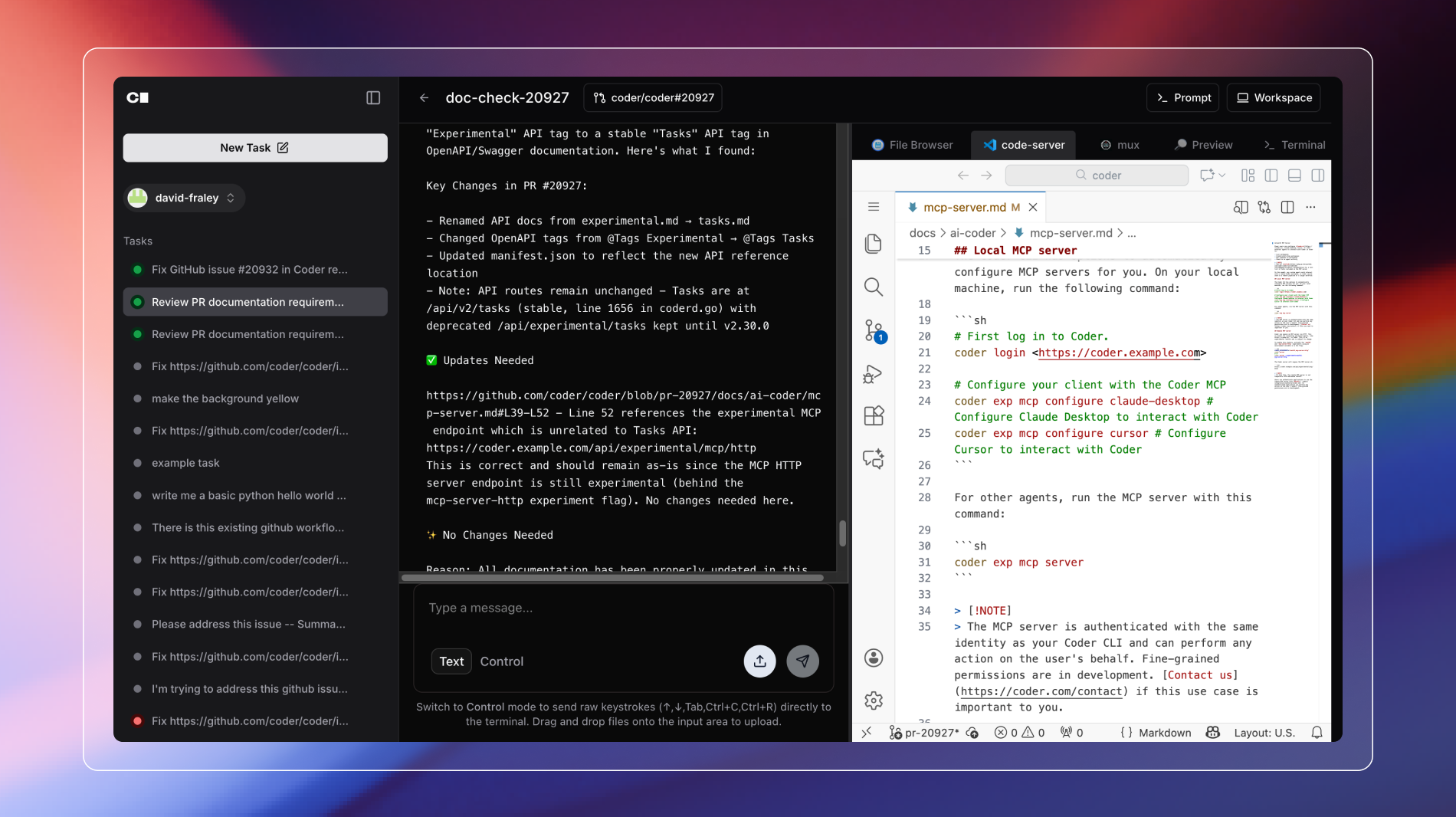
With Coder Tasks and background agents, now it is all possible. Here's how it works:
- Label a Github issue with “coder”.
- That single label triggers a GitHub action.
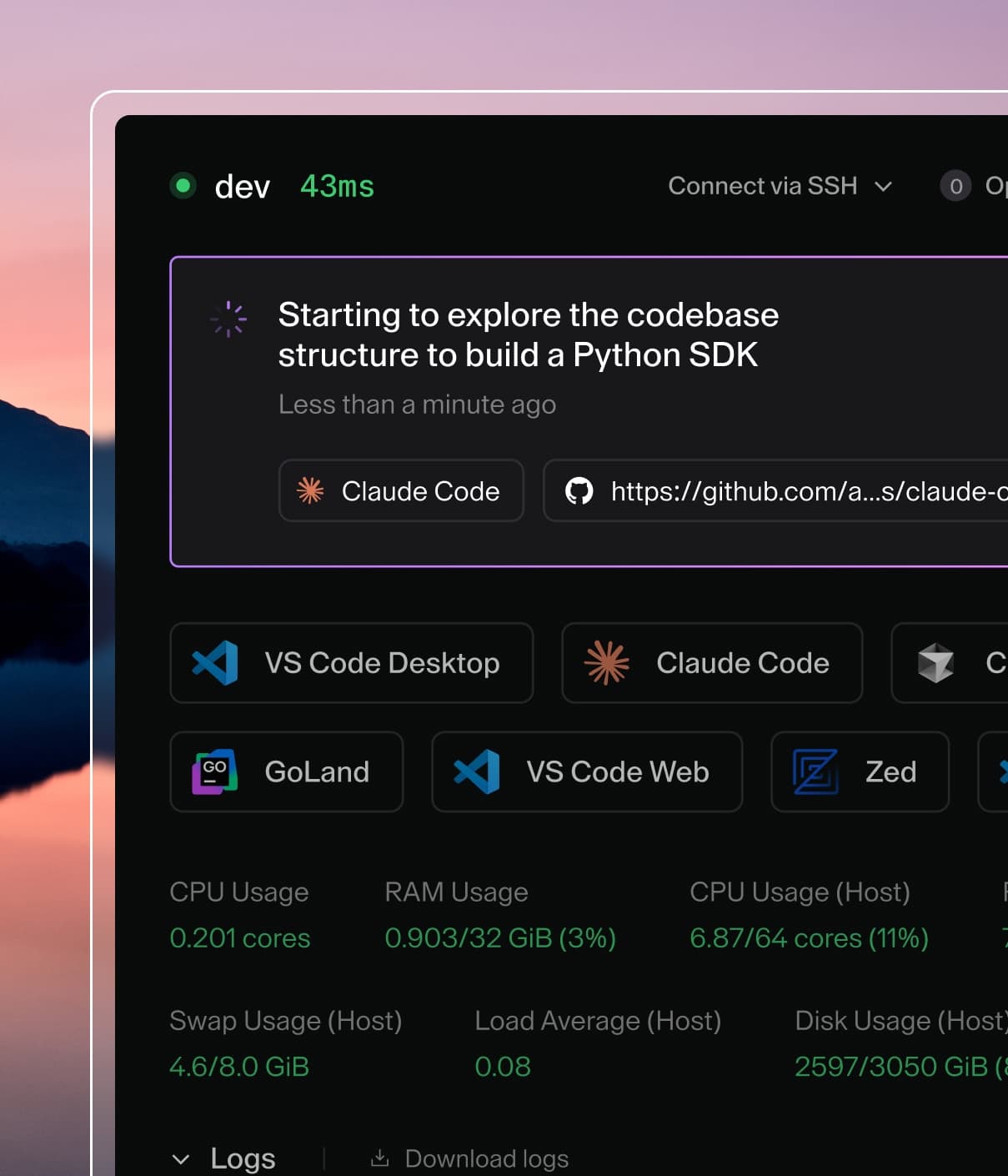
- The action launches a Coder Task running Claude Code as a background agent.
- Once the workspace is ready, the agent picks up the issue and begins working on it.
- It reads the description, comments, links and context directly from GitHub.
- When it finishes, it opens a pull request linked back to the original issue.
- If it gets stuck, Coder notifies you so you can intervene.
That's it! A simple label in GitHub can now start the entire process, taking an issue all the way to a pull request with minimal human involvement.
Why this works so well
All the context needed for the agent to succeed is already in GitHub. Your team’s usual process already provides the structured input the agent depends on:
- Proper documentation in your codebase for AI agents (see AGENTS.md)
- Writing clear requirements
- Defining scope
- Outlining success criteria
- Linking to relevant parts of the codebase, diagrams, screenshots, etc.
For teams which are sharing their backlogs with the community, that context can even include direct feedback or reports from users in the issue thread.
Because the agent automatically pulls this information, developers don’t have to spend extra time guiding or re-explaining the task. The agent starts with the same well-documented context that humans use. The difference is that it can immediately begin acting on it.
This approach also helps address one of the most common concerns customers have about AI-driven development: “Can agents really understand what we want?” In GitHub, your organization already enforces strong documentation habits and clarity standards. The agent simply benefits from that existing culture of precision and transparency.
And in some cases, the flow can be completely autonomous. For example:
- Any issue submitted with the “bug” label could automatically trigger a task template designed to reproduce and investigate user-reported issues.
- By the time a developer opens the workspace, the bug has already been reproduced and analyzed by Claude Code, ready for inspection, corrections and merging.
At Coder, we already use this workflow internally. Every AI-generated pull request is reviewed by a human expert, and if changes are needed, the process can either be repeated or the code corrected manually. This keeps quality high while maintaining the speed and efficiency of the automated flow.
Get started with a GitHub Action template and guide
Coder Workspaces already provide a solid foundation for running background agents safely, securely, and independently of local machines. I won’t go into the details of that here, as this topic has already been covered in depth elsewhere.
What I want to highlight here is the concept of the GitHub loop described above, and how easy we've made it for any team to replicate in just a few minutes.
To make that possible, we’re providing a clear, step-by-step guide: GitHub to Coder Tasks - HowTo Draft
The guide includes everything you need:
- A ready-to-use GitHub Action that triggers the workflow
- A refined Coder Template that uses Claude Code as a background agent
This is the exact setup I personally use at Coder to trigger implementations of features and bug fixes. It’s already proven itself in real-world conditions.
Please note that this GitHub integration is just the beginning. It’s powered by the new API and CLI capabilities we’ve built into Coder to manage Tasks. These foundations make it easy to connect Coder with other tools in your ecosystem just as easily. We’ll continue adding more examples like this to help you get started quickly, without having to piece everything together on your own.
Coder Tasks enters general availability
The December release of Coder 2.29 marks a major milestone for the Coder Tasks feature: we’re officially moving from Beta to General Availability (GA). This means that Tasks will be fully supported in both staging and production environments, and we’ll also be committing to REST API and CLI stability guarantees.
Yesterday, we highlighted our new AI Bridge and Boundary features. Together, these updates make it easier to use AI coding agents safely and with greater control inside Coder workspaces.
Looking ahead to 2026, we'll continue investing in new ways to bring background agents even closer to where you already work. Our goal is to make this technology feel less like an external tool and more like a natural extension of your development process.
Share your feedback
I’m curious to hear what you think. What would make this even more valuable for you and your team?
Your perspective helps us shape what comes next for Coder.
Join the discussion on the official Coder Discord and share your thoughts. Whether you’ve already tried running background agents or are just starting to explore the concept, your input is invaluable.