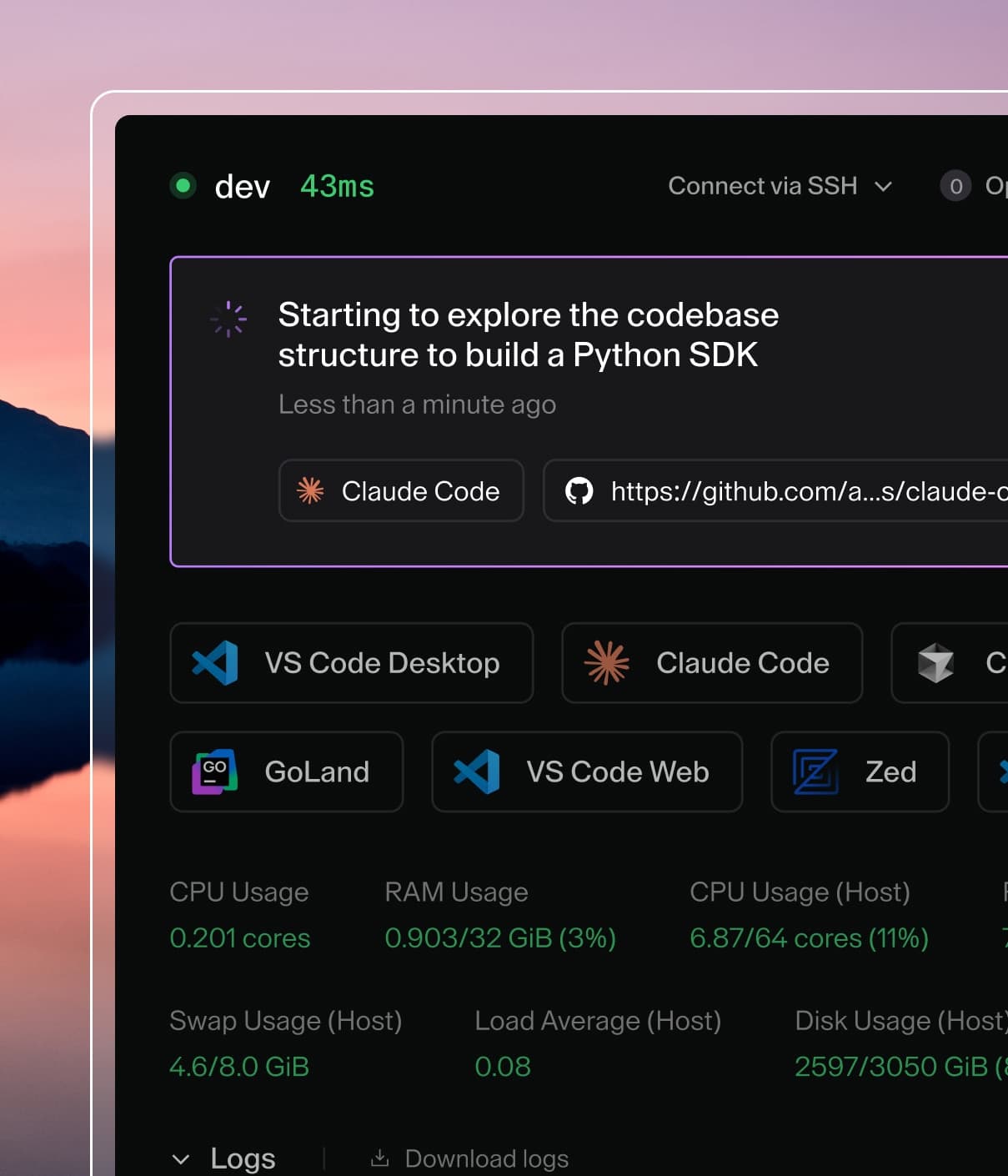
Coder powers secure, scalable development across key industries — automotive, finance, government, and technology — enabling faster builds, tighter compliance, and seamless AI adoption in enterprise-grade cloud environments.
Stable and tested. Enabled by default. Fully documented. Support based on license.
Early access features
Stable: No
Production-ready: No
Support: GitHub issues
Early access features are neither feature-complete nor stable. We do not
recommend using early access features in production deployments.
Coder sometimes releases early access features that are available for use, but
are disabled by default. You shouldn't use early access features in production
because they might cause performance or stability issues. Early access features
can be mostly feature-complete, but require further internal testing and remain
in the early access stage for at least one month.
Coder may make significant changes or revert features to a feature flag at any
time.
If you plan to activate an early access feature, we suggest that you use a
staging deployment.
To enable early access features:
Use the Coder CLI--experiments flag to enable early
access features:
You can opt-out of a feature after you've enabled it.
Target experiments at runtime
Some early access features accept runtime rules.
A rule turns the experiment on or off for every user, or targets it to some users, without a restart.
Only user-scoped experiments accept rules.
Other experiments, such as no_nats_pubsub or workspace-capable-licensing, read only the startup --experiments list and need a restart to change.
Note
The rules API and the hidden coder exp experiment-rules command are experimental.
They can change or be removed without notice.
There is no UI editor yet.
You need the Owner role to change a rule.
The Auditor role can list rules.
Run coder exp experiment-rules list to show each user-scoped experiment, its startup default, and its rule.
The list also shows stored rules that target other experiments as ignored, because they have no effect.
Rule modes
Each user-scoped experiment has at most one rule:
Rule
Effect
Command
No rule, or inherit
Uses the startup --experiments default
coder exp experiment-rules reset <experiment>
on
On for every user
coder exp experiment-rules on <experiment>
off
Off for every user, even if the experiment is enabled at startup
coder exp experiment-rules off <experiment>
condition
On for users whose CEL condition is true, off otherwise
coder exp experiment-rules set <experiment> <condition>
For example, to turn on an experiment for users in one group, widen it to every member of the coder organization, and then turn it off for everyone:
coder exp experiment-rules set mcp-tool-search '"coder/beta-testers" in user.groups'
coder exp experiment-rules set mcp-tool-search '"coder/Everyone" in user.groups'
coder exp experiment-rules off mcp-tool-search
Reset doesn't turn an experiment off.
It restores the startup default, which can enable the experiment for every user.
The command prints a warning when that happens.
To turn an experiment off for everyone, use off.
Each change increases the rule's revision.
Changing commands accept --expected-revision and fail when the stored rule has a different revision.
Without the flag, the command reads the current revision and writes against it, which protects only against a change made between that read and the write.
The command never retries a conflict: it prints the current rule and exits with an error.
If you use audit logs, each change creates an entry with the experiment_rule resource type.
The entry records who changed the rule, when, and the old and new condition.
Audit lines in the server log carry the same diff.
Condition variables
A condition is a CEL expression that returns a boolean.
It can read one variable, user, with these fields:
Field
Type
Value
user.id
string
The user's ID
user.username
string
The user's username
user.email
string
The user's email address, compared case-sensitively
user.roles
list(string)
The user's explicit site roles, such as owner. The implied member role and organization roles are not included.
user.organizations
list(string)
Names of the organizations the user belongs to
user.groups
list(string)
Groups the user belongs to, as <organization>/<group>, including <organization>/Everyone
A condition can be at most 4,096 characters long, and each evaluation has a CEL cost limit of 10,000.
Coder rejects a condition that fails to compile and returns the error to the person who wrote it.
Log lines about a failed condition record only the experiment, the rule revision, the error category, and the line and column, never the condition text.
When a change takes effect
On supporting replicas, a fresh authoritative database read after the update commits observes the new rule.
In-flight evaluations and work already using an earlier decision are not cancelled.
All serving replicas must run a supporting version before you rely on this control.
Replicas that run an earlier version ignore rules and use their startup --experiments list.
Every replica also falls back to its own startup list for experiments without a rule or with inherit, so give all replicas the same --experiments value.
The dashboard fetches the enabled experiments again when a page loads, when the browser window regains focus, and when the connection is restored, if its copy is more than 60 seconds old.
It doesn't refresh on a timer, so a tab that stays focused can show an out-of-date view.
The server applies the current rule to each request regardless of what the dashboard shows.
Failure behavior
If Coder can't read the rules, a stored rule is malformed, or a condition fails to compile or evaluate, the experiment is off for that decision, even if it is enabled at startup.
You can't change this behavior.
Rules gate features; they are not an authorization boundary.
Don't use a rule to restrict access to data or actions.
Beta features are open to the public and are tagged with a Beta label.
They’re in active development and subject to minor changes. They might contain
minor bugs, but are generally ready for use.
Beta features are often ready for general availability within two-three
releases. You should test beta features in staging environments. You can use
beta features in production, but should set expectations and inform users that
some features may be incomplete.
We keep documentation about beta features up-to-date with the latest
information, including planned features, limitations, and workarounds. If you
encounter an issue, please contact your
Coder account team, reach out on
Discord, or create a
GitHub issues if there isn't one
already. While we will do our best to provide support with beta features, most
issues will be escalated to the product team. Beta features are not covered
within service-level agreements (SLA).
Most beta features are enabled by default. Beta features are announced through
the Coder Changelog, and more information is
available in the documentation.
All features that are not explicitly tagged as Early access or Beta are considered generally available (GA).
They have been tested, are stable, and are enabled by default.
If your Coder license includes an SLA, please consult it for an outline of
specific expectations.
For support, consult our knowledgeable and growing community on
Discord, or create a
GitHub issue if one doesn't exist
already. Customers with a valid Coder license, can submit a support request or
contact your account team.
We intend Coder documentation to be the
single source of truth
and all features should have some form of complete documentation that outlines
how to use or implement a feature. If you discover an error or if you have a
suggestion that could improve the documentation, please
submit a GitHub issue.
Some GA features can be disabled for air-gapped deployments. Consult the
feature's documentation or submit a support ticket for assistance.