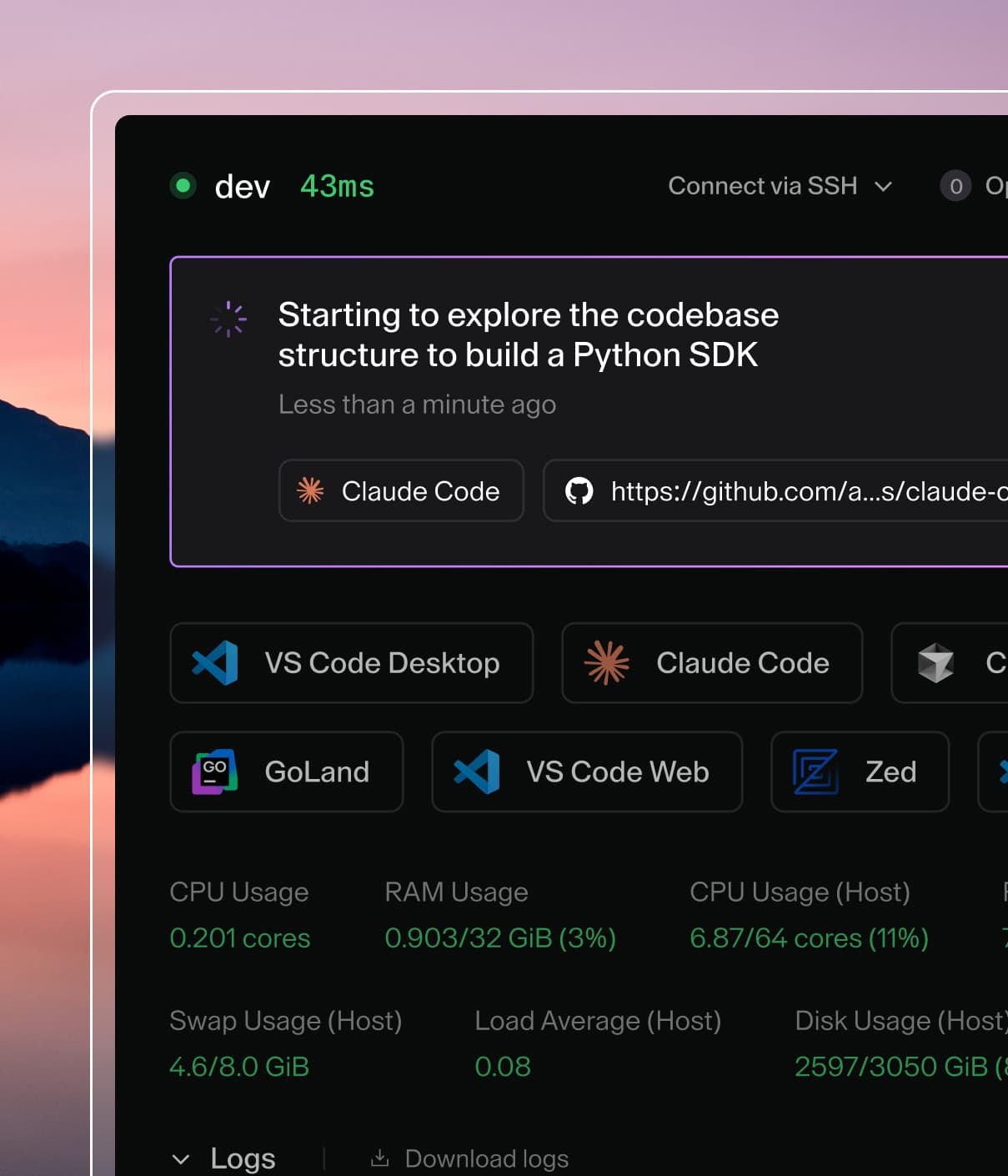
Coder powers secure, scalable development across key industries — automotive, finance, government, and technology — enabling faster builds, tighter compliance, and seamless AI adoption in enterprise-grade cloud environments.
Create a namespace for the Coder control plane. In this tutorial, we'll call it
coder.
kubectl create namespace coder
2. Create a PostgreSQL instance
Coder does not manage a database server for you. This is required for storing
data about your Coder deployment and resources.
Managed PostgreSQL (recommended)
If you're in a public cloud such as
Google Cloud,
AWS,
Azure, or
DigitalOcean,
you can use the managed PostgreSQL offerings they provide. Make sure that the
PostgreSQL service is running and accessible from your cluster. It should be in
the same network, same project, etc.
In-Cluster PostgreSQL (for proof of concepts)
You can install Postgres manually on your cluster using the
Bitnami PostgreSQL Helm chart.
There are some helpful guides
on the internet that explain sensible configurations for this chart. Example:
Create a values.yaml with the configuration settings you'd like for your
deployment. For example:
coder:
  # You can specify any environment variables you'd like to pass to Coder
  # here. Coder consumes environment variables listed in
  # `coder server --help`, and these environment variables are also passed
  # to the workspace provisioner (so you can consume them in your Terraform
  # templates for auth keys etc.).
  #
  # Please keep in mind that you should not set `CODER_HTTP_ADDRESS`,
  # `CODER_TLS_ENABLE`, `CODER_TLS_CERT_FILE` or `CODER_TLS_KEY_FILE` as
  # they are already set by the Helm chart and will cause conflicts.
  env:
    - name: CODER_PG_CONNECTION_URL
      valueFrom:
        secretKeyRef:
          # You'll need to create a secret called coder-db-url with your
          # Postgres connection URL like:
          # postgres://coder:password@postgres:5432/coder?sslmode=disable
          name: coder-db-url
          key: url
    # For production deployments, we recommend configuring your own GitHub
    # OAuth2 provider and disabling the default one.
    - name: CODER_OAUTH2_GITHUB_DEFAULT_PROVIDER_ENABLE
      value: "false"

    # (Optional) For production deployments the access URL should be set.
    # If you're just trying Coder, access the dashboard via the service IP.
    # - name: CODER_ACCESS_URL
    #   value: "https://coder.example.com"

  #tls:
  #  secretNames:
  #    - my-tls-secret-name
You can view our
Helm README for
details on the values that are available, or you can view the
values.yaml
file directly.
We support two release channels: mainline and stable - read the
Releases page to learn more about which best suits your team.
You can watch Coder start up by running kubectl get pods -n coder. Once Coder
has started, the coder-* pods should enter the Running state.
5. Log in to Coder 🎉
Use kubectl get svc -n coder to get the IP address of the LoadBalancer. Visit
this in the browser to set up your first account.
If you do not have a domain, you should set CODER_ACCESS_URL to this URL in
the Helm chart and upgrade Coder (see below). This allows workspaces to connect
to the proper Coder URL.
Upgrade Coder via Helm
To upgrade Coder in the future or change values, you can run the following
command:
Coder also publishes a chart, oci://ghcr.io/coder/chart/coder-ai-gateway, that runs AI Gateway as its own Deployment alongside the control plane.
Use it when you want to scale AI traffic independently of coderd.
For installation and configuration, refer to Deploy AI Gateway as a standalone service and the AI Gateway Helm chart README.
Coder Observability Chart
Use the Observability Helm chart for a
pre-built set of dashboards to monitor your control plane over time. It includes
Grafana, Prometheus, Loki, and Alert Manager out-of-the-box, and can be deployed
on your existing Grafana instance.
We recommend that all administrators deploying on Kubernetes set the
observability bundle up with the control plane from the start. For installation
instructions, visit the
observability repository.
Kubernetes Security Reference
Below are common requirements we see from our enterprise customers when
deploying an application in Kubernetes. This is intended to serve as a
reference, and not all security requirements may apply to your business.
All container images must be sourced from an internal container registry.
Workspaces - To pull the workspace image from your registry,
update the Terraform template code here.
This assumes your cluster nodes are authenticated to pull from the internal
registry.
Coder's control plane does not run as privileged.
We disableallowPrivilegeEscalationby default.
Workspace pods do not require any elevated privileges, with the exception
of our envbox workspace template (used for docker-in-docker workspaces,
not required).
Containers cannot mount host filesystems
Both the control plane and workspace containers do not require any host
filesystem mounts.
Containers cannot attach to host network
Both the control plane and workspaces use the Kubernetes networking layer
by default, and do not require host network access.
All Kubernetes objects must define resource requests/limits
Both the control plane and workspaces set resource request/limits by
default.
Load balancing considerations
AWS
If you are deploying Coder on AWS EKS and service is set to LoadBalancer, AWS
will default to the Classic load balancer. The load balancer external IP will be
stuck in a pending status unless sessionAffinity is set to None.
AWS recommends a Network load balancer in lieu of the Classic load balancer. Use
the following values.yaml settings to request a Network load balancer:
By default, Coder will set the externalTrafficPolicy to Cluster which will
mask client IP addresses in the Audit log. To preserve the source IP, you can
either set this value to Local, or pass through the client IP via the
X-Forwarded-For header. To configure the latter, set the following environment
variables:
coder:
  env:
    - name: CODER_PROXY_TRUSTED_HEADERS
      value: X-Forwarded-For
    - name: CODER_PROXY_TRUSTED_ORIGINS
      value: 10.0.0.1/8 # this will be the CIDR range of your Load Balancer IP address
Azure
Certain enterprise environments require the
Azure Application Gateway.
The Application Gateway supports:
Websocket traffic (required for workspace connections)
You can view Coder's logs by getting the pod name from kubectl get pods and
then running kubectl logs <pod name>. You can also view these logs in your
Cloud's log management system if you are using managed Kubernetes.
Kubernetes-based workspace is stuck in "Connecting..."
Ensure you have an externally-reachable CODER_ACCESS_URL set in your helm
chart. If you do not have a domain set up, this should be the IP address of
Coder's LoadBalancer (kubectl get svc -n coder).