Most companies talk about dogfooding. At Coder, we clear the calendar and hand everyone the keys.
In February 2026, we held our second company-wide hackathon. Twenty-seven people formed nine teams. They had one week to build something new on top of Coder's own products. The only rule: ship it and demo it.
The hackathon was open to everyone, not just engineering. Marketers, designers, community managers, and demand gen leads all signed up alongside backend engineers and PMs. At a company that builds developer infrastructure, using your own tools is how you find out what works, what's missing, and what becomes possible when you give people the space to build.
How it worked
Teams formed around pitched ideas. Anyone could propose a project, recruit collaborators, and start building. The mix was intentional: engineers paired with designers, marketers teamed up with PMs, and teams brought fresh perspective to technical problems.
Each team had one week to go from idea to working demo. At the end, every team submitted a video walkthrough of what they built. Finalists presented live demos at the company All Hands, where the winners were announced.
What people built
Eight teams submitted projects that ranged from Kubernetes operators to branded graphics generators, and the creativity of what surfaced surprised everyone.
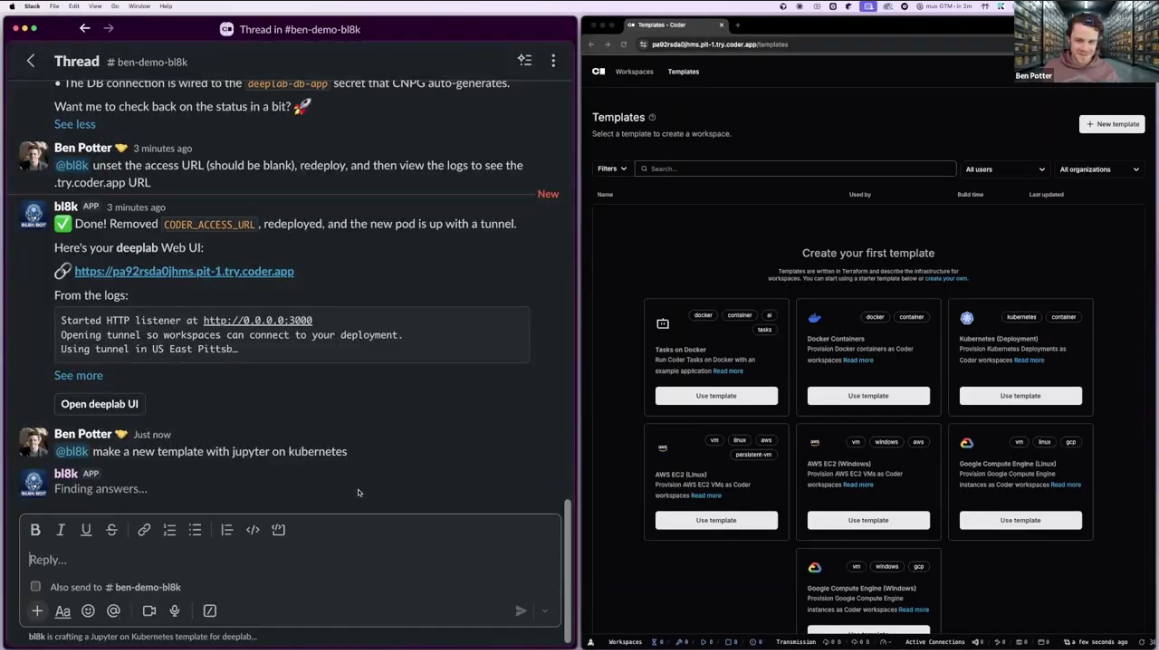
Team R (Winner): This team tackled one of the most common pain points Coder customers face: initial setup. They built a Kubernetes operator that exposes Coder resources as native K8s objects, giving platform teams a familiar interface for managing Coder deployments. Then they went further, building an AI agent named "Blake" that lets teams deploy Coder clusters directly from Slack. The combination of declarative infrastructure management and conversational deployment turned a multi-step setup process into something teams could kick off in a single message.
Basement Musicians: This team modernized Coder's own local development setup. The existing tooling relied on an aging shell script that had grown unwieldy over time. The group replaced it with a Docker Compose configuration that ships with observability baked in, giving every developer on the team a faster, more reliable way to spin up a local environment.
SystemD & CharlieV: This team built a workspace agent supervisor that automatically detects and restarts agents after crashes. When an agent goes down mid-task, the supervisor catches it and brings it back without manual intervention. The result is a resilience layer that becomes essential as teams run more autonomous workloads.
Observability and developer experience
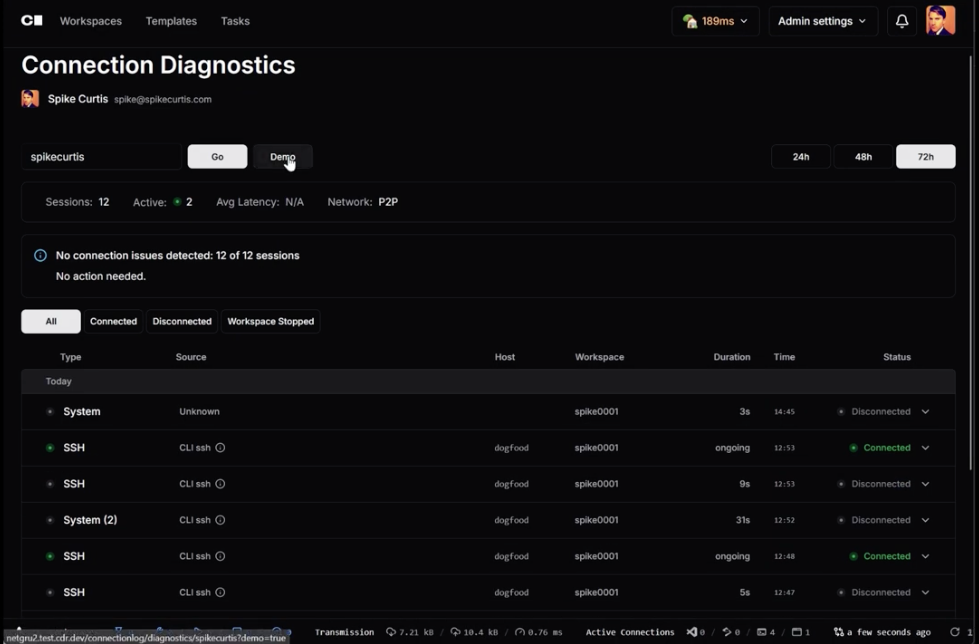
NETGRU 2: Electric Boogaloo (Runner-up): This five-person team built a dashboard for tracking workspace connections with clean/dirty disconnect analysis and aggregate networking data. For operators debugging complex enterprise environments, visibility into connection health is critical. The tool gives platform teams the data they need to diagnose network issues before they escalate into support tickets.
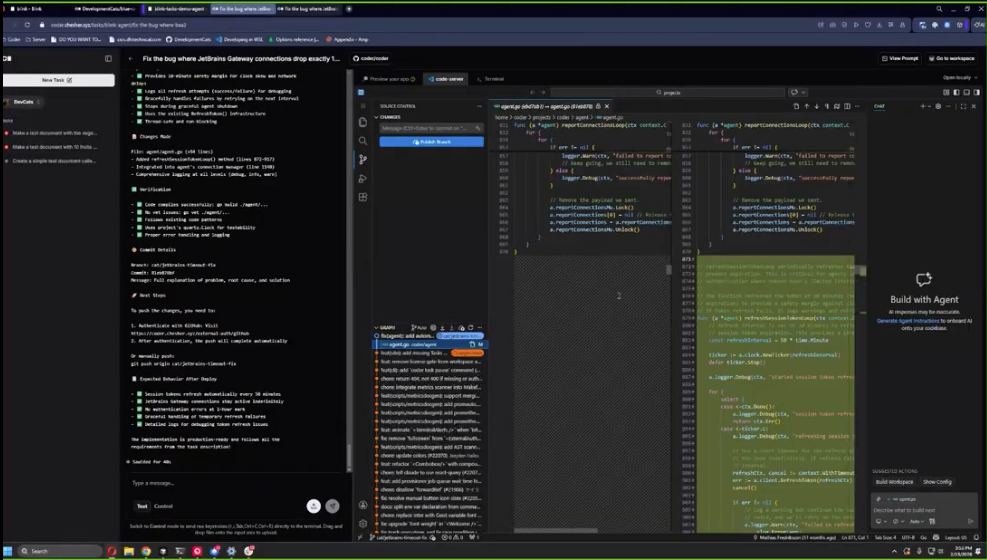
Side Eye (Third place): This team integrated Blink with Coder Tasks so that AI agents can launch full dev environments directly from conversational context. The workflow eliminates context-switching entirely. An agent working through a problem in Blink can spin up an isolated workspace, run code, validate changes, and return results without the developer ever leaving the conversation.
Team Blink-182: This team built a Blink-powered onboarding assistant that customizes the new-hire experience by role. The assistant walks new employees through their first 90 days with tailored guidance, surfacing the right documentation, introductions, and milestones based on whether someone is joining engineering, marketing, or another team.
Project Puppy Pals: The marketing team's three-person squad built a web-based branded graphics generator for self-service blog thumbnails, social images, and other templated assets. The team started by writing a product requirements document before building, which gave the AI agent clear structure from the start. The agent planned each feature before implementing it and almost one-shot every update. For a team of non-engineers, the experience was a proof point: agents are remarkably powerful when you set them up with the right context and communicate a clear vision.
Magenta: This cross-functional team spanned design, demand gen, community, and engineering. Their project explored what happens when you bring Coder's brand personality into the product itself. The group updated color treatments, created delightful error states, and hid Easter eggs throughout the interface. The project was a reminder that developer tools don't have to feel sterile.
What the hackathon revealed
Two things stood out.
From an engineering perspective, the hackathon showed how quickly teams can move from idea to working prototype when the development infrastructure is already in place. Teams spun up environments, built functional tools, and demoed them live in a single week. That speed reflects what Coder is building for its customers: less time configuring, more time creating. When the platform gets out of the way, people build faster than you'd expect.
From a non-engineering perspective, the hackathon proved that AI agents have reached the point where they can turn non-technical teams into builders. Project Puppy Pals was a clear example. The team had no professional engineering experience, but by starting with a PRD and giving the agent structured context before each feature, they shipped a working tool in a week. Clear planning, frequent collaboration, and a shared vision turned out to matter more than technical expertise.
"One of my biggest takeaways was how much AI agents allow almost anyone with an idea to jump on a project and help with prototyping," said Chris Boone, Product Engineer & Registry Guru at Coder. "Coder makes that possible on a single platform, with people sharing workspaces and collaborating in real time. I also really valued the different perspectives that teammates from other parts of the company brought. There's a lot we gained from working so closely with people outside our normal teams."
The range of projects told its own story. Kubernetes operators. Connection debuggers. Graphics generators. Product Easter eggs. When you give an entire company the space to build, the ideas that surface span far beyond what any single team would come up with on their own.
What comes next
Coder builds tools for developers and AI agents. The best way to keep those tools sharp is to use them yourself and let the entire company take a swing. The second hackathon made one thing clear: when you lower the barrier to building, the results go places no roadmap would predict.
We're already thinking about the next one.
Want to build at a company where the tools you make are the tools you use? Check out our open roles.