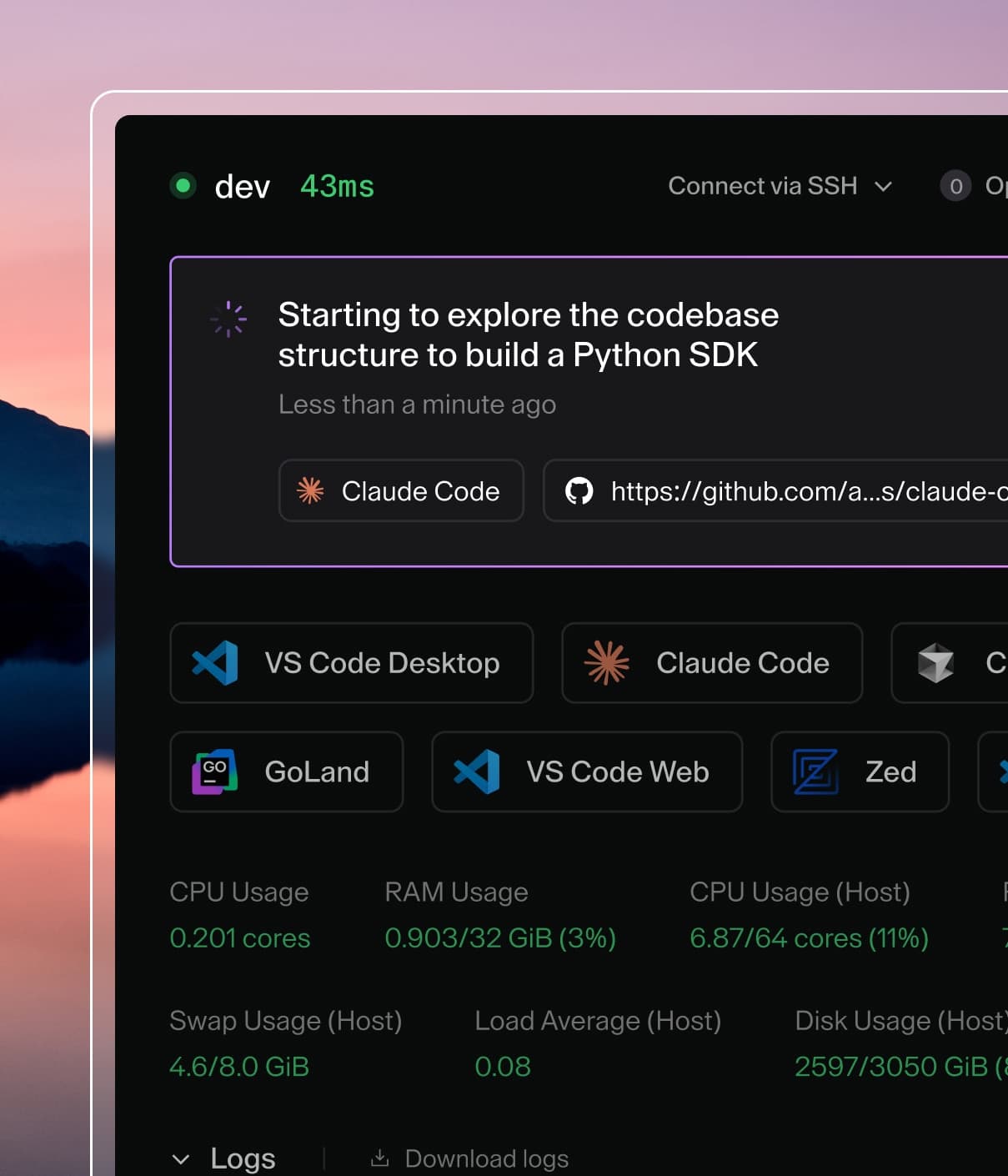
Coder powers secure, scalable development across key industries — automotive, finance, government, and technology — enabling faster builds, tighter compliance, and seamless AI adoption in enterprise-grade cloud environments.
The 1,000 users architecture is designed to cover a wide range of workflows.
Examples of subjects that might utilize this architecture include medium-sized
tech startups, educational units, or small to mid-sized enterprises.
Target load: API: up to 180 RPS
High Availability: non-essential for small deployments
Hardware recommendations
Coderd nodes
Users
Node capacity
Replicas
GCP
AWS
Azure
Up to 1,000
2 vCPU, 8 GB memory
1-2 nodes, 1 coderd each
n1-standard-2
m5.large
Standard_D2s_v3
Footnotes:
For small deployments (ca. 100 users, 10 concurrent workspace builds), it is
acceptable to deploy provisioners on coderd nodes.
Provisioner nodes
Users
Node capacity
Replicas
GCP
AWS
Azure
Up to 1,000
8 vCPU, 32 GB memory
2 nodes, 30 provisioners each
t2d-standard-8
c5.2xlarge
Standard_D8s_v3
Footnotes:
An external provisioner is deployed as Kubernetes pod.
Workspace nodes
Users
Node capacity
Replicas
GCP
AWS
Azure
Up to 1,000
8 vCPU, 32 GB memory
64 nodes, 16 workspaces each
t2d-standard-8
m5.2xlarge
Standard_D8s_v3
Footnotes:
Assumed that a workspace user needs at minimum 2 GB memory to perform. We
recommend against over-provisioning memory for developer workloads, as this my
lead to OOMKiller invocations.
Maximum number of Kubernetes workspace pods per node: 256
Database nodes
Users
Node capacity
Replicas
Storage
GCP
AWS
Azure
Up to 1,000
2 vCPU, 8 GB memory
1 node
512 GB
db-custom-2-7680
db.m5.large
Standard_D2s_v3
Footnotes for AWS instance types:
For production deployments, we recommend using non-burstable instance types,
such as m5 or c5, instead of burstable instances, such as t3.
Burstable instances can experience significant performance degradation once
CPU credits are exhausted, leading to poor user experience under sustained load.