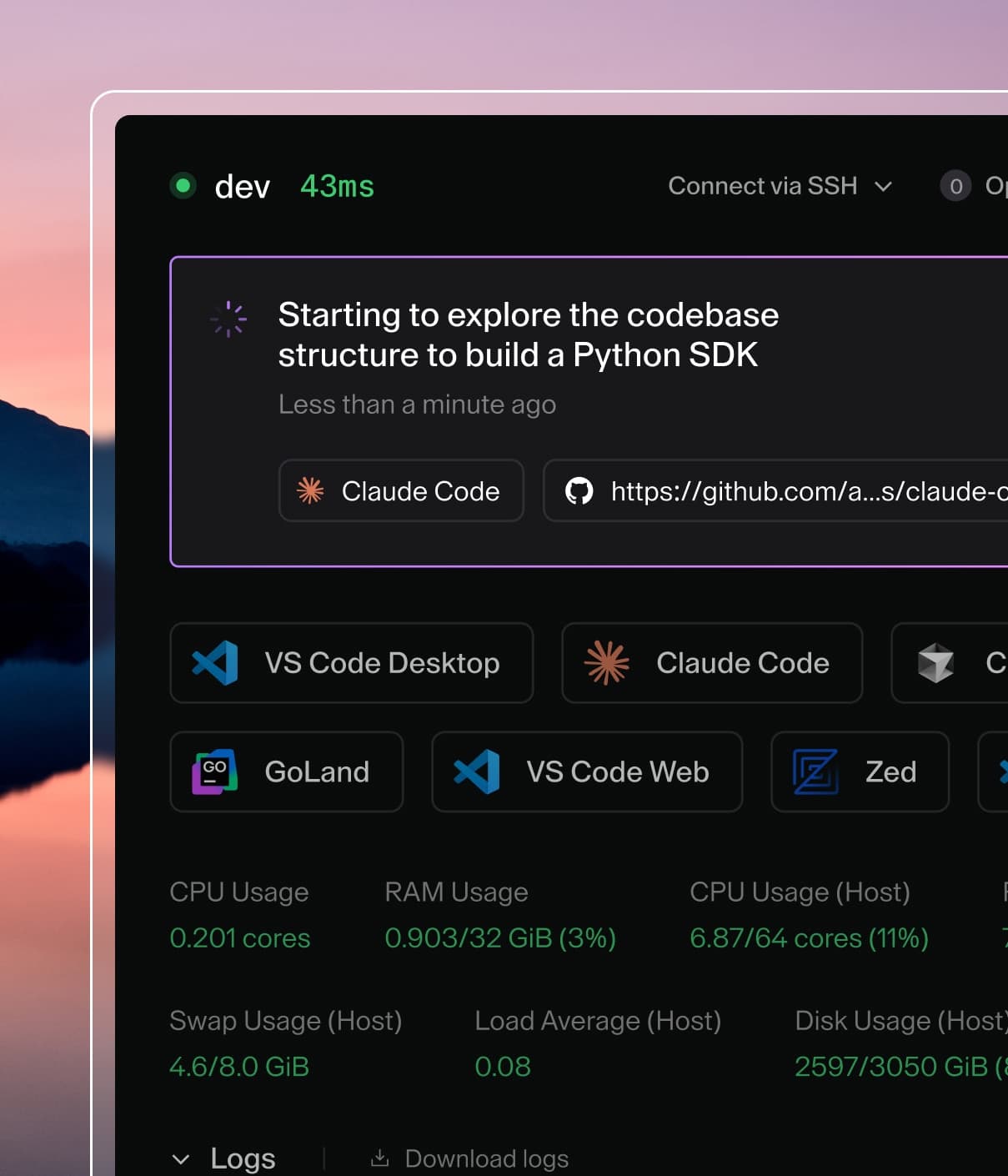
Coder powers secure, scalable development across key industries — automotive, finance, government, and technology — enabling faster builds, tighter compliance, and seamless AI adoption in enterprise-grade cloud environments.
In the 2,000 users architecture, there is a moderate increase in traffic,
suggesting a growing user base or expanding operations. This setup is
well-suited for mid-sized companies experiencing growth or for universities
seeking to accommodate their expanding user populations.
Users can be evenly distributed between 2 regions or be attached to different
clusters.
Target load: API: up to 300 RPS
High Availability: The mode is enabled; multiple replicas provide higher
deployment reliability under load.
Hardware recommendations
Coderd nodes
Users
Node capacity
Replicas
GCP
AWS
Azure
Up to 2,000
4 vCPU, 16 GB memory
2 nodes, 1 coderd each
n1-standard-4
m5.xlarge
Standard_D4s_v3
Provisioner nodes
Users
Node capacity
Replicas
GCP
AWS
Azure
Up to 2,000
8 vCPU, 32 GB memory
4 nodes, 30 provisioners each
t2d-standard-8
c5.2xlarge
Standard_D8s_v3
Footnotes:
An external provisioner is deployed as Kubernetes pod.
It is not recommended to run provisioner daemons on coderd nodes.
Consider separating provisioners into different namespaces in favor of
zero-trust or multi-cloud deployments.
Workspace nodes
Users
Node capacity
Replicas
GCP
AWS
Azure
Up to 2,000
8 vCPU, 32 GB memory
128 nodes, 16 workspaces each
t2d-standard-8
m5.2xlarge
Standard_D8s_v3
Footnotes:
Assumed that a workspace user needs 2 GB memory to perform
Maximum number of Kubernetes workspace pods per node: 256
Nodes can be distributed in 2 regions, not necessarily evenly split, depending
on developer team sizes
Database nodes
Users
Node capacity
Replicas
Storage
GCP
AWS
Azure
Up to 2,000
4 vCPU, 16 GB memory
1 node
1 TB
db-custom-4-15360
db.m5.xlarge
Standard_D4s_v3
Footnotes:
Consider adding more replicas if the workspace activity is higher than 500
workspace builds per day or to achieve higher RPS.
Footnotes for AWS instance types:
For production deployments, we recommend using non-burstable instance types,
such as m5 or c5, instead of burstable instances, such as t3.
Burstable instances can experience significant performance degradation once
CPU credits are exhausted, leading to poor user experience under sustained load.