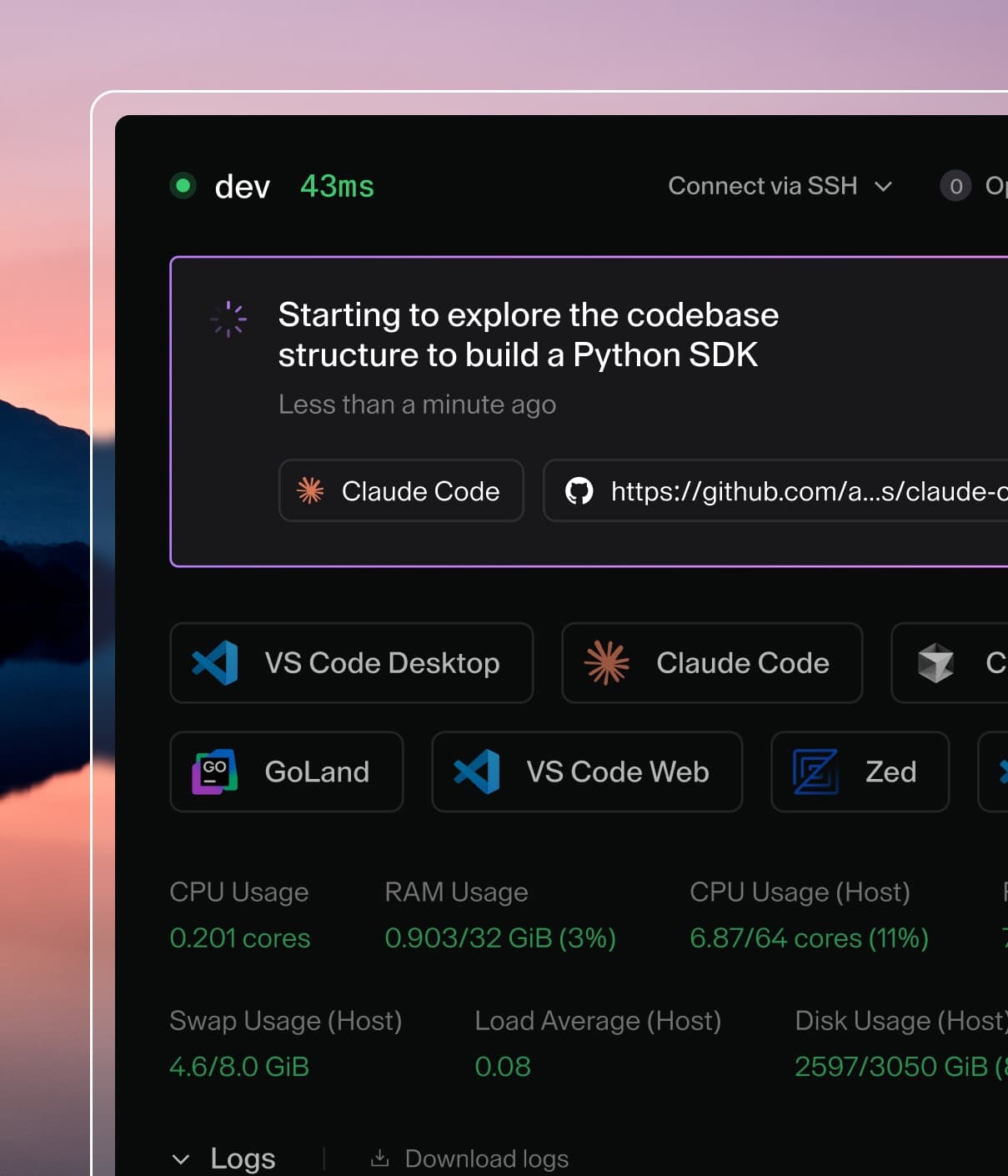
Coder powers secure, scalable development across key industries — automotive, finance, government, and technology — enabling faster builds, tighter compliance, and seamless AI adoption in enterprise-grade cloud environments.
Use the coder_env resource to inject environment variables into your workspace agents.
This is useful for configuring tools, setting paths, and passing configuration to development environments.
Basic usage
resource "coder_agent" "dev" {
  os   = "linux"
  arch = "amd64"
}

resource "coder_env" "go_path" {
  agent_id = coder_agent.dev.id
  name     = "GOPATH"
  value    = "/home/coder/go"
}
Each coder_env resource sets a single environment variable on the specified agent.
You can define multiple coder_env resources targeting the same agent.
Merge strategies
When multiple coder_env resources define the same variable name, use the merge_strategy attribute to control how values are combined:
Strategy
Behavior
replace(default)
Last value wins. Backward compatible.
append
Appends to the existing value with : separator.
prepend
Prepends to the existing value with : separator.
error
Fails the build if the variable is already defined.
The append and prepend strategies use : as a separator, which matches the convention for PATH-style variables on Unix systems.
Merges and the host environment
merge_strategy only combines values across coder_env resources in the same template.
It does not know about the value already set by the workspace's image or host, such as the base PATH.
An append or prepend builds its value from coder_env resources alone, and that value replaces whatever the host had set for that variable.
To extend a variable that the host already sets, reference it directly in one of the values (for example, $PATH), so the agent expands it against the real environment at startup.
Only one resource in the chain needs the reference; the rest can use plain values.
The next example covers this.
Example: Appending to PATH
Multiple coder_env resources can each add directories to PATH.
Reference $PATH in one of them to keep the host's original directories:
resource "coder_agent" "dev" {
  os   = "linux"
  arch = "amd64"
}

resource "coder_env" "path_cuda" {
  agent_id       = coder_agent.dev.id
  name           = "PATH"
  value          = "$PATH:/usr/local/cuda/bin"
  merge_strategy = "append"
}

resource "coder_env" "path_go" {
  agent_id       = coder_agent.dev.id
  name           = "PATH"
  value          = "/usr/local/go/bin"
  merge_strategy = "append"
}

resource "coder_env" "path_rust_cargo" {
  agent_id       = coder_agent.dev.id
  name           = "PATH"
  value          = "/usr/local/cargo/bin"
  merge_strategy = "append"
}
This produces PATH with the host's original value, followed by /usr/local/cuda/bin:/usr/local/go/bin:/usr/local/cargo/bin.
Example: Preventing duplicates
Use error to catch accidental duplicate definitions:
resource "coder_env" "editor" {
  agent_id       = coder_agent.dev.id
  name           = "EDITOR"
  value          = "vim"
  merge_strategy = "error"
}
If another coder_env resource also sets EDITOR, the build fails with a clear error message.
Ordering
When multiple coder_env resources append or prepend to the same variable, they are processed in alphabetical order by their Terraform resource address.
In the previous PATH example, coder_env.path_cuda is processed first, then coder_env.path_go, then coder_env.path_rust_cargo, because that is their alphabetical order.
This is why only one resource in the chain needs the $PATH reference: the merged value is built as one string before it's expanded, so the reference works no matter where in the chain it appears.
Agent env override
The env block inside a coder_agent resource always takes final precedence over any coder_env resources.
If both define the same variable, the coder_agent value wins regardless of merge_strategy.
This override happens after coder_env resources are merged, so merge_strategy = "error" does not trigger when the conflict is with the agent's env block (it only triggers when two coder_env resources define the same key):
resource "coder_agent" "dev" {
  os   = "linux"
  arch = "amd64"
  env = {
    PATH = "/usr/local/bin:/usr/bin:/bin"
  }
}

# This value is ignored because coder_agent.dev.env sets PATH directly.
resource "coder_env" "extra_path" {
  agent_id       = coder_agent.dev.id
  name           = "PATH"
  value          = "/home/coder/bin"
  merge_strategy = "append"
}