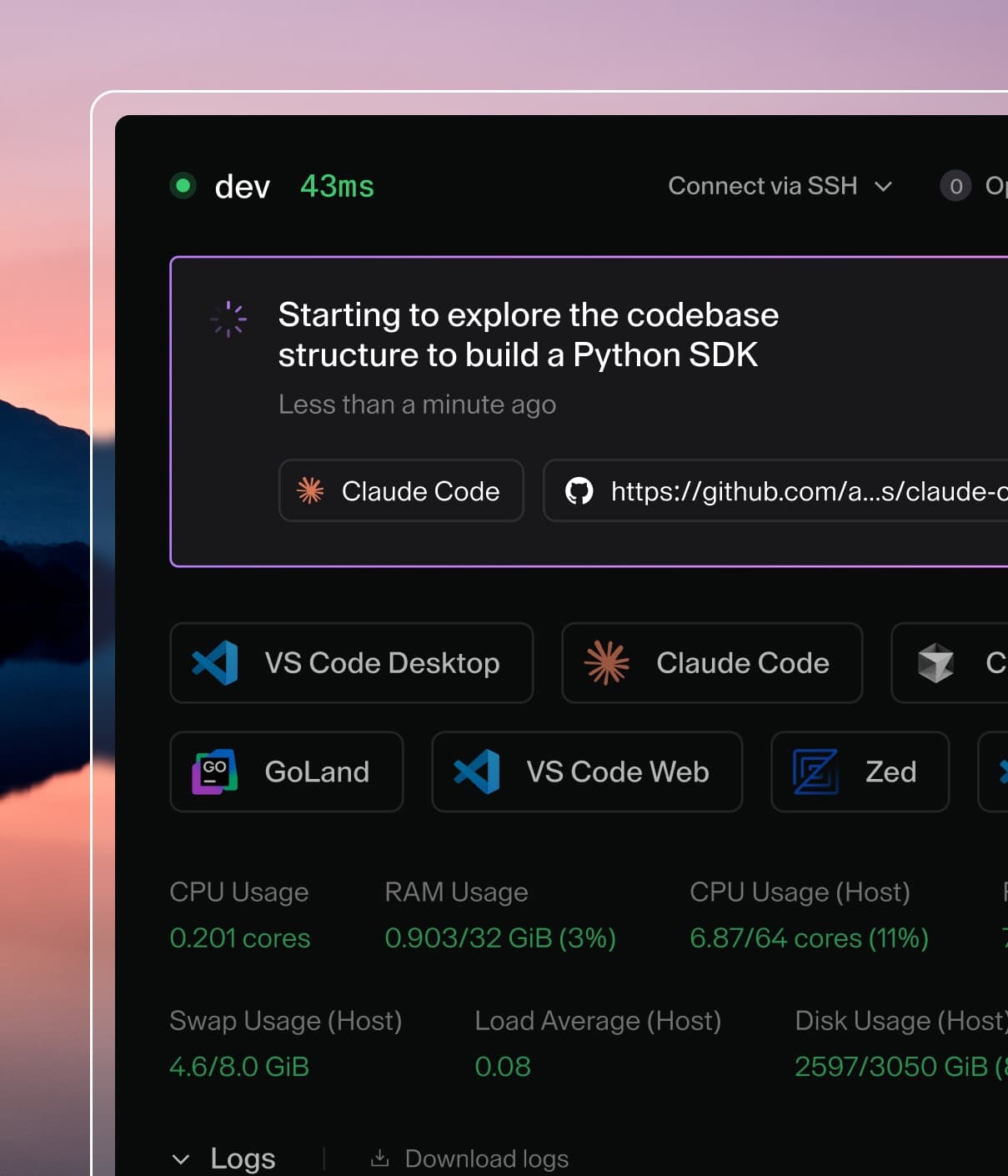
Coder powers secure, scalable development across key industries — automotive, finance, government, and technology — enabling faster builds, tighter compliance, and seamless AI adoption in enterprise-grade cloud environments.
This section describes how to plan, install, and configure a Coder deployment, from the initial decisions you need to make in order to successfully run Coder to a steady-state operating environment.
The five phases are meant to be read in order: each phase produces the required information for the next phase.
Tip
If you only need the coder command-line client on your own machine, refer to Coder CLI.
You don't need the rest of this section.
If you want a Coder deployment on a single machine as quickly as possible, follow the Quickstart instead.
It installs Coder and launches a first workspace without the planning and preparation work described here.
Come back to this section when you want an expanded Coder deployment.
How to keep the deployment healthy, upgraded, and correctly sized
An upgrade and scaling routine, plus a removal path
Phases 1 and 2 are advisory rather than a gate.
Nothing stops you from installing the control plane first, but the recommendations in those phases are what keep a deployment from needing to be rebuilt later.
Not sure where to start?
Read Plan your deployment and Prepare prerequisites first.
A Coder deployment usually crosses team boundaries.
The following actors appear throughout this section, so you can anticipate which conversations you need to start and how long they're likely to take.
Actor
Responsible for
Appears in phase
Coder platform owner
The deployment itself: installation, configuration, upgrades, and support
1 to 5
Infrastructure team
Clusters, virtual machines, networking, load balancers, and egress rules
1 to 4
DNS and TLS owner
The Coder hostname, the wildcard record for workspace apps, and certificates
2
Database administrator
PostgreSQL provisioning, sizing, backups, and restore tests
2, 4, 5
Identity provider administrator
The OIDC application, claims, and group mappings
2
Security and compliance reviewer
Audit requirements, network policy, data handling, and sign-off
2, 4
Licensing contact
Purchasing and renewing the Coder license
2
Template author
The workspace templates developers use once the deployment is running
4, 5
These are roles, not people.
One person may serve as several actors, which is common for a proof of concept run by a single platform engineer.
Several people may also serve as one actor, which is common for an infrastructure team that splits networking and compute ownership.
Use the table to identify who has to agree, not to count headcount.