Coder powers secure, scalable development across key industries — automotive, finance, government, and technology — enabling faster builds, tighter compliance, and seamless AI adoption in enterprise-grade cloud environments.
Development containers are an open source
specification for defining development environments.
Envbuilder is an open source project by
Coder that runs dev containers via Coder templates and your underlying
infrastructure. It can run on Docker or Kubernetes.
There are several benefits to adding a devcontainer-compatible template to
Coder:
Drop-in migration from Codespaces (or any existing repositories that use dev
containers)
Easier to start projects from Coder. Just create a new workspace then pick a
starter devcontainer.
Developer teams can "bring their own image." No need for platform teams to
manage complex images, registries, and CI pipelines.
How it works
A Coder admin adds a devcontainer-compatible template to Coder (envbuilder).
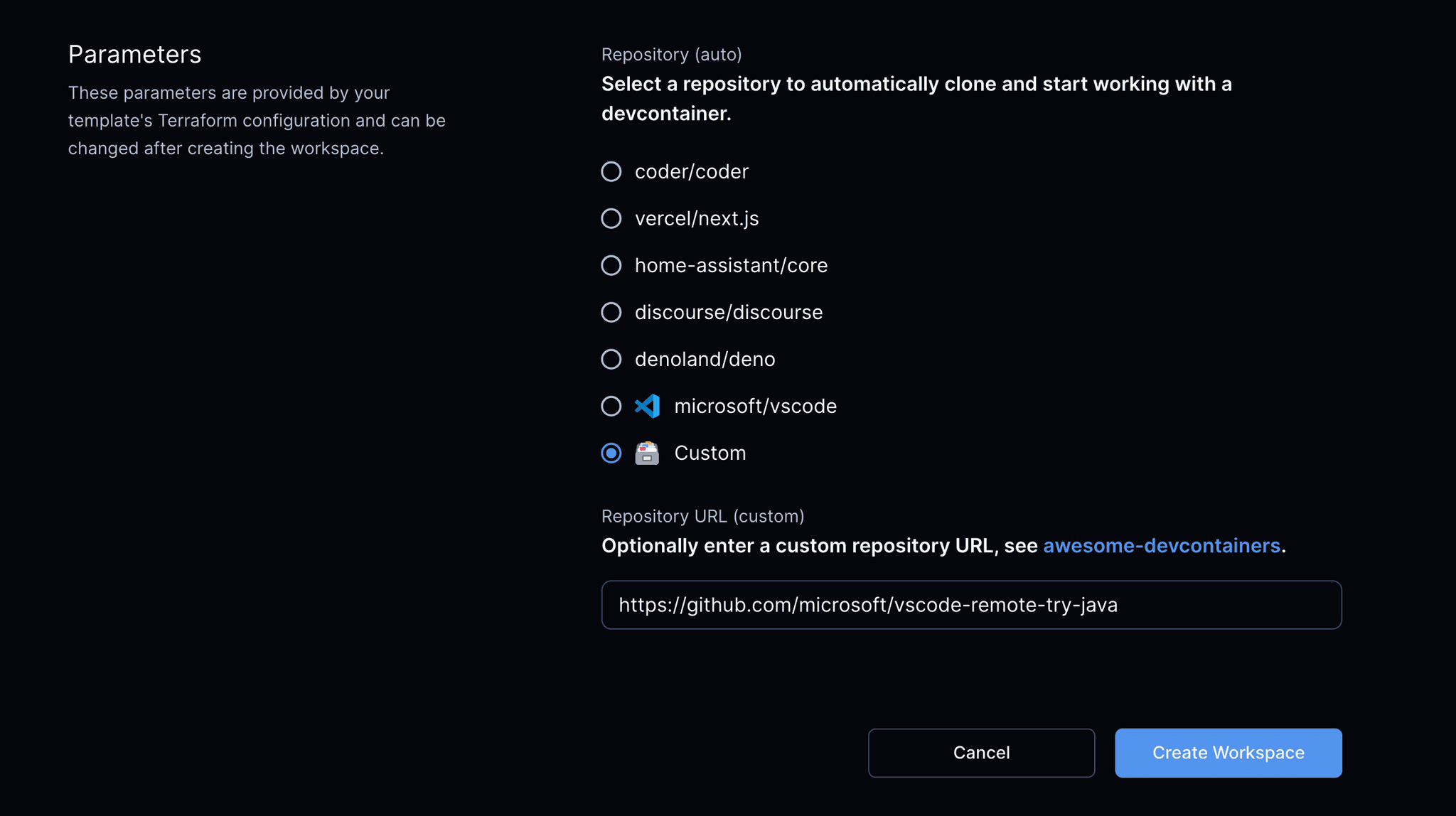
Then developers enter their repository URL as a
parameter when they create their
workspace. Envbuilder clones the repo and
builds a container from the devcontainer.json specified in the repo.
When using the Envbuilder Terraform provider,
a previously built and cached image can be re-used directly, allowing
instantaneous dev container starts.
Developers can edit the devcontainer.json in their workspace to rebuild to
iterate on their development environments.
Google Compute Engine (Devcontainer)
runs a development container inside a single GCP instance. It also mounts the
Docker socket from the VM inside the container to enable Docker inside the
workspace.
AWS EC2 (Devcontainer)
runs a development container inside a single EC2 instance. It also mounts the
Docker socket from the VM inside the container to enable Docker inside the
workspace.
Your template can prompt the user for a repo URL with
Parameters.
Authentication
You may need to authenticate to your container registry, such as Artifactory, or
git provider such as GitLab, to use Envbuilder. See the
Envbuilder documentation
for more information.
Caching
To improve build times, dev containers can be cached. There are two main forms
of caching:
Layer Caching caches individual layers and pushes them to a remote
registry. When building the image, Envbuilder will check the remote registry
for pre-existing layers. These will be fetched and extracted to disk instead
of building the layers from scratch.
Image Caching caches the entire image, skipping the build process
completely (except for post-build lifecycle scripts).
Preview: available at
ghcr.io/coder/envbuilder-preview.
This is built from the tip of main, and should be considered
experimental and prone to breaking changes.
Refer to the Envbuilder GitHub repo for
more information and to submit feature requests or bug reports.