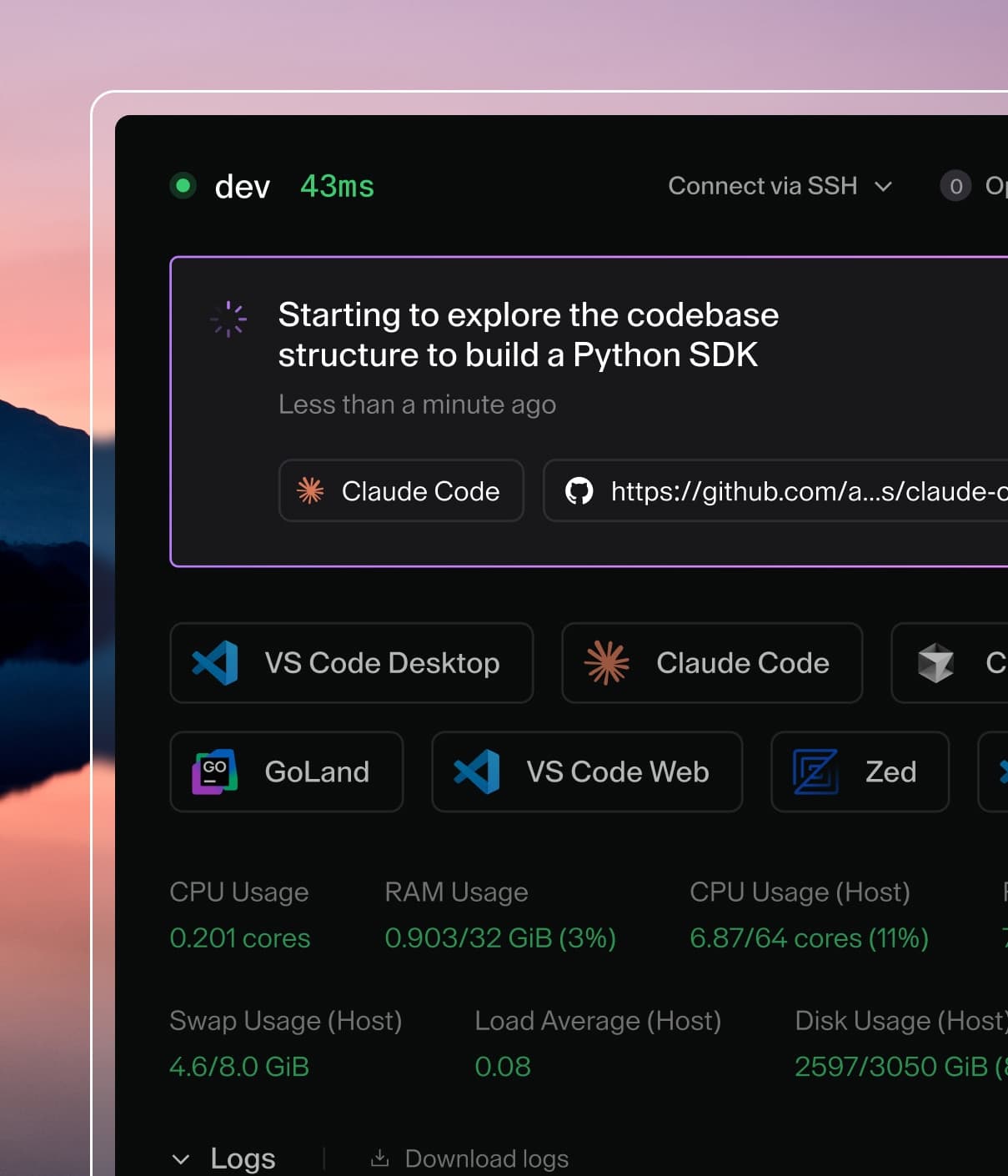
Coder powers secure, scalable development across key industries — automotive, finance, government, and technology — enabling faster builds, tighter compliance, and seamless AI adoption in enterprise-grade cloud environments.
./coderd/database/migrations/create_fixture.sh my name
/home/coder/src/coder/coderd/database/migrations/000070_my_name.up.sql
/home/coder/src/coder/coderd/database/migrations/000070_my_name.down.sql
Run "make gen" to generate models.
Then write queries into the generated .up.sql and .down.sql files and commit
them into the repository. The down script should make a best-effort to retain as
much data as possible.
Database fixtures (for testing migrations)
There are two types of fixtures that are used to test that migrations don't
break existing Coder deployments:
Both types behave like database migrations (they also
migrate). Their behavior mirrors
Coder migrations such that when migration number 000022 is applied, fixture
000022 is applied afterwards.
Partial fixtures are used to conveniently add data to newly created tables so
that we can ensure that this data is migrated without issue.
Full database dumps are for testing the migration of fully-fledged Coder
deployments. These are usually done for a specific version of Coder and are
often fixed in time. A full database dump may be necessary when testing the
migration of multiple features or complex configurations.
To add a new partial fixture, run the following command:
./coderd/database/migrations/create_fixture.sh my fixture
/home/coder/src/coder/coderd/database/migrations/testdata/fixtures/000070_my_fixture.up.sql
Then add some queries to insert data and commit the file to the repo. See
000024_example.up.sql
for an example.
To create a full dump, run a fully fledged Coder deployment and use it to
generate data in the database. Then shut down the deployment and take a snapshot
of the database.
mkdir -p coderd/database/migrations/testdata/full_dumps/v0.12.2 && cd $_
pg_dump "postgres://coder@localhost:..." -a --inserts >000069_dump_v0.12.2.up.sql
Make sure sensitive data in the dump is desensitized, for instance names,
emails, OAuth tokens and other secrets. Then commit the dump to the project.
To find out what the latest migration for a version of Coder is, use the
following command:
Contributions must adhere to the guidelines outlined in
Effective Go. We prefer linting rules over
documenting styles (run ours with make lint); humans are error-prone!
Coder writes packages that are used during implementation. It isn't easy to
validate whether an abstraction is valid until it's checked against an
implementation. This results in a larger changeset, but it provides reviewers
with a holistic perspective regarding the contribution.
Coder values thorough reviews. For each review comment that you receive, please
"close" it by implementing the suggestion or providing an explanation on why the
suggestion isn't the best option. Be sure to do this for each comment; you can
click Done to indicate that you've implemented the suggestion, or you can
add a comment explaining why you aren't implementing the suggestion (or what you
chose to implement instead).
It is perfectly normal for changes to go through several rounds of reviews, with
one or more reviewers making new comments every time, then waiting for an
updated change before reviewing again. All contributors, including those from
maintainers, are subject to the same review cycle; this process is not meant to
be applied selectively or to discourage anyone from contributing.
Releases
Coder releases are initiated via
./scripts/release.sh
and automated via GitHub Actions. Specifically, the
release.yaml
workflow. They are created based on the current
main branch.
The release notes for a release are automatically generated from commit titles
and metadata from PRs that are merged into main.
Creating a release
The creation of a release is initiated via
./scripts/release.sh.
This script will show a preview of the release that will be created, and if you
choose to continue, create and push the tag which will trigger the creation of
the release via GitHub Actions.
See ./scripts/release.sh --help for more information.
Creating a release (via workflow dispatch)
Typically the workflow dispatch is only used to test (dry-run) a release,
meaning no actual release will take place. The workflow can be dispatched
manually from
Actions: Release.
Simply press "Run workflow" and choose dry-run.
If a release has failed after the tag has been created and pushed, it can be
retried by again, pressing "Run workflow", changing "Use workflow from" from
"Branch: main" to "Tag: vX.X.X" and not selecting dry-run.
Allowed commit types (feat, fix, etc.) are listed in
conventional-commit-types.
Note that these types are also used to automatically sort and organize the
release notes.
A good commit message title uses the imperative, present tense and is ~50
characters long (no more than 72).
Note: We lint PR titles to ensure they follow the Conventional Commits
specification, however, it's still possible to merge PRs on GitHub with a badly
formatted title. Take care when merging single-commit PRs as GitHub may prefer
to use the original commit title instead of the PR title.
Breaking changes
Breaking changes can be triggered in two ways:
Add ! to the commit message title, e.g.
feat(api)!: remove deprecated endpoint /test
Add the
release/breaking
label to a PR that has, or will be, merged into main.
Security
If you find a vulnerability, DO NOT FILE AN ISSUE. Instead, send an email
to [email protected].
The
security
label can be added to PRs that have, or will be, merged into main. Doing so
will make sure the change stands out in the release notes.
Experimental
The
release/experimental
label can be used to move the note to the bottom of the release notes under a
separate title.
Troubleshooting
Nix on macOS: error: creating directory
On macOS, a direnv bug can cause
nix-shell to fail to build or run coder. If you encounter
error: creating directory when you attempt to run, build, or test, add a
mkdir line to your .envrc: