Coder Agents
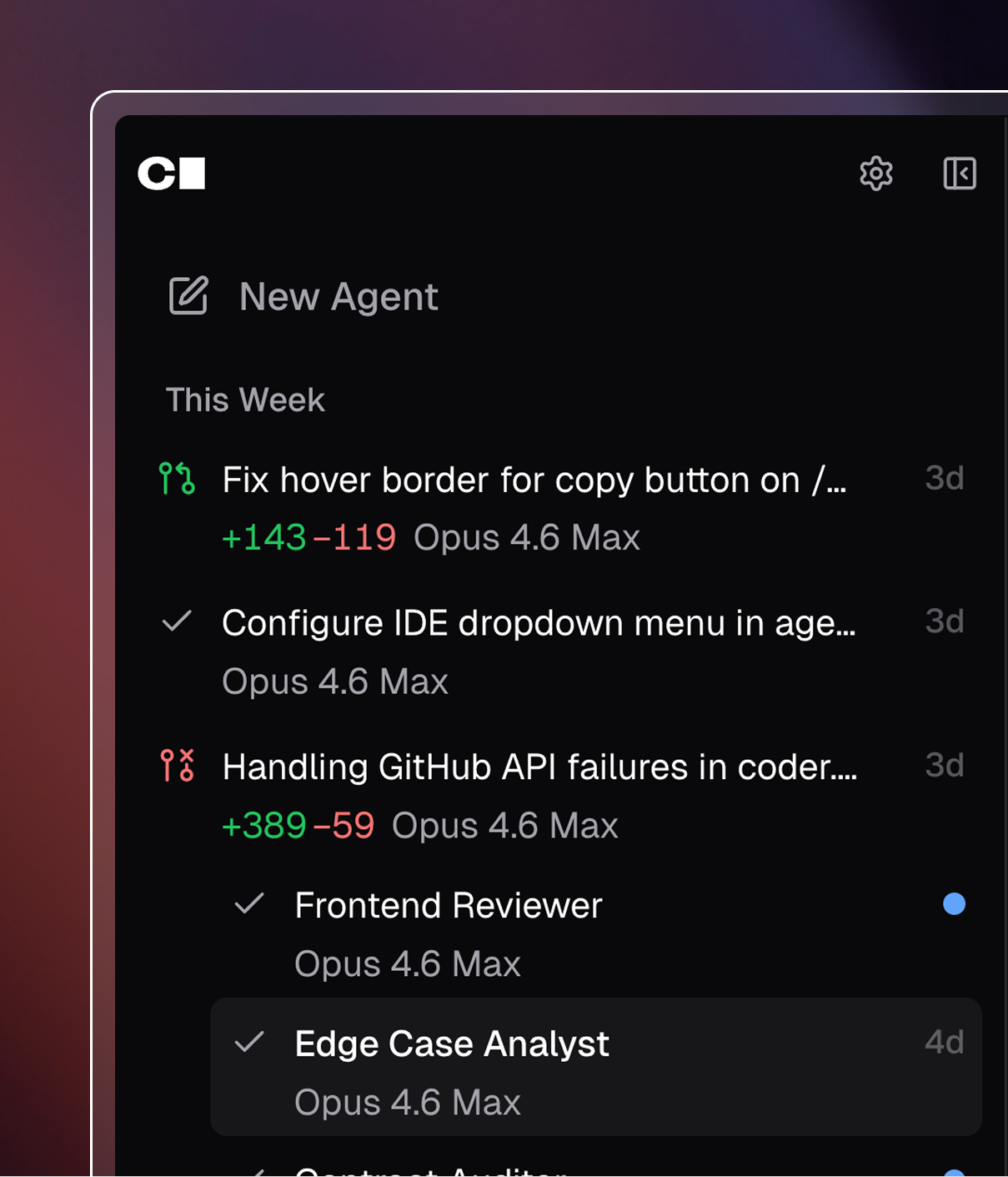
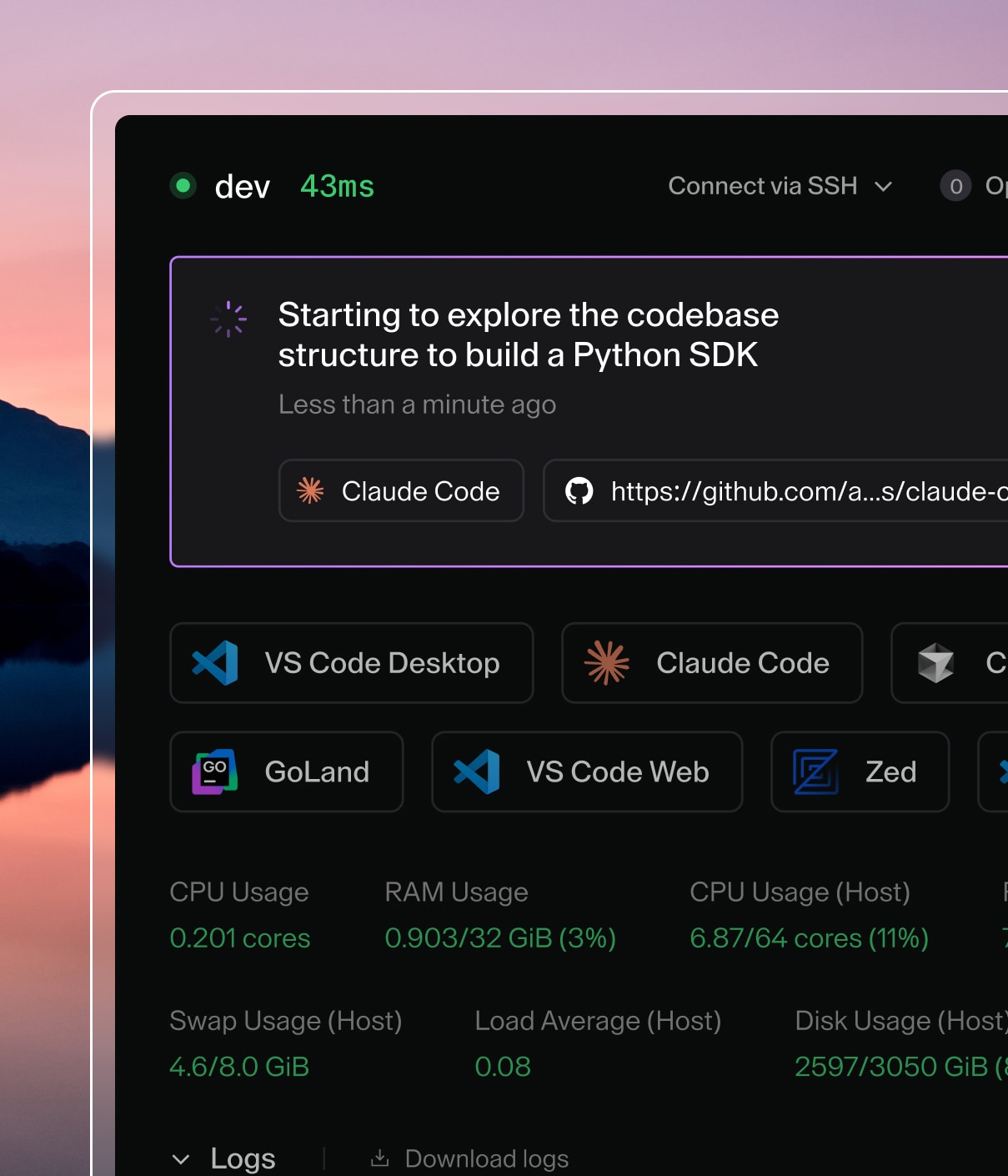
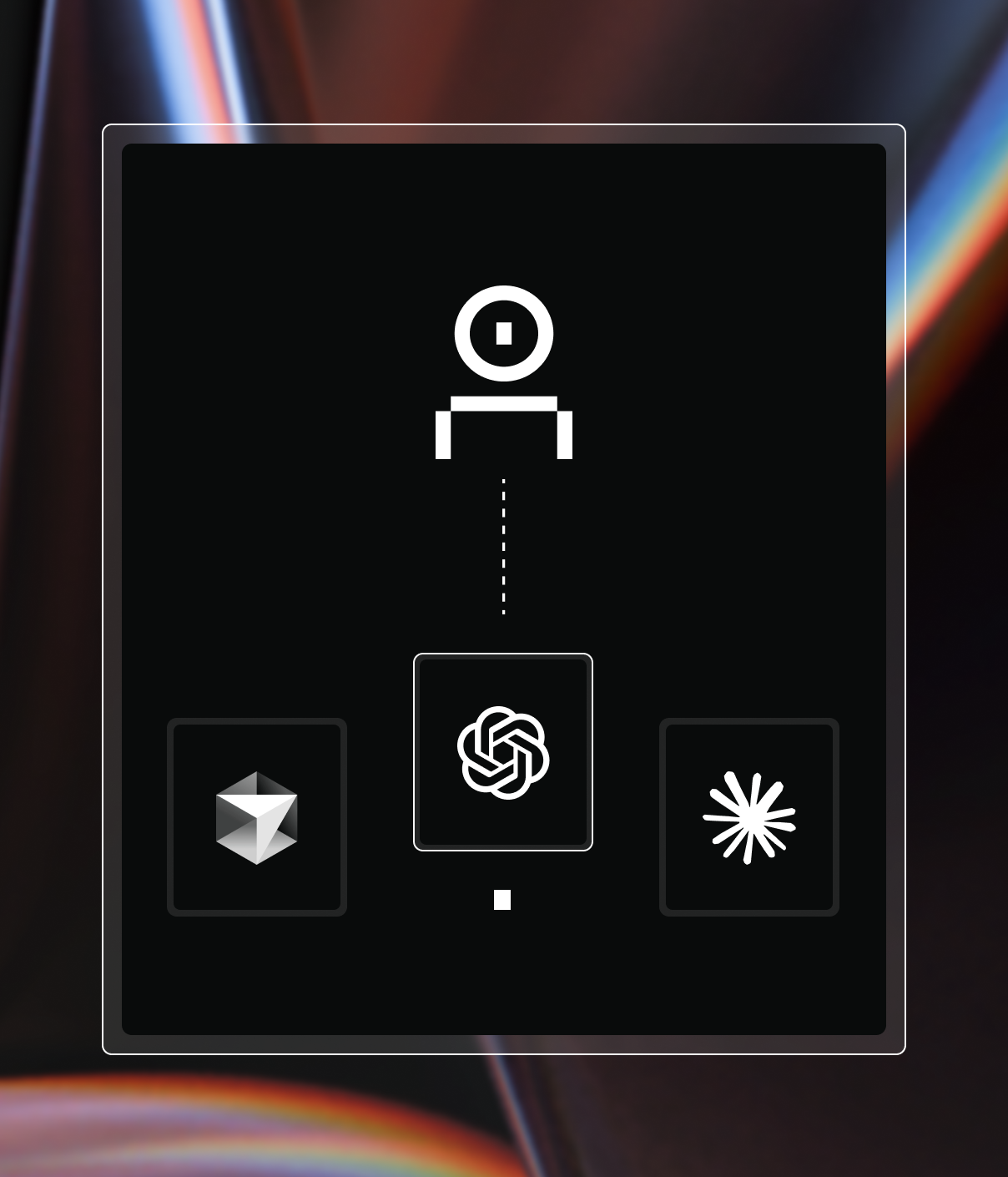
Coder Agents is a chat interface and API for delegating development work to coding agents that run inside the Coder control plane. When AI Gateway is enabled on the same deployment, Coder Agents traffic can be routed through it for full audit and governance coverage.
Prerequisites
- AI Gateway is enabled on your Coder deployment.
- At least one provider is configured in AI Gateway with a valid upstream key.
- You are an administrator with permission to configure Coder Agents providers.
Note
AI Gateway and Coder Agents use independent provider configurations. Adding a provider to AI Gateway does not enable it in Coder Agents, and vice versa. Configure each separately.
Configuration
Point each Agents provider's Base URL at your local AI Gateway endpoint
and set the API Key to a credential AI Gateway accepts. Because both
services run in the same coderd process, the AI Gateway endpoint is just
your deployment URL plus /api/v2/aibridge/<provider>.
The steps are the same regardless of provider type, only the Base URL changes:
- Open the Coder dashboard and navigate to the Agents page.
- Click Admin, then select the Providers tab.
- Click the provider you want to route through AI Gateway.
- Set the Base URL using the table below.
- Set the API Key to a Coder API token. See Authentication for which token to use.
- Click Save.
| Agents provider | Base URL |
|---|---|
| Anthropic | https://coder.example.com/api/v2/aibridge/anthropic |
| OpenAI | https://coder.example.com/api/v2/aibridge/openai/v1 |
| OpenAI Compatible (named OpenAI instance) | https://coder.example.com/api/v2/aibridge/<name>/v1 |
Replace coder.example.com with your Coder deployment URL.
To target a named AI Gateway instance
through the Anthropic or OpenAI providers, swap the provider segment
of the Base URL for the instance name. For example, an Anthropic instance
named anthropic-corp becomes
https://coder.example.com/api/v2/aibridge/anthropic-corp, and an OpenAI
instance named azure-openai becomes
https://coder.example.com/api/v2/aibridge/azure-openai/v1.
Note
The table above covers the Coder Agents provider types most commonly
routed through AI Gateway. Coder Agents also supports Azure OpenAI,
AWS Bedrock, Google, OpenRouter, and Vercel AI Gateway provider types,
but only providers that speak a wire protocol AI Gateway supports
(Anthropic, OpenAI, or Copilot today) can be routed through it. The
base URL pattern is the same for any compatible provider: point it at
https://<your-coder-host>/api/v2/aibridge/<instance-name>.
After saving, add or update a model on each provider so developers can select it from the chat. Models from a provider only appear in the model selector once the provider has valid credentials.
Authentication
AI Gateway accepts Coder-issued tokens for client authentication and also
supports Bring Your Own Key
(BYOK) for other clients.
Coder Agents only uses the centralized key mode today. The upstream
provider keys you configured for AI Gateway (for example,
CODER_AI_GATEWAY_OPENAI_KEY) are used by AI Gateway internally to call the
upstream provider; they are not what Coder Agents sends.
Coder Agents stores the API Key field on each provider as the bearer credential it forwards to AI Gateway on every request from any chat that uses that provider. AI Gateway resolves the bearer token to a Coder user and uses that user as the initiator on every interception.
Because the Agents provider config is deployment-wide, every chat that uses this provider is logged in AI Gateway under the identity of whoever owns the API token configured here. Per-chat attribution to the developer who started a chat is not preserved when routing Agents traffic through AI Gateway today. See Known limitations below.
For that reason, use a long-lived API token for a dedicated service account that is intended to represent Agents traffic in audit. Avoid using an admin's personal token: every chat would otherwise appear to have been initiated by that admin.
Note
Coder Agents does not support Bring Your Own Key when routing through AI Gateway today, but we plan to unify these authentication modes in a future release. For now, the Agents User API keys feature is independent of AI Gateway and applies to direct provider calls only.
Identity and correlation headers
When Coder Agents calls a provider, it attaches identity headers to every outgoing request. Today AI Gateway uses two of them:
| Header | Used by AI Gateway today |
|---|---|
User-Agent | Detects Coder Agents traffic and labels sessions with the Coder Agents client name. |
X-Coder-Chat-Id | Acts as the AI Gateway session key, so every interception in a chat (and its sub-agents) appears under a single session. |
Coder Agents also sends X-Coder-Owner-Id, X-Coder-Subchat-Id, and
X-Coder-Workspace-Id. These are emitted for forward compatibility but
are not consumed by AI Gateway today, which is why per-developer
attribution is not preserved. See
Known limitations for details.
You don't need to configure these headers; they are set automatically.
Pre-configuring in templates
You don't need to configure anything inside workspaces for Coder Agents itself to use AI Gateway. The agent loop runs in the control plane, so the Agents provider's Base URL is the only place AI Gateway needs to be wired up.
If you also want IDE-based clients running inside Agents-provisioned workspaces (such as Claude Code or Codex CLI) to route through AI Gateway, configure them on the workspace template. See the Configuring In-Workspace Tools section for the general pattern, plus the per-client pages such as Claude Code.
Verifying the integration
After saving the provider, start a new chat from the Agents page and send a short prompt. Then:
- Open the AI Gateway sessions UI at
https://coder.example.com/aibridge/sessions. - The most recent session should show Coder Agents as the client and the user that owns the API token configured on the Agents provider as the initiator.
- Click into the session to see the chat's interceptions, token usage, and any tool invocations.
If the session does not appear, check that the Agents provider's Base URL
points at your deployment's /api/v2/aibridge/... path and that the API
key is a valid Coder token.
Troubleshooting
401 Unauthorizedfrom the chat. The API key on the Agents provider is not a valid Coder token, has been revoked, or belongs to a user that cannot reach AI Gateway. Generate a new long-lived token and update the provider.- Sessions in audit show a generic client instead of Coder Agents.
This usually means the request bypassed AI Gateway. Confirm the
provider's Base URL starts with your deployment's
/api/v2/aibridge/path and not the upstream provider URL. - Provider does not appear in the Agents model selector. Add at least one model to the provider after saving the Base URL. Providers without an enabled model are hidden from developers.
Known limitations
- Per-developer attribution is not preserved. AI Gateway attributes
every interception to the user that owns the bearer token configured
on the Agents provider, regardless of which developer started the
chat. The chat owner ID is sent by Coder Agents in
X-Coder-Owner-Idbut is not consumed by AI Gateway today. Use a dedicated service account for the Agents provider's API token so audit data is attributed to a single, non-human identity. - Bring Your Own Key (BYOK) is not supported through AI Gateway. Personal LLM credentials configured under User API keys are sent directly to the provider; AI Gateway is not involved when BYOK is active.
Related documentation
- Coder Agents: Models and providers for the full reference on configuring providers in Agents.
- Coder Agents: Using an LLM proxy for the short version of this same configuration.
- AI Gateway setup for enabling AI Gateway and configuring upstream provider credentials.
- Auditing AI sessions for how AI Gateway groups Coder Agents traffic into sessions.