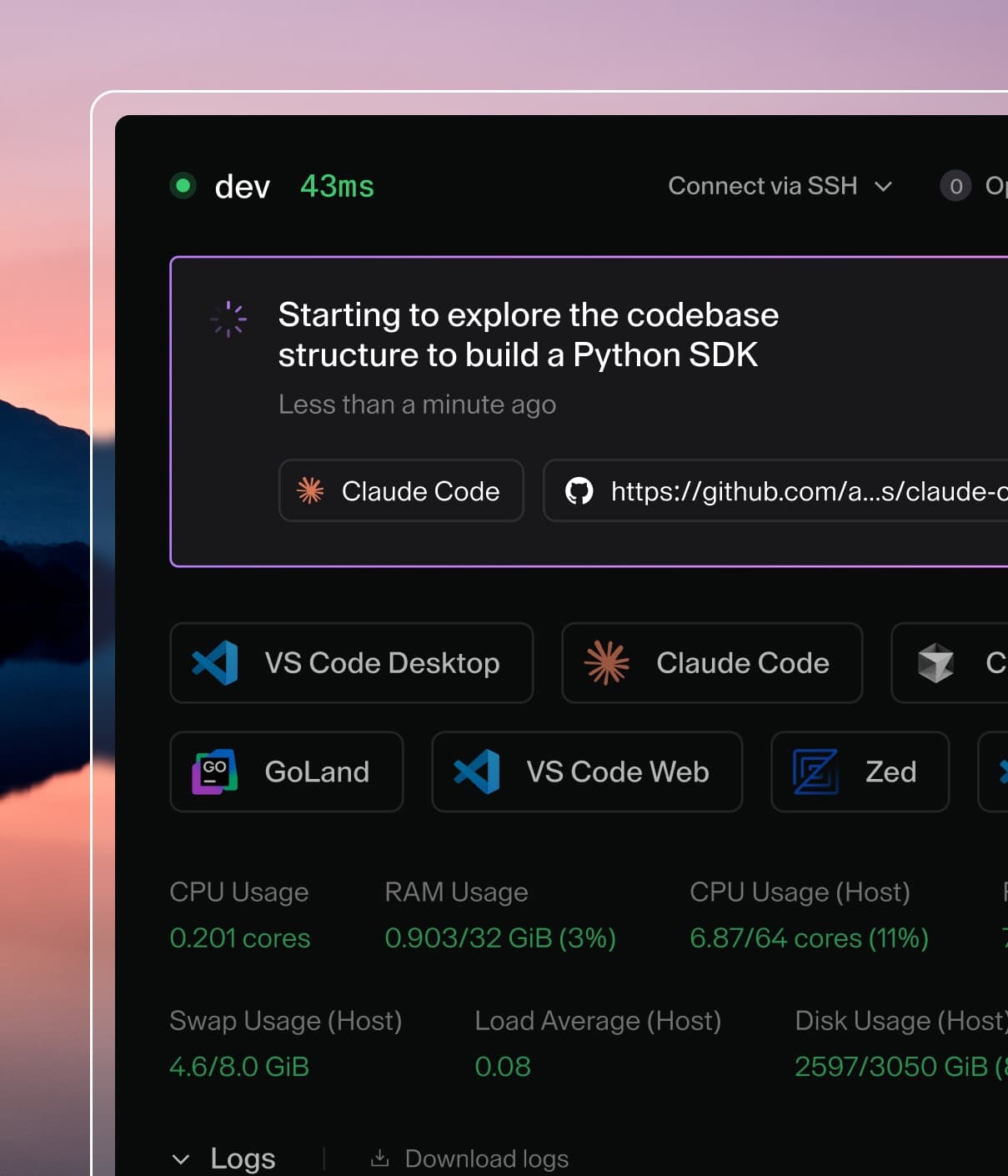
Coder powers secure, scalable development across key industries — automotive, finance, government, and technology — enabling faster builds, tighter compliance, and seamless AI adoption in enterprise-grade cloud environments.
The provider is off.
Set CODER_OAUTH2_PROVIDER_ENABLE=true and restart the server.
Refer to Enable OAuth2 Provider.
"Invalid redirect_uri"
Ensure the redirect URI in your request exactly matches one of the redirect URIs registered for your application.
The one exception is the port of a loopback http:// redirect URI (localhost, 127.0.0.1, [::1]), which may differ from the registered one.
Refer to Callback URL schemes.
"Invalid Callback URL" on the consent page
If you see this error when authorizing, one of the application's registered redirect URIs is not usable: either it does not parse as a URL, or it uses a blocked scheme (javascript:, data:, file:, or ftp:).
The same cause answers server_error on POST /oauth2/authorize.
Use GET /api/v2/oauth2-provider/apps/{app} to see every registered redirect URI, then update the application with a corrected redirect_uris list as shown under Create an application with the API.
Refer to Callback URL schemes for which values are accepted.
The coderd log records the application ID and the stored value.
The response does not, so a bad URL is never echoed back to a browser.
"invalid_scope" returned to your callback
The authorization endpoint validates the scope parameter.
When it cannot grant what was asked for, it redirects to your registered callback with error=invalid_scope rather than issuing a code.
The error_description opens with the requested name that caused the rejection:
unknown or unsupported scope: this deployment does not offer that name to OAuth2 clients.
It may not exist, or it may exist and be internal-only, which no version offers.
Read the current list from scopes_supported in GET /.well-known/oauth-authorization-server.
scope requests permissions beyond this app's allowed scopes: the name is supported, but the application's scope allowlist does not cover it.
Request less, or widen the allowlist.
If the application registered itself and an administrator has since narrowed its allowlist, refer to Scopes.
none of the scopes registered for this app are supported by this deployment: the application's scope allowlist names nothing this deployment offers, so no request against it can succeed, including one that omits scope.
Update the allowlist with supported scopes.
This description stands alone.
Dynamic Client Registration drops unsupported names before storing, so this applies to an allowlist set through the web UI or the management API, or to an application that registered before names were checked.
Such a value was never checked against the catalog, so the response never echoes it; the coderd log records the application ID.
scope requests permissions beyond the signed-in session: the session authorizing the request does not hold that scope.
Authorize from a browser session, which holds every scope.
the signed-in session is restricted to an allow list: the session authorizing the request has an allow list other than *:*.
Authorize from a browser session, which has none.
This description stands alone.
Omitting scope requests the application's allowlist, or full access if it has none.
The negotiated scope is recorded on the authorization, shown on the consent page, and applied to the access token issued when the code is exchanged.
"invalid_grant" for a scope the deployment cannot mint
POST /oauth2/tokens mints the access token with the scope recorded on the authorization code, or on the refresh token when refreshing.
If that stored scope names something this deployment cannot mint, the exchange answers HTTP 400 with error=invalid_grant and an error_description naming the value.
The usual cause is a grant made against a scope the deployment has since dropped.
Authorize again to negotiate a scope it still supports; the stored scope is not something the client can change by requesting a different one.
The exchange also re-checks the code's scope against the application's registered scope, which can change during the 10 minutes a code stays valid.
Two more descriptions can open the error_description here:
scope is no longer allowed by this app's registered scopes: the allowlist narrowed after the code was issued and no longer covers the code's scope.
Authorize again to negotiate a scope within the new allowlist.
none of the scopes registered for this app are supported by this deployment: the allowlist names nothing this deployment offers, so no code against it can be redeemed.
Update the allowlist with supported scopes.
As on the authorize endpoint, the stored value stays out of the response.
A coverage comparison this deployment cannot decide answers HTTP 500 with error=server_error and The requested scope could not be evaluated; the scope that could not be compared is in the coderd logs, not the response.
An application's scope allowlist can change through Dynamic Client Registration, by the application itself, or through the management API, by an administrator.
An application that holds its registration access token can widen its own allowlist again before redeeming a code, so treat this re-check as reflecting the allowlist at redemption time rather than as a constraint on the client.
A refresh is not re-checked against the registration.
That is a Coder policy choice: withdrawing scope from a session already running would break it mid-flight, so a narrowing takes effect at the next authorization.
A refresh token keeps its granted scope until it expires, which can be up to the configured refresh lifetime; revoke the token to cut a live session.
Codes issued before the upgrade that added scope columns carry coder:all, recorded as an unrestricted grant.
For an application with a narrower scope allowlist, those codes are refused with scope is no longer allowed by this app's registered scopes until they expire, which takes at most 10 minutes.
Authorizing again issues a code within the current allowlist.
"invalid_scope" for a refresh that names a scope
POST /oauth2/tokens answers HTTP 400 with error=invalid_scope when a refresh request names a scope the control plane will not grant.
This is the token endpoint, not the authorization endpoint above: there is no redirect, and the error is in the response body.
A refresh may name a scope of its own to give up authority.
The narrowing applies to the access token that refresh mints, and to nothing else.
The refresh token continues to represent the scope the user consented to, so the ceiling does not move and a later refresh may ask for a different part of the same grant, or omit scope to take the grant whole again.
The request may name any scope the original grant confers that also appears in scopes_supported, including a single permission out of a composite scope, so a token granted coder:workspaces.access can refresh down to workspace:read for one call and to workspace:ssh for the next.
Two descriptions can open the error_description, each opening with the requested name that caused it:
scope requests permissions beyond the scope originally granted; a refresh cannot widen a grant, so authorize again to obtain a broader one: the name is offered, but the resource owner never granted it.
unknown or unsupported scope: this deployment does not offer that name to OAuth2 clients, either because it does not exist or because it is internal.
A refused refresh mints nothing and leaves the refresh token usable, so a client that asked for too much can retry with less rather than re-authorizing.
Only the resource owner lowers the ceiling, by revoking the token or authorizing again with less.
This is also what OAuth 2.1 section 4.3.3 requires: a rotated refresh token carries the scope of the one presented.
Narrowing a composite scope to the low-level names you can request may drop permissions that have no requestable name of their own.
coder:workspaces.create confers organization_member:read, which a workspace build needs and which scopes_supported does not list, so a token narrowed to the fullest set a client can name will fail to create a workspace.
Refresh without a scope to return to the composite.
"invalid_client" for a refresh or a revocation
POST /oauth2/tokens with grant_type=refresh_token and POST /oauth2/revoke answer HTTP 401 with error=invalid_client when a confidential client does not authenticate.
The usual causes are a client_secret that was omitted, a secret that belongs to a different client, or a secret that has since been deleted or rotated.
Present the client's current secret, as HTTP Basic or as a form parameter, following Refresh tokens.
The refresh token is not consumed and nothing is revoked by the refusal, so the retry needs no new authorization.
If the secret was deleted, the tokens issued under it were revoked with it, and the client must authorize again.
Public clients have no secret and never receive this error for omitting one.
"invalid_request" for client_secret in the query string
POST /oauth2/tokens and POST /oauth2/revoke answer HTTP 400 with error=invalid_request when client_secret appears in the URL query string.
OAuth 2.1 section 2.4.1 allows the secret in the request body or the Authorization header only.
Send it as a form parameter or as HTTP Basic, following Client authentication methods.
The rule covers client_secret only.
Coder still reads refresh_token, code, and the revocation token from the query string.
Send those in the request body too, not in the query string.
A client_secret with no value, as in ?client_secret=, counts as absent under RFC 6749 section 3.2 and is not refused by this rule.
POST /oauth2/revoke accepts such a request when the body authenticates.
POST /oauth2/tokens answers 400 only when the body also carries a client_secret, because it reads the body copy and the empty URL copy as the same parameter sent twice, and the error says so.
An empty query value alone never causes a 400: a request that authenticates with HTTP Basic and sends no secret in the body, or one from a public client, succeeds.
A copy in the body does not excuse one in the URL: the request is refused on the query string alone, whatever the body holds.
The refusal issues no token and revokes nothing, so the retry needs no new authorization.
GET /oauth2/authorize is not rejected when its URL carries client_secret, because RFC 6749 section 3.1 requires that endpoint to ignore parameters it does not recognize.
Coder ignores the value and logs a warning instead.
Each refusal and the authorization warning write a log line containing client_secret in the URL query string with the app_id, remote_addr, and user_agent of the request.
Search the Coder logs for that string to find the integration that sends the secret in the URL.
The log line records that the parameter was present, not that its value was a valid secret.
The check runs before client authentication, so anyone who knows the public client_id can produce the same line without credentials.
Confirm with the client's owner that their integration sent the request before rotating.
The check also runs after the client_id is resolved.
A request with a missing, malformed, or unknown client_id is answered by that lookup first and writes no such line, so an absent line does not mean no integration is leaking.
Rotate the secret that was in the URL.
It is still valid, and a URL is recorded by reverse proxies, load balancers, CDN access logs, shell history, and client libraries.
Coder does not log query strings, so an empty result when you search the Coder logs does not mean the secret stayed private.
Deleting a secret also revokes the tokens issued under it, so the client has to authorize again.
Earlier releases accepted the parameter in the query string.
An integration that relied on that has to move it into the body or the header.
HTTP 401 for an access token in the query string
Coder ignores an access token issued by the OAuth2 provider when it arrives only in the URL query string, as ?access_token= or ?coder_session_token=.
OAuth 2.1 section 5.1 requires the resource server to ignore access tokens in a URI query parameter.
Coder handles the request as if it carried no token at all.
Most endpoints require a signed-in user, so they answer HTTP 401 with a WWW-Authenticate: Bearer header.
That header carries no error code, since no token was accepted, and the JSON body says to send the token in the Authorization header instead.
A few endpoints also work without a signed-in user, and those handle the request as an anonymous one and return no error.
Send the token in the Authorization header instead, as shown under Authorization code flow.
The rule applies to tokens the OAuth2 provider issued.
Coder session tokens and API tokens created from the dashboard or the CLI are still accepted in the query string, because browsers cannot set headers on WebSocket connections.
A dashboard page embedded in another application and authenticated with an OAuth2 access token cannot open WebSocket connections, because the page has no other way to send the token on a WebSocket.
A token that also appears in the Authorization header, the Coder-Session-Token header, or the session cookie is accepted, and the query copy is ignored.
An app served through an external workspace proxy is not covered by this rule.
The proxy forwards the client's request to the primary as a header regardless of how the client sent it to the proxy, so a token sent only in the query string to the proxy can still authenticate, and no warning is logged.
Each ignored token writes a log line containing oauth2 access token ignored: sent in the URL query string with the api_key_id, user_id, app_id, path, remote_addr, and user_agent of the request.
The app_id matches the application in the OAuth2 Applications admin page, and the user_id names the user whose authorization the integration is using.
Search the Coder logs for that string to find the integration that sends the token in the URL.
The ignored token stays valid and is not marked as used.
A URL is recorded by reverse proxies, load balancers, CDN access logs, browser history, and Referer headers.
Treat a token that was sent this way as exposed and end it in one of these ways:
The integration owner, who holds the token value and the client credentials, revokes it following Revoke a token.
An administrator deletes the key with the two IDs from the log line, DELETE /api/v2/users/{user_id}/keys/{api_key_id}, or cuts off every user of the application by deleting it or one of its secrets following Delete an application.
Earlier releases accepted the token in the query string.
An integration that relied on that has to move it into the Authorization header.
"unsupported_response_type" returned to your callback
Coder supports the authorization code flow only, so response_type=code is the single accepted value.
GET /.well-known/oauth-authorization-server reports it in response_types_supported.
Any other value, including the token of the implicit grant, redirects to your registered callback with error=unsupported_response_type, an error_description of Only response_type=code is supported, and the state you sent.
This holds for both GET /oauth2/authorize and POST /oauth2/authorize.
Earlier releases answered on Coder instead: GET rendered an "Unsupported Response Type" page and POST returned a 400 with a JSON body.
An integration that watched for either now has to read the error from its own callback.
"invalid_request" for code_challenge_method
Coder supports the S256 challenge method only.
plain sends the verifier itself as the challenge, so anything that can observe the authorization request can complete the exchange, which is what PKCE exists to prevent.
Omitting the parameter is allowed and means S256.
An unsupported method redirects to your registered callback with error=invalid_request, an error_description that names the method, and the state you sent.
This holds for both GET /oauth2/authorize and POST /oauth2/authorize.
"invalid_request" for a rejected parameter
Coder validates every authorization parameter before issuing a code, and reports all the failing fields together in one error_description.
Each entry reads field: reason, and entries are separated by a semicolon and a space.
Common causes are a code_challenge outside the 43 to 128 character unreserved set, and any parameter sent more than once.
The rejection redirects to your registered callback with error=invalid_request, an error_description naming the fields, and the state you sent.
This holds for both GET /oauth2/authorize and POST /oauth2/authorize.
A description longer than 2048 characters is cut short and marked (truncated).
Parameters the endpoint does not read are ignored, as RFC 6749 Section 3.1 requires, so an OIDC nonce or a vendor extension does not fail the request.
A misspelled parameter is ignored on the same rule, so what you see is the failure caused by the parameter you meant to send being absent.
Two failures stay on Coder rather than reaching your callback, because in both cases the callback is not yet trustworthy:
A redirect_uri that does not parse, or that does not exactly match one of the redirect URIs registered for the application.
Redirecting to it would defeat the check that just rejected it, so Coder answers 400 (refer to "Invalid redirect_uri").
A client_id sent more than once, or one that does not name the application the callback was matched against.
Coder cannot tell whose registration it is about to redirect to.
Earlier releases answered on Coder for all of these: GET rendered an "Invalid Query Parameters" page and POST returned a 400 with a JSON body.
An integration that watched for either now has to read the error from its own callback.
"invalid_request" from POST /oauth2/tokens for a repeated parameter
The token endpoint ignores parameters it does not read, as RFC 6749 Section 3.2 requires, so an OIDC nonce, a client_assertion, or a vendor extension does not fail the exchange.
A misspelled parameter is ignored on the same rule, so what you see is the failure caused by the parameter you meant to send being absent.
A known parameter sent more than once is rejected with a 400 and a JSON body.
The error is invalid_request, except for a repeated grant_type, which answers unsupported_grant_type.
Earlier releases returned 400 invalid_request for any parameter the endpoint did not recognize.
An integration that relied on that error to catch a misspelled optional parameter no longer receives it.
"invalid_target" for a rejected resource
resource must be an absolute URI without a fragment (RFC 8707).
A value that is not redirects to your registered callback with error=invalid_target, an error_description naming the field, and the state you sent.
POST /oauth2/token already answered invalid_target for the same value.
If anything else in the request also failed, the answer is invalid_request instead, naming every failing field.
Correct them all before retrying: a retry that fixes only resource fails again.
"PKCE verification failed"
Verify that the code_verifier used in the token request matches the one used to generate the code_challenge.
"public clients may not use the mailto/tel/sms scheme"
This error appears during client registration when a public client (token_endpoint_auth_method: none) registers a redirect URI using the mailto:, tel:, or sms: scheme.
These schemes hand off to a mail client, dialer, or SMS app instead of returning control to the application that started the flow, so a public client registered with one of them could never complete authorization.
Register a redirect URI the client can actually receive control on instead, such as a custom scheme (myapp://callback) or a loopback HTTP address.
Learn more
Review OAuth2 provider for enabling the provider and creating an application