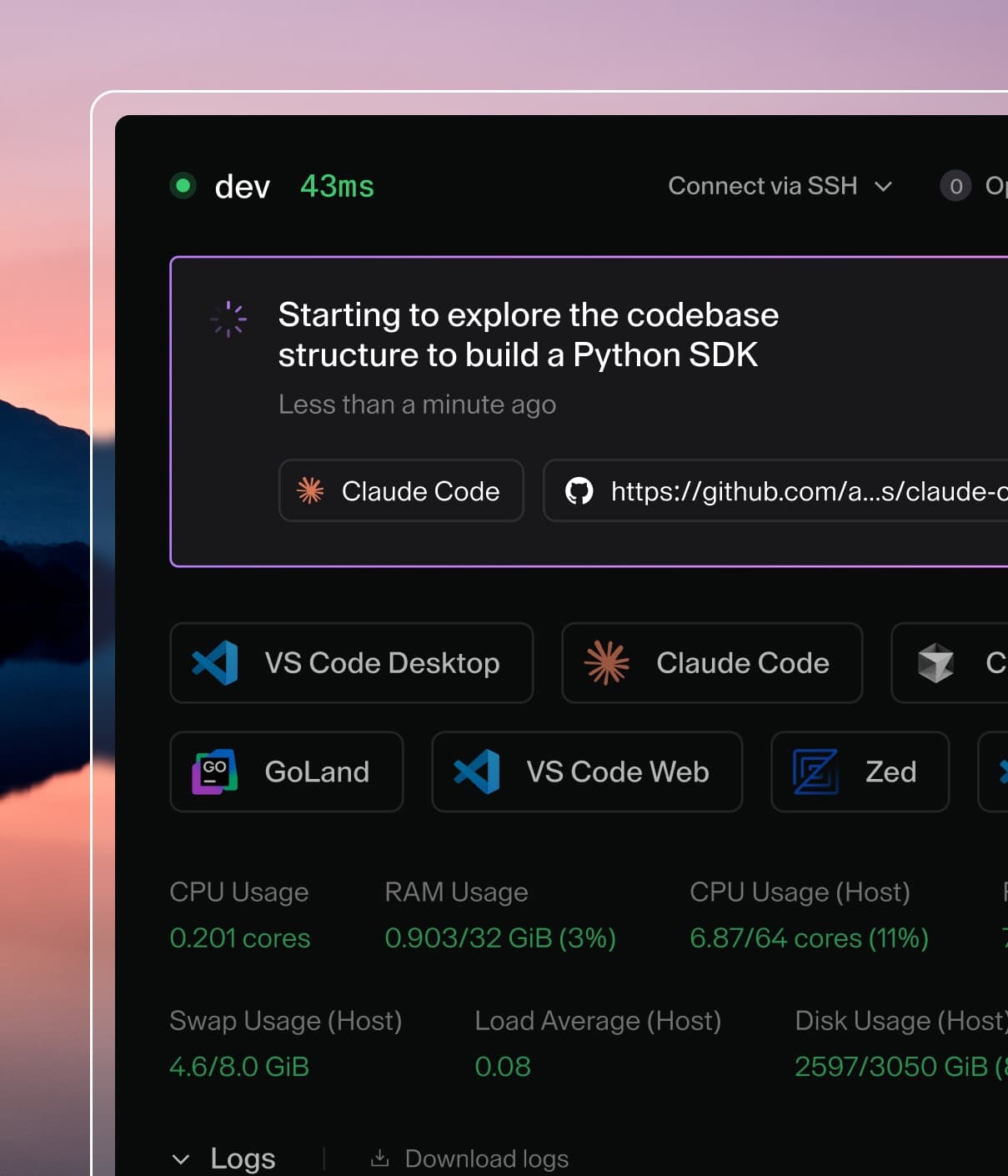
Coder powers secure, scalable development across key industries — automotive, finance, government, and technology — enabling faster builds, tighter compliance, and seamless AI adoption in enterprise-grade cloud environments.
The Connection Log page in the dashboard allows Auditors to monitor workspace agent connections.
Workspace App Connections
The connection log contains a complete record of all workspace app connections.
These originate from within the Coder deployment, and thus the connection log is a source of truth for these events.
Browser Port Forwarding
The connection log contains a complete record of all workspace port forwarding performed via the dashboard.
SSH and IDE Sessions
The connection log aims to capture a record of all workspace SSH and IDE sessions.
These events are reported by workspace agents, and their receipt by the control plane is not guaranteed.
Agent-reported events do not identify the Coder user who connected.
To attribute SSH and IDE activity to a user, correlate them with tunnel events for the same workspace and agent.
Tunnel Connections
The connection log records the authorization decision for each request to add a tunnel to a workspace agent.
Accepted requests have status code 101, and denied requests have status code 403.
Tunnel events include the authenticated user's identity, IP address, and user agent.
Keep the following in mind when interpreting tunnel events:
A tunnel event records an authorization decision, not how the tunnel was used.
Clients such as coder ssh, coder port-forward, coder ping, coder speedtest, Coder Desktop, and IDE extensions can request tunnels.
Tunnel events are deduplicated per workspace agent, actor, IP address, client, and authorization result.
Clients automatically re-request tunnels after network interruptions or server restarts.
These requests do not produce new events while a session is active.
A new event is recorded after one hour of inactivity, or when the actor, IP address, client, or result changes.
Like workspace app connections, tunnel events are point-in-time records.
They have no close time and are excluded from status: filter results.
How to Filter Connection Logs
You can filter connection logs by the following parameters:
organization - The name or ID of the organization of the workspace being connected to.
workspace_owner - The username of the owner of the workspace being connected to.
method - How the connection was established, such as ssh, reconnecting_pty, or workspace_app.
For every method, refer to the codersdk.ConnectionLogMethod schema.
For example, method:ssh matches every SSH connection, whichever app made it.
app - The name of the application that made an SSH or reconnecting PTY connection, such as cursor.
Repeat the filter to match any of several apps, for example app:vscode app:cursor.
Some clients report only vscode or jetbrains instead of their own name, so app:vscode and app:jetbrains can also include other VS Code-based editors and JetBrains IDEs.
Coder lowercases the value and replaces hyphens with underscores before it matches.
Workspace app slugs and forwarded ports don't match this filter.
type - Deprecated and will be removed in a future release.
Use method and app instead, as described in Replace the type filter.
username: The name of the user who initiated the connection.
Results do not include agent-reported SSH or IDE sessions.
user_email: The email of the user who initiated the connection.
Results do not include agent-reported SSH or IDE sessions.
connected_after: The time after which the connection started.
Uses the RFC3339Nano format.
connected_before: The time before which the connection started.
Uses the RFC3339Nano format.
workspace_id: The ID of the workspace being connected to.
connection_id: The ID of the connection.
status: The status of the connection, either ongoing or completed.
Only SSH and reconnecting PTY connections have a status.
A connection is completed after Coder receives its disconnect event, and ongoing until then.
Workspace app, port forwarding, and tunnel events never match a status filter.
Replace the type filter
If you have saved searches or scripts that use the type filter, replace it with method and app:
type filter
Replacement
type:ssh
method:ssh, which also matches SSH connections from VS Code and JetBrains apps
type:vscode
method:ssh with an app filter for each VS Code-based app, for example app:vscode app:cursor
type:jetbrains
method:ssh app:jetbrains, plus an app filter for any JetBrains IDE that reports its own name
Each connection log in the response describes the connection with these fields:
connection_method: How the connection was established, with the same values as the method filter.
app_name: The name of the application that made an SSH or reconnecting PTY connection, such as vscode.
The client reports this name, so treat it as a label rather than a verified identity.
The response omits this field when the app isn't known, and for workspace app, port forwarding, and tunnel connections.
web_info.slug_or_port: The workspace app slug or forwarded port, for workspace app and port forwarding connections.
type: Deprecated.
Use connection_method and app_name instead.
It will be removed in a future release.
If you read type, map its values to the new fields as follows:
type
connection_method
app_name
ssh
ssh
Omitted, or an app outside the VS Code and JetBrains families
vscode
ssh
An app in the VS Code family, such as vscode
jetbrains
ssh
An app in the JetBrains family, such as jetbrains
reconnecting_pty
reconnecting_pty
Omitted unless the app is known
workspace_app, port_forwarding, tunnel
Same as type
Omitted
The type field keeps the same values, but the API schema describes it as a string rather than an enum.
Service Logs
Connection events are also dispatched as service logs and can be captured and categorized using any log management tool such as Splunk.
Each connection_log entry describes the connection with these fields:
ConnectionMethod: How the connection was established, with the same values as the API connection_method field.
AppNameOrPort: The name of the connecting application for SSH and reconnecting PTY connections, or the workspace app slug or forwarded port for workspace app and port forwarding connections.
The value is an empty string when there is nothing to report.
If your log pipeline reads the Type or SlugOrPort fields, update it to read ConnectionMethod and AppNameOrPort, because entries no longer include the old fields.
For SSH connections from a VS Code or JetBrains family app, ConnectionMethod is ssh and AppNameOrPort holds the app name, such as vscode.
Every other former Type value matches ConnectionMethod directly.
Example of a JSON formatted connection log entry, when VS Code connects over SSH:
Coder supports configurable retention policies that automatically purge old Connection Logs.
To enable automated purging, configure the --connection-logs-retention flag or CODER_CONNECTION_LOGS_RETENTION environment variable.
For comprehensive configuration options, see Data Retention.