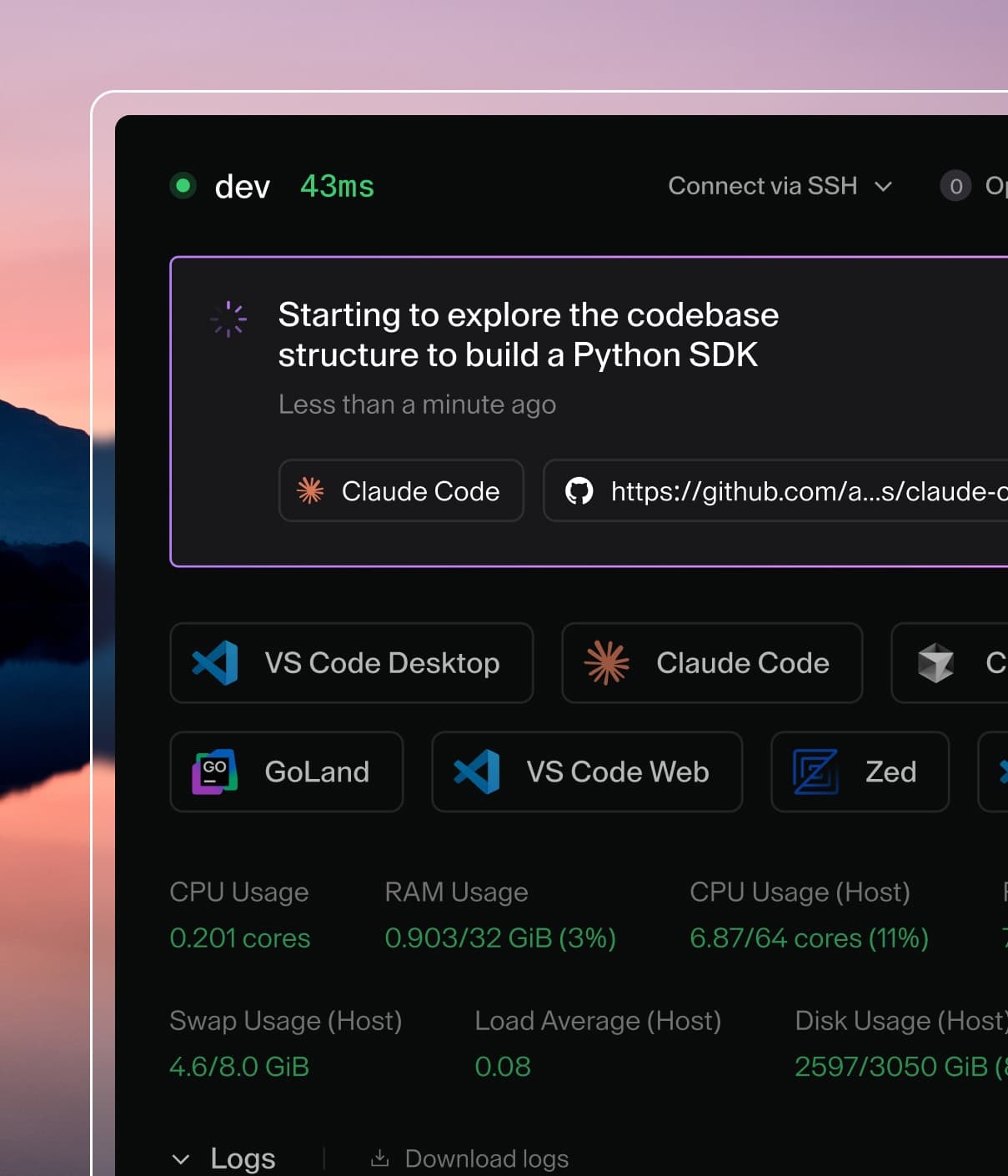
Coder powers secure, scalable development across key industries — automotive, finance, government, and technology — enabling faster builds, tighter compliance, and seamless AI adoption in enterprise-grade cloud environments.
Starting June 2, 2026, Coder Tasks will move to a 12-month Extended Support Release (ESR) for Premium customers.
Tasks will be removed from new Coder releases beginning with v2.37 (September 1, 2026) and will only be available via the ESR during the support period.
We recommend transitioning to Coder Agents, the long-term replacement.
Background
Most software engineering organizations track and manage their codebase through GitHub, and use project management tools like Asana, Jira, or even GitHub's Projects to coordinate work. Across these systems, engineers are frequently performing the same repetitive workflows: triaging and addressing bugs, updating documentation, or implementing well-defined changes for example.
Coder Tasks provides a method for automating these repeatable workflows. With a Task, you can direct an agent like Claude Code to update your documentation or even diagnose and address a bug. By connecting GitHub to Coder Tasks, you can build out a GitHub workflow that will for example:
Trigger an automation to take a pre-existing issue
Automatically spin up a Coder Task with the context from that issue and direct an agent to work on it
Focus on other higher-priority needs, while the agent addresses the issue
Get notified that the issue has been addressed, and you can review the proposed solution
This guide walks you through how to configure GitHub and Coder together so that you can tag Coder in a GitHub issue comment, and securely delegate work to coding agents in a Coder Task.
Implementing the GHA
The below steps outline how to use the Coder Create Task Action GHA in a GitHub workflow to solve a bug. The guide makes the following assumptions:
You have access to a Coder Server that is running. If you don't have a Coder Server running, follow our Get started guide
Your Coder Server is accessible from GitHub
You have an AI-enabled Task Template that can successfully create a Coder Task. If you don't have a Task Template available, follow our Getting Started with Tasks Guide
GitHub OAuth is configured in your Coder Deployment
Users have linked their GitHub account to Coder via /settings/external-auth
This guide can be followed for other use cases beyond bugs like updating documentation or implementing a small feature, but may require minor changes to file names and the prompts provided to the Coder Task.
Step 1: Create a GitHub Workflow file
In your repository, create a new file in the ./.github/workflows/ directory named triage-bug.yaml. Within that file, add the following code:
name: Start Coder Task

on:
  issues:
    types:
      - labeled

permissions:
  issues: write

jobs:
  coder-create-task:
    runs-on: ubuntu-latest
    if: github.event.label.name == 'coder'
    steps:
      - name: Coder Create Task
        uses: coder/create-task-action@v0
        with:
          coder-url: ${{ secrets.CODER_URL }}
          coder-token: ${{ secrets.CODER_TOKEN }}
          coder-organization: "default"
          coder-template-name: "my-template"
          coder-task-name-prefix: "gh-task"
          coder-task-prompt: "Use the gh CLI to read ${{ github.event.issue.html_url }}, write an appropriate plan for solving the issue to PLAN.md, and then wait for feedback."
          github-user-id: ${{ github.event.sender.id }}
          github-issue-url: ${{ github.event.issue.html_url }}
          github-token: ${{ github.token }}
          comment-on-issue: true
This code will perform the following actions:
Create a Coder Task when you apply the coder label to an existing GitHub issue
Pass as a prompt to the Coder Task:
Use the GitHub CLI to access and read the content of the linked GitHub issue
Generate an initial implementation plan to solve the bug
Write that plan to a PLAN.md file
Wait for additional input
Post an update on the GitHub ticket with a link to the task
The prompt text can be modified to not wait for additional human input, but continue with implementing the proposed solution and creating a PR for example. Note that this example prompt uses the GitHub CLI gh, which must be installed in your Coder template. The CLI will automatically authenticate using the user's linked GitHub account via Coder's external auth.
Step 2: Setup the Required Secrets & Inputs
The GHA has multiple required inputs that require configuring before the workflow can successfully operate.
You must set the following inputs as secrets within your repository:
coder-token: follow our API Tokens documentation to generate a token. Note that the token must be an admin/org-level with the "Read users in organization" and "Create tasks for any user" permissions
You must also set coder-template-name as part of this. The GHA example has this listed as a secret, but the value doesn't need to be stored as a secret. The template name can be determined the following ways:
By viewing the URL of the template in the UI, e.g. https://<your-coder-url>/templates/<org-name>/<template-name>
Using the Coder CLI:
# List all templates in your organization
coder templates list
You can also choose to modify the other input parameters to better fit your desired workflow.
Template Requirements for GitHub CLI
If your prompt uses the GitHub CLI gh, your template must pass the user's GitHub token to the agent. Add this to your template's Terraform:
data "coder_external_auth" "github" {
  id = "github" # Must match your CODER_EXTERNAL_AUTH_0_ID
}

resource "coder_agent" "dev" {
  # ... other config ...
  env = {
    GITHUB_TOKEN = data.coder_external_auth.github.access_token
  }
}
Note that tokens passed as environment variables represent a snapshot at task creation time and are not automatically refreshed during task execution.
If your GitHub external auth is configured as a GitHub App with token expiration enabled (the default), tokens expire after 8 hours
If configured as a GitHub OAuth App or GitHub App with expiration disabled, tokens remain valid unless unused for 1 year
Because of this, we recommend to:
Keep tasks under 8 hours to avoid token expiration issues
For longer workflows, break work into multiple sequential tasks
If authentication fails mid-task, users must re-authenticate at /settings/external-auth and restart the task
Create a new GitHub issue for a bug in your codebase. We recommend a basic bug, for this test, like “The sidebar color needs to be red” or “The text ‘Coder Tasks are Awesome’ needs to appear in the top left corner of the screen”. You should adapt the phrasing to be specific to your codebase.
Add the coder label to that GitHub issue. You should see the following things occur:
A comment is made on the issue saying Task created: https://<your-coder-url>/tasks/username/task-id
A Coder Task will spin up, and you'll receive a Tasks notification to that effect
You can click the link to follow the Task's progress in creating a plan to solve your bug
Depending on the complexity of the task and the size of your repository, the Coder Task may take minutes or hours to complete. Our recommendation is to rely on Task Notifications to know when the Task completes, and further action is required.
And that’s it! You may now enjoy all the hours you have saved because of this easy integration.
Step 4: Adapt this Workflow to your Processes
Following the above steps sets up a GitHub Workflow that will
Allow you to label bugs with coder
A coding agent will determine a plan to address the bug
You'll receive a notification to review the plan and prompt the agent to proceed, or change course
We recommend that you further adapt this workflow to better match your process. For example, you could:
Modify the prompt to implement the plan it came up with, and then create a PR once it has a solution
Update your GitHub issue template to automatically apply the coder label to attempt to solve bugs that have been logged
Modify the underlying use case to handle updating documentation, implementing a small feature, reviewing bug reports for completeness, or even writing unit tests
Modify the workflow trigger for other scenarios such as:
# Comment-based trigger slash commands
on:
  issue_comment:
    types: [created]

jobs:
  trigger-on-comment:
    runs-on: ubuntu-latest
    if: startsWith(github.event.comment.body, '/coder')

# On Pull Request Creation
jobs:
  on-pr-opened:
    runs-on: ubuntu-latest
    # No if needed - just runs on PR open

# On changes to a specific directory
on:
  pull_request:
    paths:
      - 'docs/**'
      - 'src/api/**'
      - '*.md'

jobs:
  on-docs-changed:
    runs-on: ubuntu-latest
    # Runs automatically when files in these paths change
Summary
This guide shows you how to automatically delegate routine engineering work to AI coding agents by connecting GitHub issues to Coder Tasks. When you label an issue (like a bug report or documentation update), a coding agent spins up in a secure Coder workspace, reads the issue context, and works on solving it while you focus on higher-priority tasks. The agent reports back with a proposed solution for you to review and approve, turning hours of repetitive work into minutes of oversight. This same pattern can be adapted to handle documentation updates, test writing, code reviews, and other automatable workflows across your development process.
Troubleshooting
"No Coder user found with GitHub user ID X"
Cause: The user who triggered the workflow hasn't linked their GitHub account to Coder.
Have the user visit https://<your-coder-url>/settings/external-auth and link their GitHub account
Retry the workflow by re-applying the coder label or however else the workflow is triggered
"Failed to create task: 403 Forbidden"
Cause: The coder-token doesn't have the required permissions.
Solution: The token must have:
Read users in organization
Create tasks for any user
Generate a new token with these permissions at https://<your-coder-url>/deployment/general. See the Coder Create Task GHA requirements for more specific information.
"Template 'my-template' not found"
Cause: The coder-template-name is incorrect or the template doesn't exist in the specified organization.
Solution:
Verify the template name using: coder templates list
Update the coder-template-name input in your workflow file to match exactly, or input secret or variable saved in GitHub
Ensure the template exists in the organization specified by coder-organization
Task fails with "authentication failed" or "Bad credentials" after running for hours
Symptoms:
Task starts successfully and works initially
After some time passes, gh CLI commands fail with:
authentication failed
Bad credentials
HTTP 401 Unauthorized
error getting credentials from git operations
Cause: The GitHub token expired during task execution. Tokens passed as environment variables are captured at task creation time and expire after 8 hours (for GitHub Apps with expiration enabled). These tokens are not automatically refreshed during task execution.
Diagnosis:
From within the running task workspace, check if the token is still valid:
# Check if the token still works
curl -H "Authorization: token ${GITHUB_TOKEN}" \
  https://api.github.com/user
If this returns 401 Unauthorized or Bad credentials, the token has expired.
Solution:
Have the user re-authenticate at https://<your-coder-url>/settings/external-auth
Verify the GitHub provider shows "Authenticated" with a green checkmark
Re-trigger the workflow to create a new task with a fresh token