Coder powers secure, scalable development across key industries — automotive, finance, government, and technology — enabling faster builds, tighter compliance, and seamless AI adoption in enterprise-grade cloud environments.
By default, AI Gateway runs inside the Coder control plane (coderd) and requires no separate compute.
In embedded mode, coderd runs the gateway in memory and brokers traffic to your configured AI providers on behalf of authenticated users.
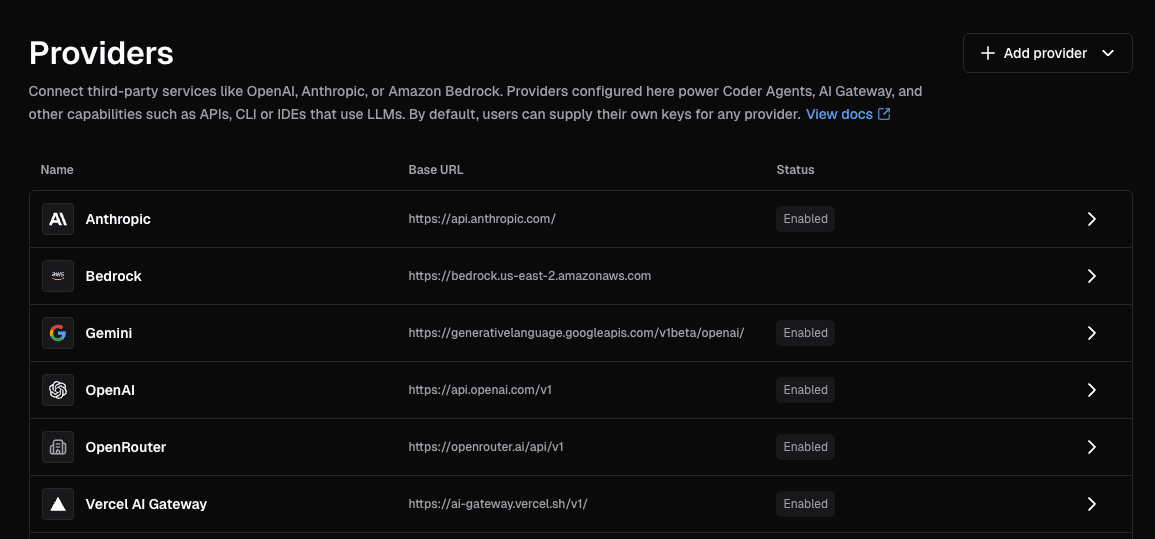
Provider records are managed through the dashboard or API and stored in the database.
Provider environment variables, flags, and YAML options no longer seed the database.
Refer to Database management of providers for details.
Activation
The AI Gateway feature must be enabled in the Coder deployment configuration before embedded or standalone gateway instances can serve authenticated traffic.
AI Gateway is enabled by default as of v2.34.
export CODER_AI_GATEWAY_ENABLED=true
coder server
# or
coder server --ai-gateway-enabled=true
A standalone process does not read CODER_AI_GATEWAY_ENABLED from its own environment.
However, this setting must remain enabled on coderd.
It is required for gateway key management endpoints to work and for standalone replicas to connect to the control plane.
Configure Providers
Configure at least one provider before exposing AI Gateway to end users.
Providers are deployment-scoped.
Add them from the dashboard or the AI Providers API.
Changes take effect without restarting coderd.
Dashboard
Navigate to Admin settings > AI
Select Providers
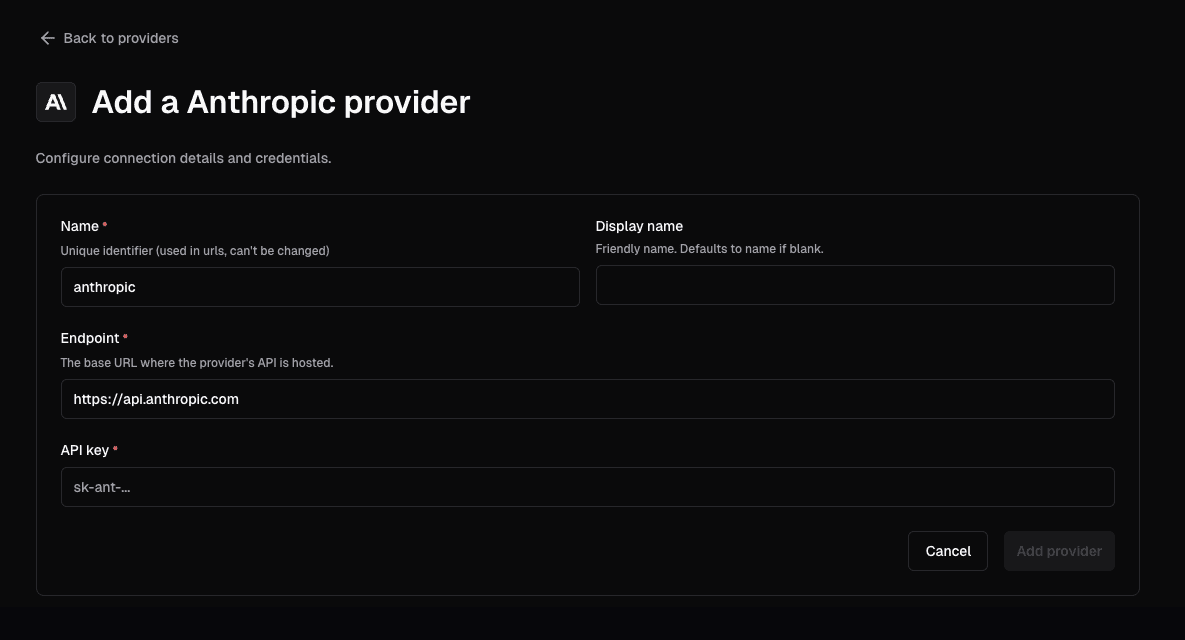
Select Add provider
Select the provider type
Enter a unique lowercase name, the upstream endpoint, and the credentials
Save the provider
Each provider gets its own AI Gateway route at /api/v2/ai-gateway/<provider-name>/.
Note
Provider names must be unique and use lowercase, hyphen-separated identifiers such as anthropic-corp or azure-openai.
Once deleted, another provider may reuse the name.
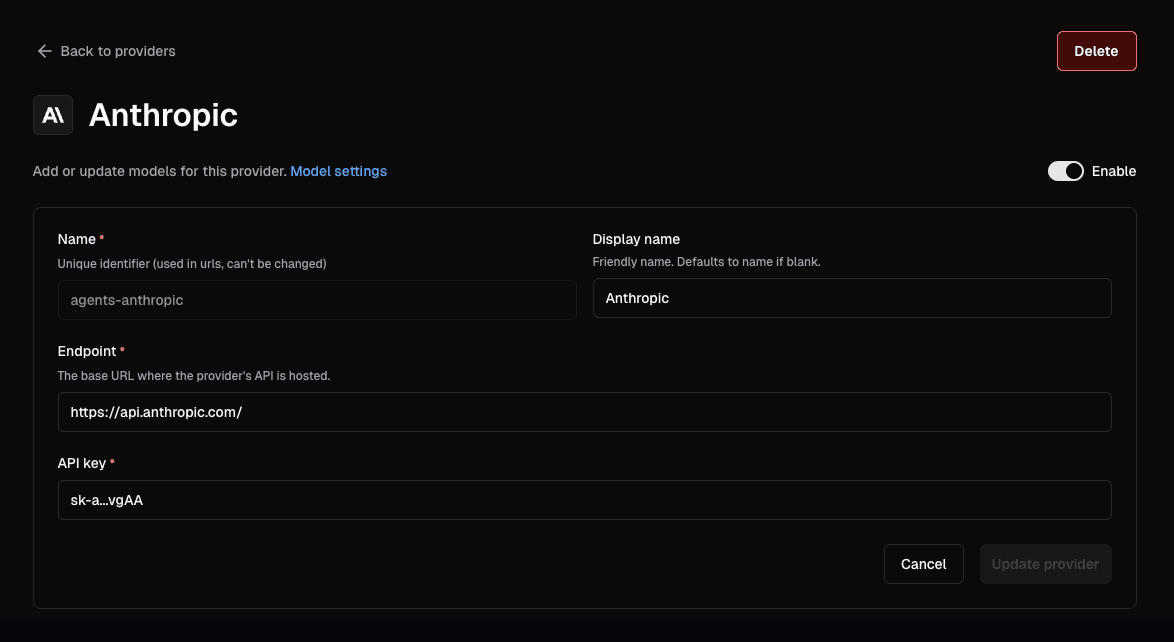
Open an existing provider to rotate credentials, update its endpoint, or disable it without restarting coderd.
API Dumps
AI Gateway can dump provider request and response pairs to disk for debugging.
Configure the dump directory with --ai-gateway-dump-dir or CODER_AI_GATEWAY_DUMP_DIR:
coder server --ai-gateway-dump-dir=/var/lib/coder/ai-gateway-dumps
This top-level setting replaces the previous per-provider DUMP_DIR field.
For each provider, AI Gateway writes dumps under <base>/<provider_name>, where <base> is the configured dump directory and <provider_name> is the provider instance name used in the route.
For example, a provider named anthropic-corp with /var/lib/coder/ai-gateway-dumps configured writes to /var/lib/coder/ai-gateway-dumps/anthropic-corp.
Sensitive headers are redacted before dumps are written.
Leave the value empty to disable dumping.
Each standalone gateway replica accepts the same API dump settings and writes optional dumps to its own local disk.
Warning
API dumps are intended for short diagnostic sessions only.
Dump files contain raw request and response data, which may include proprietary or sensitive information such as prompts, completions, and tool inputs.
Protect the target directory and disable dumping when diagnostics are complete.
Send actor headers
Enable send_actor_headers to add authenticated actor identity to intercepted upstream requests.
The setting is disabled by default.
CODER_AI_GATEWAY_SEND_ACTOR_HEADERS=true
You can also enable the setting with --ai-gateway-send-actor-headers or ai_gateway.send_actor_headers.
Configure the ID, username, and email header names independently with CODER_AI_GATEWAY_ACTOR_HEADER_ID, CODER_AI_GATEWAY_ACTOR_HEADER_USERNAME, and CODER_AI_GATEWAY_ACTOR_HEADER_EMAIL:
The equivalent CLI options are --ai-gateway-actor-header-id, --ai-gateway-actor-header-username, and --ai-gateway-actor-header-email.
The email header is empty by default.
To forward email, set actor_header_email, for example to X-AI-Bridge-Actor-Metadata-Email.
The setting applies to every configured provider, so enable it only if all of them, and any proxy in between, may receive user email addresses.
For defaults, precedence, and privacy considerations, refer to Actor header forwarding.
Data Retention
AI Gateway records prompts, token usage, tool invocations, and model reasoning for auditing and monitoring purposes.
By default, this data is retained for 60 days.
Configure retention using --ai-gateway-retention or CODER_AI_GATEWAY_RETENTION:
coder server --ai-gateway-retention=90d
Or in YAML:
ai_gateway:
  retention: 90d
Set to 0 to retain data indefinitely.
For duration formats, how retention works, and best practices, see the Data Retention documentation.
Structured Logging
AI Gateway can emit structured logs for every interception record, making it straightforward to export data to external SIEM or observability platforms.
Enable with --ai-gateway-structured-logging or CODER_AI_GATEWAY_STRUCTURED_LOGGING:
coder server --ai-gateway-structured-logging=true
Or in YAML:
ai_gateway:
  structured_logging: true
These logs are written to the same output stream as all other coderd logs, using the format configured by --log-human (default, writes to stderr) or --log-json.
For machine ingestion, set --log-json to a file path or /dev/stderr so that records are emitted as JSON.
Choose which process emits the records
By default coderd emits these records as they arrive from the gateway.
Set --ai-gateway-structured-logging-source to change that:
Value
Emitted by
Use it when
coderd
coderd (default)
You want today's behavior.
gateway
The AI Gateway process
You need records that the gateway never persists, such as when content recording is disabled.
both
Both processes
You are moving from one to the other and want to compare the two streams.
coder server --ai-gateway-structured-logging=true \
  --ai-gateway-structured-logging-source=gateway
Gateway-emitted records carry the same message, the same record_type values and the same fields, with one exception: they omit thread_parent_id and thread_root_id.
Those are resolved from recorded tool usage by a database lookup that only coderd can perform.
Important
With both, every record that reaches coderd is logged twice.
Deduplicate on interception_id, record_type and msg_id if your pipeline counts records.
When the gateway emits the records, they are written to the gateway's log output rather than coderd's, and under a different logger name.
Match on the "interception log" message rather than the logger name so that your pipeline works with either source.
On a standalone gateway, set CODER_AI_GATEWAY_STRUCTURED_LOGGING and CODER_AI_GATEWAY_STRUCTURED_LOGGING_SOURCE on both processes, and ship the gateway's logs.
Disable content recording
Three of the record types store conversation content verbatim: aibridge_user_prompts.prompt, aibridge_tool_usages.input and aibridge_model_thoughts.content.
Deployments that want AI Governance cost controls without retaining conversation content can stop recording them:
coder server --ai-gateway-disable-content-recording=true
Or in YAML:
ai_gateway:
  disable_content_recording: true
Interceptions and token usage are still recorded, so cost controls are unaffected.
This option only stops the records being written to the database.
To keep exporting them to your SIEM, combine it with gateway-emitted structured logs:
coder server --ai-gateway-disable-content-recording=true \
  --ai-gateway-structured-logging=true \
  --ai-gateway-structured-logging-source=gateway
Without --ai-gateway-structured-logging-source=gateway, the dropped records reach neither the database nor your SIEM, because coderd never receives them.
The gateway logs a warning at startup in that configuration.
What you lose
Disabling content recording is a governance trade-off, not only a storage saving:
Session grouping degrades for clients that don't send their own session ID.
Coder groups those interceptions into threads by correlating recorded tool calls, so without tool usage records each interception becomes its own session.
The grouping is stored when the row is written, so it can't be recovered later by re-enabling the option.
Sessions pages are largely empty, since there is no prompt, tool call or reasoning content to show.
Prompt and tool call telemetry report zero.
The audit trail of what was asked is gone, including for incident review.
Token counts, spend, model and provider attribution, and request volume are all unaffected, as are the Prometheus metrics for prompt and tool call counts.
Filter for AI Gateway records in your logging pipeline by matching on the "interception log" message.
Each log line includes a record_type field that indicates the kind of event captured: