Coder powers secure, scalable development across key industries — automotive, finance, government, and technology — enabling faster builds, tighter compliance, and seamless AI adoption in enterprise-grade cloud environments.
AI Gateway is part of AI Governance, which is included with a Premium license.
Providers are deployment-scoped and managed from the dashboard or the AI Providers API.
See Setup for the steps to add, edit, and disable a provider.
This page covers the provider types AI Gateway supports, the setup considerations for each, how a provider's lifecycle affects request handling, and how to monitor providers.
Database management of providers
Manage provider records through the dashboard at https://<your-coder-host>/ai/settings/providers or AI Providers API.
Provider setup through environment variables, CLI flags, and YAML is no longer supported.
Leftover provider environment variables are ignored and no longer seed the database.
Warning
A removed provider CLI flag or YAML key prevents Coder from starting, with an unknown flag or unknown option error.
Files generated by coder server --write-config in older versions include these YAML keys by default, even if you never configured an AI provider.
Provider options to remove before upgrading
Remove any of the following options from your deployment configuration, including empty or default-valued YAML entries.
The table shows AI Gateway names.
For AI Bridge aliases, replace CODER_AI_GATEWAY_ with CODER_AIBRIDGE_, --ai-gateway- with --aibridge-, and the YAML group ai_gateway with aibridge.
Option
Environment variable
CLI flag
YAML key under ai_gateway
Indexed providers
CODER_AI_GATEWAY_PROVIDER_<N>_*
None
None
OpenAI base URL
CODER_AI_GATEWAY_OPENAI_BASE_URL
--ai-gateway-openai-base-url
openai_base_url
OpenAI API key
CODER_AI_GATEWAY_OPENAI_KEY
--ai-gateway-openai-key
None
Anthropic base URL
CODER_AI_GATEWAY_ANTHROPIC_BASE_URL
--ai-gateway-anthropic-base-url
anthropic_base_url
Anthropic API key
CODER_AI_GATEWAY_ANTHROPIC_KEY
--ai-gateway-anthropic-key
None
Bedrock base URL
CODER_AI_GATEWAY_BEDROCK_BASE_URL
--ai-gateway-bedrock-base-url
bedrock_base_url
Bedrock region
CODER_AI_GATEWAY_BEDROCK_REGION
--ai-gateway-bedrock-region
bedrock_region
Bedrock access key
CODER_AI_GATEWAY_BEDROCK_ACCESS_KEY
--ai-gateway-bedrock-access-key
None
Bedrock secret access key
CODER_AI_GATEWAY_BEDROCK_ACCESS_KEY_SECRET
--ai-gateway-bedrock-access-key-secret
None
Bedrock model
CODER_AI_GATEWAY_BEDROCK_MODEL
--ai-gateway-bedrock-model
bedrock_model
Bedrock small fast model
CODER_AI_GATEWAY_BEDROCK_SMALL_FAST_MODEL
--ai-gateway-bedrock-small-fastmodel
bedrock_small_fast_model
Credential options had no YAML equivalent, and indexed provider options were environment-only.
Providers already stored in the database remain available without these options.
Both the embedded gateway and a standalone gateway fetch provider configuration from Coder.
Provider types
AI Gateway speaks two upstream API formats: the OpenAI format (Chat Completions and Responses) and the Anthropic format (Messages).
Every provider type maps to one of these.
Type
API format
Setup notes
openai
OpenAI
Native OpenAI, or any OpenAI-compatible endpoint via the base URL
anthropic
Anthropic
Native Anthropic, or an Anthropic-compatible broker
bedrock
Anthropic
Anthropic models hosted on AWS Bedrock; authenticates via AWS
copilot
OpenAI
GitHub Copilot; authenticates via each user's GitHub OAuth token
azure
OpenAI
OpenAI-compatible endpoint only
google
OpenAI
OpenAI-compatible endpoint only
openrouter
OpenAI
OpenAI-compatible endpoint only
vercel
OpenAI
OpenAI-compatible endpoint only
openai-compat
OpenAI
Generic OpenAI-compatible endpoint
azure, google, openrouter, vercel, and openai-compat are supported only as OpenAI-compatible endpoints: AI Gateway sends them OpenAI-format requests, so each must expose an OpenAI-compatible API at its base URL.
They have no provider-specific integration beyond that.
OpenAI
Set the base URL to the upstream endpoint and provide an API key.
The default https://api.openai.com/v1/ targets the native OpenAI service; point it at any OpenAI-compatible endpoint (for example, a hosted proxy or LiteLLM deployment) when needed.
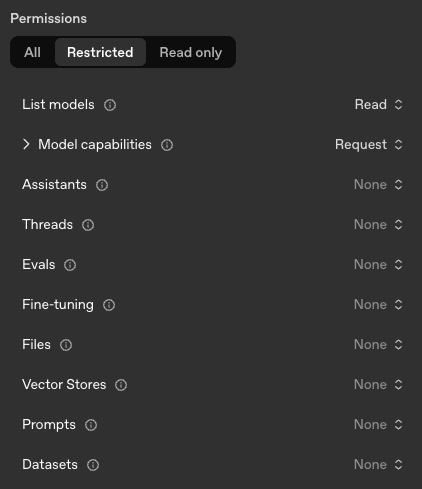
If you create an OpenAI key with minimal privileges, this is the minimum required set:
Anthropic
Set the base URL and provide an API key.
The default https://api.anthropic.com/ targets Anthropic's public API; override it for Anthropic-compatible brokers.
Anthropic does not allow API keys to have restricted permissions at the time of writing (June 2026).
Claude Platform for AWS
Claude Platform for AWS is Anthropic's own Messages API hosted on AWS.
It is an authentication method on the anthropic provider type, not a separate provider type: requests and responses are the standard Anthropic format with standard Anthropic model IDs, and only routing and authentication differ.
It is distinct from Amazon Bedrock, which is a separate provider type.
Every Claude Platform provider requires:
A region, for example us-east-1.
It selects the default endpoint https://aws-external-anthropic.<region>.api.aws and, for IAM authentication, the signing scope.
Set it explicitly even when you override the endpoint, so requests routed through a proxy are still signed for the correct region.
A workspace ID, sent as the anthropic-workspace-id header on every request.
AI Gateway sets the header from provider configuration and strips any value a client sends, so a client cannot choose which workspace its traffic is attributed to.
AI Gateway chooses authentication from the credentials available for each request:
When Bring Your Own Key is enabled, a client key takes precedence over stored provider keys and IAM signing.
Otherwise, AI Gateway uses the provider's stored API-key collection, with key pooling, rotation, masking, and key failover.
When no client or stored provider key is available, AI Gateway signs the request with AWS SigV4 for the aws-external-anthropic service using its ambient AWS credentials.
Configure the AWS identity on the gateway process through the default AWS credential chain, such as an instance profile, container identity, or AWS_PROFILE.
Individual Claude Platform provider settings do not select an AWS identity or authentication mode.
Adding a stored key selects API-key authentication; removing the last stored key allows requests without a client key to use IAM.
A supplied key that fails authentication does not trigger a fallback to IAM.
A client sending an ordinary Anthropic key to a Claude Platform provider receives an upstream authentication error.
Amazon Bedrock
Bedrock providers serve Anthropic models hosted on AWS and authenticate with AWS credentials rather than a registered API key.
Configure:
A protocol, either InvokeModel or Mantle.
It determines the endpoint format and which of the fields below apply.
See InvokeModel and Mantle.
An endpoint in the format the protocol requires: https://bedrock-runtime.<region>.amazonaws.com for InvokeModel or https://bedrock-mantle.<region>.api.aws/anthropic for Mantle.
The AWS region is read from the endpoint host.
The model and small fast model identifiers, for InvokeModel only.
Mantle providers do not set them; the client chooses the model on each request and AI Gateway forwards it upstream.
InvokeModel
The legacy Bedrock runtime API.
AI Gateway translates each request into Bedrock's InvokeModel format and sends it to https://bedrock-runtime.<region>.amazonaws.com.
Still supported, but Mantle is recommended for new deployments.
Mantle
The newer Anthropic-compatible Bedrock endpoint, recommended by AWS for new deployments.
AI Gateway serves Anthropic models through the native Messages API, forwarding the request body unchanged and only applying AWS SigV4 signing with the provider's base identity.
To route Claude Code through a Mantle provider, run it in mantle mode with client-side signing disabled so the gateway signs centrally:
Do not attach API keys to a Bedrock provider.
The provider itself always authenticates with AWS credentials.
When BYOK is enabled, a user can save a personal Amazon Bedrock API key under their Agents API keys.
AI Gateway then sends that key as a bearer token for the user's requests instead of signing them with the deployment's AWS credentials.
Requests from users without a personal key continue to use the credentials below.
AI Gateway resolves AWS credentials one of three ways:
AWS SDK default credential chain (recommended).
When no explicit credentials are configured, the AWS SDK resolves them automatically from the environment: IAM Roles (instance profiles, IRSA, ECS task roles), shared config files, environment variables, SSO, and more.
Attaching an IAM Role to the compute running Coder follows AWS best practices for temporary credentials.
The role must permit bedrock:InvokeModel and bedrock:InvokeModelWithResponseStream for the configured models.
Static credentials.
Provide an access key and secret for an IAM user with the same Bedrock permissions.
Assumed IAM role.
Set a Role ARN to have the gateway assume that role before calling Bedrock, signing requests with the resulting temporary credentials.
This works on top of either of the above base identities and supports cross-account Bedrock access.
See IAM role assumption.
Static Bedrock credentials
When you cannot use the default credential chain, create a dedicated IAM user and generate a static access key:
Choose a region where you want to use Bedrock.
Generate API keys in the AWS Bedrock console (replace us-east-1 in the URL with your chosen region):
Choose an expiry period for the key.
Select Generate.
This creates an IAM user with strictly-scoped permissions for Bedrock access.
Create an access key for the IAM user:
After generating the API key, select "You can directly modify permissions for the IAM user associated".
In the IAM user page, navigate to the Security credentials tab.
Under Access keys, select Create access key.
Select "Application running outside AWS" as the use case.
Select Next.
Add a description like "Coder AI Gateway token".
Select Create access key.
Save both the access key ID and secret access key securely.
Enter the access key ID and secret access key when you add or edit the Bedrock provider from the dashboard or the AI Providers API, along with the region (or base URL) and model identifiers.
IAM role assumption
Set the optional Role ARN field to have the gateway assume an IAM role before calling Bedrock.
The base identity (static credentials or the default credential chain) signs an STS AssumeRole call, and the temporary credentials it returns sign Bedrock requests.
The field is optional: a provider with no Role ARN authenticates with its base identity directly, exactly as described above.
To use role assumption:
Create the IAM role in the target account and grant it bedrock:InvokeModel and bedrock:InvokeModelWithResponseStream for the configured models.
The base identity does not need Bedrock permissions itself; the assumed role does.
Configure the role's trust policy to allow the gateway's base identity to assume it.
Enter the Role ARN when you add or edit the Bedrock provider.
It must be a valid IAM role ARN, for example arn:aws:iam::123456789012:role/BedrockRole.
Each provider assumes a single role.
To use several roles, configure one provider per role.
External ID
When a Bedrock provider assumes a role, the gateway generates a unique external ID for it and sends that value on every AssumeRole call.
The external ID guards against the confused deputy problem on cross-account assumption.
The gateway generates and owns the value, as AWS recommends: you cannot set or change it.
It is not a secret, and it is shown on the provider's edit page once a Role ARN is configured.
To enforce it, add the external ID to the target role's trust policy as an sts:ExternalId condition:
The gateway sends the external ID whether or not the trust policy checks it.
Until you add the sts:ExternalId condition, the value is sent but not enforced, and the role can still be assumed without it.
To rotate the external ID, recreate the provider.
Application inference profiles
For InvokeModel, the model and small fast model identifiers can be application inference profile ARNs, which attribute Bedrock spend to a team or workload through AWS cost allocation tags.
AI Gateway passes the profile upstream so AWS records the attribution, while internally resolving and using the underlying model identity, including for usage pricing.
Resolution requires a GetInferenceProfile call, so the AWS identity used by the gateway must have bedrock:GetInferenceProfile permission for the profile.
Providers configured with plain model identifiers do not need this permission.
If resolution fails, the provider is skipped.
GitHub Copilot
GitHub Copilot offers three plans: Individual, Business, and Enterprise, each with its own API endpoint.
Add one copilot provider per plan your organization uses, setting the base URL accordingly:
Plan
Base URL
Individual
https://api.individual.githubcopilot.com
Business
https://api.business.githubcopilot.com
Enterprise
https://api.enterprise.githubcopilot.com
Copilot providers authenticate with each user's request-time GitHub OAuth token, so do not attach API keys.
For client-side setup (proxy, certificates, IDE configuration), see GitHub Copilot client configuration.
ChatGPT
ChatGPT subscriptions (Plus, Pro, Business) are supported through a provider of type openai with a specific name and base URL:
Field
Value
Type
openai
Name
chatgpt
Base URL
https://chatgpt.com/backend-api/codex
The name must be exactly chatgpt.
It determines the route clients use to reach the provider: /api/v2/ai-gateway/chatgpt/v1.
If no provider with this name exists, requests to that route fail with 404 route not supported.
Do not attach API keys.
ChatGPT providers authenticate with each user's ChatGPT OAuth token through BYOK, so BYOK must remain enabled.
For client-side setup, see the Codex CLI ChatGPT subscription configuration.
OpenAI-compatible providers
Azure-hosted OpenAI, Google, OpenRouter, Vercel, and any other OpenAI-compatible service are configured with the matching type (or the generic openai-compat), the provider's OpenAI-compatible base URL, and an API key.
Note
See the Supported APIs section for precise endpoint coverage and interception behavior.
Provider lifecycle
Every provider carries an explicit status, reported by the provider_info metrics.
coder_ai_gateway_provider_info reports enabled, disabled, and error, and coder_ai_gateway_proxy_provider_info also reports proxy_excluded:
Status
Meaning
Effect on requests
enabled
Configuration is valid and the provider is serving traffic
Requests are proxied to the upstream
disabled
The provider exists but has been turned off
Requests are rejected with a non-retryable error
error
The provider is enabled but cannot be built (missing credentials, bad config)
Requests fail; the error is surfaced in metrics
proxy_excluded
Another enabled provider already claims this hostname; the AI Gateway Proxy routes traffic to the first claimant (by database name sort order, ORDER BY name ASC)
Proxy-routed requests go to the first claimant; direct routing (/api/v2/ai-gateway/{name}/...) still works for this provider
Disabling a provider does not delete it, its credentials, or its historical interception data.
Re-enabling restores it to service.
Monitoring and reloads
Provider configuration changes take effect automatically, without restarting coderd.
AI Gateway records the timestamp of each reload attempt and each successful reload, exposed as Prometheus metrics:
If you run the external proxy, it exposes the same pair under the coder_ai_gateway_proxy_ prefix.
Each standalone gateway replica reloads providers independently and replaces only its own provider snapshot.
If a reload fails, that replica retains its previous provider snapshot and continues serving from it.
A growing gap between the attempt and success timestamps means reloads are firing but failing to apply.
Alert on that gap rather than on a single failure, which may resolve on the next change.
Refer to Monitoring for the full metric list and sample alert queries.
Key failover
You can configure multiple centralized API keys for a single provider instance so that AI Gateway automatically retries with the next key when one fails.
This is transparent to end users, and clients see no difference in behavior or need any configuration changes.
Key failover is supported for OpenAI and Anthropic providers.
Amazon Bedrock and GitHub Copilot do not support key failover.
Multiple keys can be added per provider through the AI Providers API.
Each provider supports a maximum of 5 keys.
Failover behavior
Every request starts with the first key in the list.
If a key is rate-limited (429 Too Many Requests) or fails authentication (401 Unauthorized), AI Gateway puts that key on a temporary cooldown and retries the request with the next available key.
Keys recover automatically when the cooldown elapses, so failover stays transparent to end users.
Any other response, including a 403 Forbidden, is returned to the caller unchanged.
If all keys in the pool are exhausted, AI Gateway returns:
429 Too Many Requests when at least one key is rate-limited, with a Retry-After header set to the shortest cooldown across all keys.
502 Bad Gateway when every key is in an authentication-failure cooldown.
The keys still recover automatically once their cooldowns elapse, so no Retry-After is sent.
Bring Your Own Key
A provider's configured credentials are the centralized default.
When Bring Your Own Key (BYOK) is enabled, a user's own credential takes precedence over the provider's for that user's requests, and AI Gateway falls back to the provider credentials when the user has none.
See Authentication for the BYOK flow and how to enable or disable it.