Coder powers secure, scalable development across key industries — automotive, finance, government, and technology — enabling faster builds, tighter compliance, and seamless AI adoption in enterprise-grade cloud environments.
Port forwarding lets developers securely access processes on their Coder
workspace from a local machine. A common use case is testing web applications in
a browser.
There are three ways to forward ports in Coder:
The coder port-forward command
Dashboard
SSH
The coder port-forward command is generally more performant than:
The Dashboard which proxies traffic through the Coder control plane versus
peer-to-peer which is possible with the Coder CLI
sshd which does double encryption of traffic with both Wireguard and SSH
The coder port-forward command
This command can be used to forward TCP or UDP ports from the remote workspace
so they can be accessed locally. Both the TCP and UDP command line flags
(--tcp and --udp) can be given once or multiple times.
The supported syntax variations for the --tcp and --udp flag are:
Single port with optional remote port: local_port[:remote_port]
Comma separation local_port1,local_port2
Port ranges start_port-end_port
Any combination of the above
Examples
Forward the remote TCP port 8080 to local port 8000:
coder port-forward myworkspace --tcp 8000:8080
Forward the remote TCP port 3000 and all ports from 9990 to 9999 to their
respective local ports.
To enable port forwarding via the dashboard, Coder must be configured with a
wildcard access URL. If an
access URL is not specified, Coder will create
a publicly accessible URL to reverse
proxy the deployment, and port forwarding will work.
There is a
DNS limitation
where each segment of hostnames must not exceed 63 characters. If your app
name, agent name, workspace name and username exceed 63 characters in the
hostname, port forwarding via the dashboard will not work.
From an coder_app resource
One way to port forward is to configure a coder_app resource in the
workspace's template. This approach shows a visual application icon in the
dashboard. See the following coder_app example for a Node React app and note
the subdomain and share settings:
Valid share values include owner - private to the user, authenticated -
accessible by any user authenticated to the Coder deployment, and public -
accessible by users outside of the Coder deployment.
Accessing workspace ports
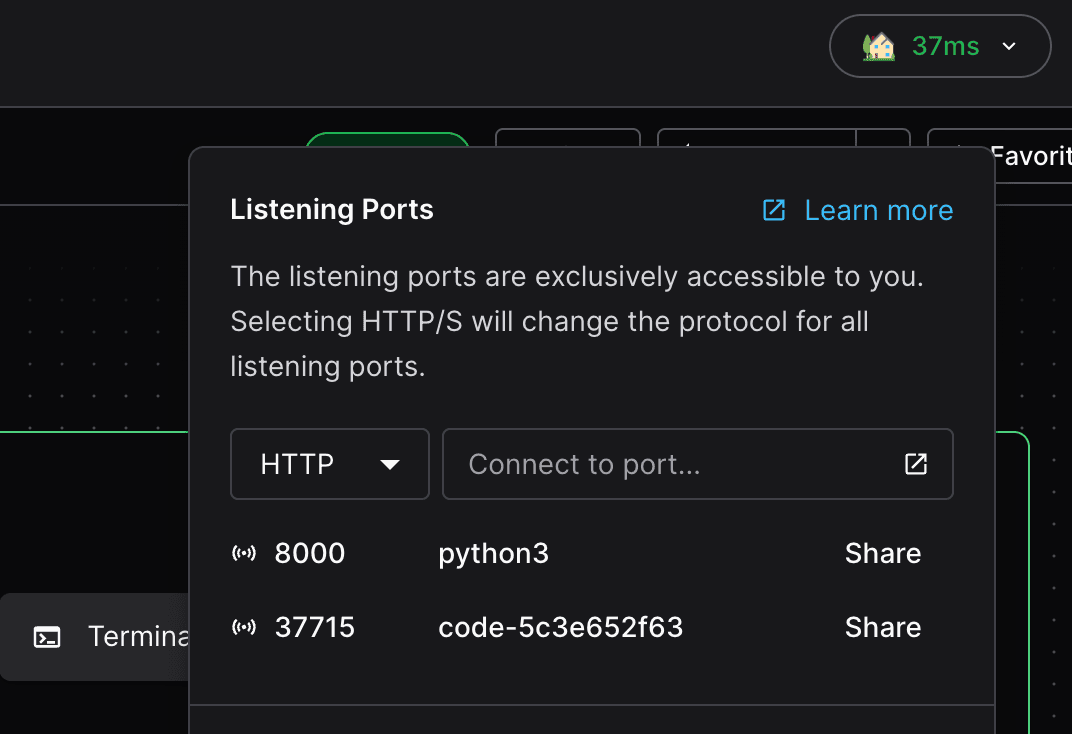
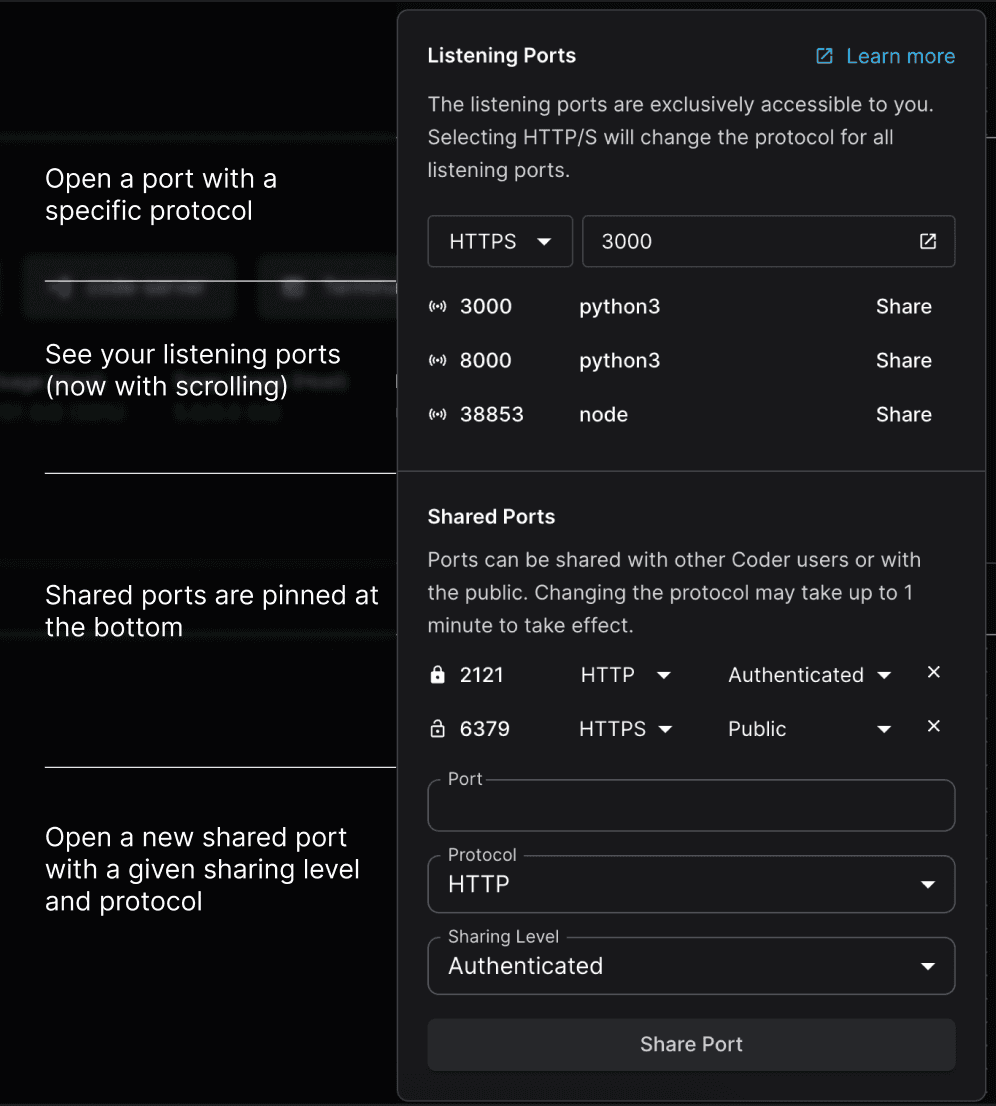
Another way to port forward in the dashboard is to use the "Open Ports" button
to specify an arbitrary port. Coder will also detect if apps inside the
workspace are listening on ports, and list them below the port input (this is
only supported on Windows and Linux workspace agents).
Sharing ports
You can share ports as URLs, either with other authenticated coder users or
publicly. Using the open ports interface, you can assign a sharing levels that
match our coder_app’s share option in
Coder terraform provider.
owner (Default): The implicit sharing level for all listening ports, only
visible to the workspace owner
authenticated: Accessible by other authenticated Coder users on the same
deployment.
public: Accessible by any user with the associated URL.
Once a port is shared at either authenticated or public levels, it will stay
pinned in the open ports UI for better visibility regardless of whether or not
it is still accessible.
The sharing level is limited by the maximum level enforced in the template
settings in licensed deployments, and not restricted in OSS deployments.
This can also be used to change the sharing level of port-based coder_apps by
entering their port number in the sharable ports UI. The share attribute on
coder_app resource uses a different method of authentication and is not
impacted by the template's maximum sharing level, nor the level of a shared
port that points to the app.
Configuring port protocol
Both listening and shared ports can be configured to use either HTTP or
HTTPS to connect to the port. For listening ports the protocol selector
applies to any port you input or select from the menu. Shared ports have
protocol configuration for each shared port individually.
You can also access any port on the workspace and can configure the port
protocol manually by appending a s to the port in the URL.