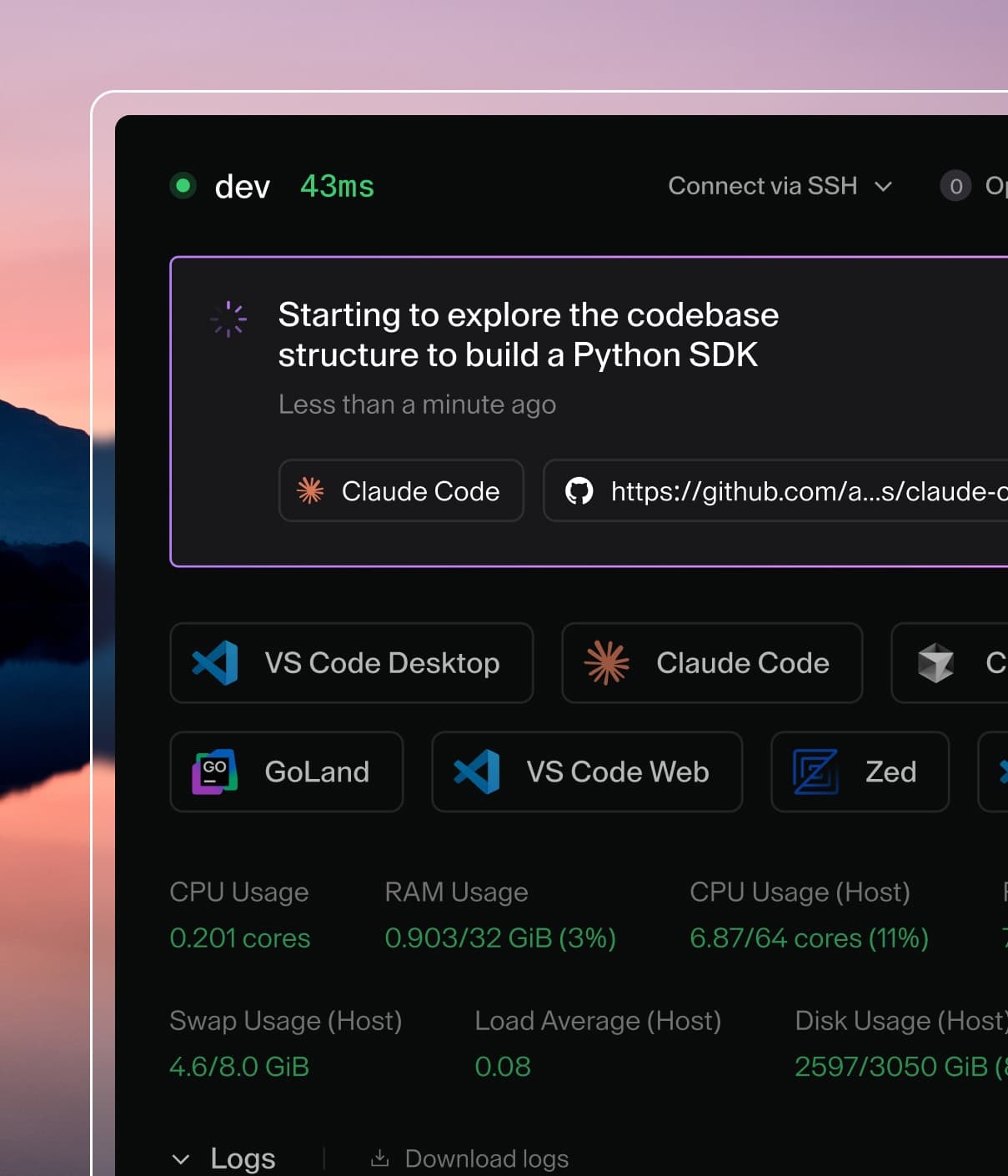
Coder powers secure, scalable development across key industries — automotive, finance, government, and technology — enabling faster builds, tighter compliance, and seamless AI adoption in enterprise-grade cloud environments.
Use Coder and JFrog Artifactory together to secure your development environments
without disturbing your developers' existing workflows.
This guide will demonstrate how to use JFrog Artifactory as a package registry
within a workspace.
Requirements
A JFrog Artifactory instance
1:1 mapping of users in Coder to users in Artifactory by email address or
username
Repositories configured in Artifactory for each package manager you want to
use
Provisioner Authentication
The most straight-forward way to authenticate your template with Artifactory is
by using our official Coder modules. We publish
two type of modules that automate the JFrog Artifactory and Coder integration.
This module is usable by JFrog self-hosted (on-premises) Artifactory as it
requires configuring a custom integration. This integration benefits from Coder's external-auth feature allows each user to authenticate with Artifactory using an OAuth flow and issues user-scoped tokens to each user.
To set this up, follow these steps:
Add the following to your Helm chart values.yaml for JFrog Artifactory. Replace CODER_URL with your JFrog Artifactory base URL:
Create a new Application Integration by going to
https://JFROG_URL/ui/admin/configuration/integrations/app-integrations/new and select the
Application Type as the integration you created in step 1 or Custom Integration if you are using SaaS instance i.e. example.jfrog.io.
Add a new external authentication to Coder by setting these
environment variables in a manner consistent with your Coder deployment. Replace JFROG_URL with your JFrog Artifactory base URL:
Create or edit a Coder template and use the JFrog-OAuth module to configure the integration:
module "jfrog" {
  count          = data.coder_workspace.me.start_count
  source         = "registry.coder.com/modules/jfrog-oauth/coder"
  version        = "1.0.19"
  agent_id       = coder_agent.example.id
  jfrog_url      = "https://example.jfrog.io"
  username_field = "username" # If you are using GitHub to login to both Coder and Artifactory, use username_field = "username"

  package_managers = {
    npm    = ["npm", "@scoped:npm-scoped"]
    go     = ["go", "another-go-repo"]
    pypi   = ["pypi", "extra-index-pypi"]
    docker = ["example-docker-staging.jfrog.io", "example-docker-production.jfrog.io"]
  }
}
JFrog-Token
This module makes use of the Artifactory terraform
provider and an admin-scoped token to create
user-scoped tokens for each user by matching their Coder email or username with
Artifactory. This can be used for both SaaS and self-hosted (on-premises)
Artifactory instances.
To set this up, follow these steps:
Get a JFrog access token from your Artifactory instance. The token must be an admin token with scope applied-permissions/admin.
Create or edit a Coder template and use the JFrog-Token module to configure the integration and pass the admin token. It is recommended to store the token in a sensitive Terraform variable to prevent it from being displayed in plain text in the terraform state:
The admin-level access token is used to provision user tokens and is never exposed to developers or stored in workspaces.
If you don't want to use the official modules, you can read through the example template, which uses Docker as the underlying compute. The
same concepts apply to all compute types.
Air-Gapped Deployments
See the air-gapped deployments section for instructions on how to use Coder modules in an offline environment with Artifactory.