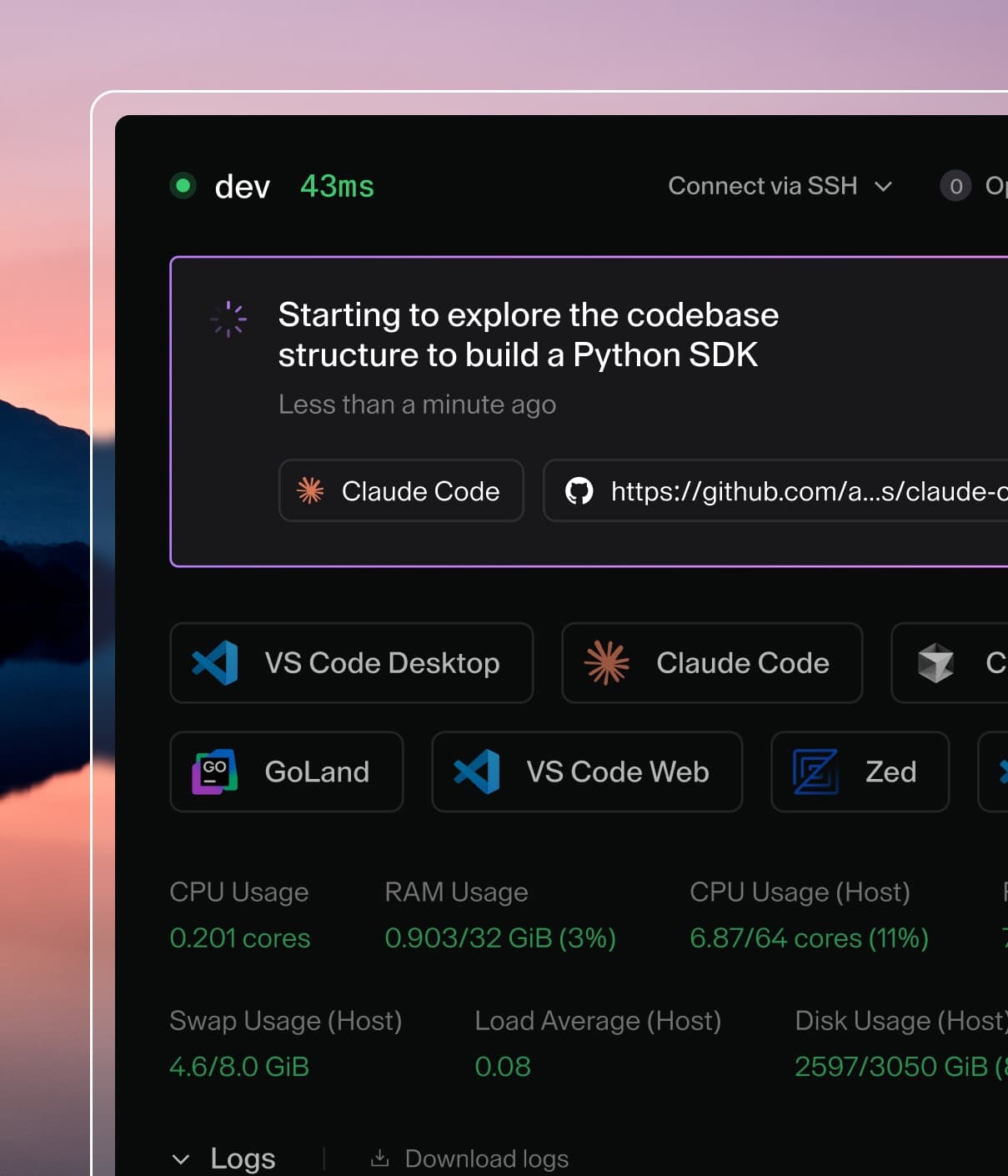
Coder powers secure, scalable development across key industries — automotive, finance, government, and technology — enabling faster builds, tighter compliance, and seamless AI adoption in enterprise-grade cloud environments.
This glossary defines the Coder-specific terms and product names you encounter across the documentation.
Each entry gives a short definition and, where it helps, links to the page that covers the term in depth.
Important
Several Coder terms share the word "agent" but mean different things:
Coder Agents is the AI product for delegating development work to coding agents.
Agent Relay connects a cloud-hosted AI agent provider's hosted sessions to self-hosted workspaces.
It is not Coder Agents.
A workspace agent is the process that runs inside a workspace to provide SSH, port forwarding, the web terminal, and other services.
coder_agent is the Terraform resource in a template that declares a workspace agent.
A
Agent API
The API a workspace agent uses to report logs, metrics, and activity.
Refer to the Agent API reference.
Agent Firewall
A process-level firewall that enforces domain and verb allowlists on AI agent processes inside a workspace and streams audit logs to coderd.
It was previously named Agent Boundaries and uses a sandbox backend, nsjail by default or landjail.
This feature requires a Premium license.
Refer to Agent Firewall.
Agent Relay
A feature that connects a supported cloud-hosted AI agent provider's hosted sessions to self-hosted workspaces.
The provider's orchestration and AI inference stay cloud-hosted; a worker process inside the workspace executes the agent's tool calls.
In early access.
Refer to Agent Relay.
AI Gateway
An LLM gateway in coderd that authenticates users, forwards traffic to providers such as OpenAI and Anthropic, audits prompts and tool invocations, and centralizes MCP administration.
It was previously named AI Bridge and runs the aibridged component in memory inside coderd.
This feature requires a Premium license.
Refer to AI Gateway.
AI Gateway Proxy
An HTTP proxy component, aibridgeproxyd, for AI clients that cannot override their base URL, such as GitHub Copilot.
This feature requires a Premium license.
Refer to AI Gateway Proxy.
AI Governance
Included with a Premium license, AI Governance unlocks AI Gateway and Agent Firewall.
Refer to AI Governance.
Air-gapped deployment
A Coder installation that has no outbound internet access.
Refer to Air-gapped deployments.
Audit logging
Structured logs of user and admin operations.
This is a Premium feature.
Refer to Audit logs.
Autostop requirement
A template or deployment setting that forcibly stops workspaces on a recurring cadence, for example to apply updates.
Refer to Workspace scheduling.
B
Built-in roles
The roles Coder predefines at two scopes.
Deployment roles such as Owner, User Admin, Template Admin, and Auditor apply across the deployment, and organization roles apply inside one organization.
Refer to Groups and roles.
C
CDE
Cloud development environment, the category of product that hosts development environments on remote infrastructure.
A Coder workspace is a CDE.
Change management
The GitOps flow that stores templates in Git and pushes them through CI/CD with coder templates push.
Refer to Change management.
code-server
The Coder-maintained build of VS Code that runs in the browser.
Refer to code-server.
Coder
The self-hosted platform that provisions and manages remote development environments, called workspaces, as code.
Coder, the company and the product, is always capitalized.
Coder Agents
The native, self-hosted AI product for delegating development work and research to coding agents.
The agent loop runs in the control plane, and developers work through the dashboard, the coder agents CLI, or the REST API.
Not to be confused with a workspace agent or the coder_agent resource.
Refer to Coder Agents.
Coder CLI
The single coder binary used for admin and user operations.
The same binary runs inside a workspace as the workspace agent through coder agent.
Refer to the CLI reference.
Coder Connect
The Coder Desktop feature that runs a local tunnel so workspaces are reachable at workspace-name.coder hostnames.
Refer to Coder Desktop.
Coder Desktop
A native desktop application that connects your machine to your workspaces so you can reach them by hostname and launch apps without configuring the CLI.
Refer to Coder Desktop.
Coder extension for VS Code
The editor extension that connects VS Code, and forks such as Cursor and Devin Desktop (formerly Windsurf), to workspaces.
Refer to VS Code.
Coder Validated Architecture
Coder's reference designs for sizing and deploying a control plane, abbreviated CVA.
Each design covers a user count, from 1,000 to 10,000, and prescribes a Kubernetes-based deployment with tested component sizes, so a deployment is easier to operate and troubleshoot.
A CVA is guidance rather than a certification: it recommends an architecture, but it doesn't approve yours.
Refer to Coder Validated Architecture.
Coder Workspaces
The self-hosted platform capability for running cloud development environments, defined with Terraform, on infrastructure you control.
Not to be confused with a workspace, the individual on-demand development environment a developer creates from a template.
Refer to About Coder.
coder server
The CLI command that starts coderd.
Use this name only for the command a reader runs, not as a name for the control plane itself.
Refer to the coder server reference.
The Terraform resource that declares an app, IDE, or URL entry surfaced on the workspace page, such as VS Code Web, JupyterLab, or code-server.
Refer to the coder_app resource.
coder_metadata
The Terraform resource that surfaces static resource information in the dashboard.
Refer to the coder_metadata resource.
coder_script
The Terraform resource that runs a shell script inside the workspace on start or stop, or on demand.
Refer to the coder_script resource.
coderd
The process that runs the control plane, started with coder server.
Use coderd for the process itself, such as in metric names, log output, configuration flags, and troubleshooting steps.
Introduce it on first use in a page as "coderd, the process that runs the control plane".
Refer to Architecture.
codersdk
The Go SDK that the CLI and dashboard use and that you can use for automation.
Refer to the codersdk package.
Coding agent
An AI agent that reads and writes code on a developer's behalf, such as Claude Code or Coder Agents.
Refer to AI in Coder.
Community
The free, open-source tier of Coder.
Computational resource
A resource that provides compute for the workspace, such as a virtual machine or container, and typically runs the workspace agent.
Connection logs
Structured logs of connections to workspaces, such as SSH and application sessions.
This is a Premium feature.
Refer to Connection logs.
Control plane
The component that serves the Coder API and dashboard, brokers connections to workspaces, and coordinates provisioners.
It is implemented by the coderd process and also runs the agent loop for Coder Agents.
Use control plane in prose, diagrams, and any planning, sizing, architecture, or security discussion.
Do not call it "the Coder server", and do not describe it generically as "a service".
Custom roles
Roles an administrator defines inside an organization from a chosen set of permissions.
This is a Premium feature.
Refer to Groups and roles.
A single installation of Coder, comprising the control plane, its provisioners, and its database.
Deployment ID
The unique identifier for a Coder deployment.
You provide it when you request a trial or a license.
DERP
Designated Encrypted Relay for Packets.
The Tailnet uses DERP relays to carry traffic when a direct peer-to-peer connection between two nodes is not possible.
Refer to Networking.
Dev container
An environment that conforms to the Development Container Specification and is defined by a devcontainer.json file.
Dev Containers is the Coder feature that runs dev containers inside a workspace.
Refer to Dev containers.
display_apps
A field on coder_agent that toggles the built-in agent apps, such as vscode, vscode_insiders, web_terminal, ssh_helper, and port_forwarding_helper.
The enabled apps appear as buttons in the row on the workspace page.
Refer to Web IDEs.
Dormancy
Automatic cleanup of workspaces that stay inactive past a threshold, up to and including deletion.
This is a Premium feature.
Refer to Workspace scheduling.
Dotfiles
Personal shell and editor configuration loaded into a workspace with coder dotfiles.
Refer to Dotfiles.
The Coder-built tool that constructs a workspace image from a devcontainer.json file without requiring Docker inside the workspace.
Refer to Envbuilder and the envbuilder repository.
Ephemeral resource
A resource that is destroyed when the workspace stops and recreated on the next start.
Refer to Resource persistence.
External authentication
In-workspace OAuth to Git providers, artifact registries, and similar services, configured with CODER_EXTERNAL_AUTH_* variables.
Refer to External authentication.
External provisioner
A provisionerd that runs outside coderd, tagged so specific templates route to it, for example to reach an isolated network or to scale build throughput.
Refer to External provisioners.
External workspace
A workspace that runs on infrastructure Coder did not provision, connected to Coder through an agent.
This is a Premium feature in early access.
Refer to External workspaces.
F
Feature stages
The Early Access, Beta, and General Availability labels that describe how production-ready a feature is.
Refer to Feature stages.
G
Group
A collection of users used to grant template and workspace permissions and to apply quotas.
Refer to Groups and roles.
H
Headless authentication
Authentication for automated users and service accounts that cannot complete an interactive browser login.
Refer to Headless authentication.
High availability
Running multiple coderd replicas behind a load balancer for redundancy and scale.
This is a Premium feature.
Refer to High availability.
I
IDE agent
A coding agent embedded in an editor or IDE, such as Cursor, connected to a Coder workspace.
Refer to IDE agents.
IdP sync
Automatic mapping of identity-provider claims to Coder groups, roles, and organizations.
This is a Premium feature.
Refer to IdP sync.
Infrastructure as code
The practice of defining infrastructure in version-controlled configuration files.
Coder templates are infrastructure as code, written in Terraform.
L
License key
A signed token applied through the dashboard or with coder licenses add.
Coder validates the key locally, so it works in air-gapped deployments.
Refer to Licensing.
M
MCP
Model Context Protocol, the standard for exposing tools and servers to LLM agents.
Coder ships an MCP server and lets admins centrally manage approved MCP servers through AI Gateway.
Refer to MCP server.
Module
A reusable Terraform building block that a template composes in.
Coder publishes modules in the Coder Registry.
Refer to Modules.
O
OIDC
OpenID Connect.
Coder supports any specification-compliant OIDC provider for single sign-on.
Refer to OIDC authentication.
OpenTofu
An open-source alternative to Terraform.
Coder deployments can run a custom Terraform binary such as OpenTofu, though custom Terraform binaries are not officially supported.
Refer to Provisioning with OpenTofu.
Organization
An isolation boundary for members, templates, provisioners, and quotas.
Multi-organization support is a Premium feature.
Refer to Organizations.
Organization roles
The built-in roles that apply inside a single organization, such as Organization Admin and Organization Template Admin.
A user can hold different organization roles in each organization they belong to.
Refer to Organization roles.
Owner
The top-level administrator role, with full access to the deployment and every organization.
Refer to Groups and roles.
P
Parameters
Template inputs that a user sets when they create or update a workspace, with conditional visibility, identity-aware values, and validation.
Previously, the conditional and identity-aware capabilities were called dynamic parameters.
Refer to Parameters.
Peripheral resource
A supporting resource, such as a disk or network object, that a computational resource depends on.
Persistent resource
A resource that stays provisioned when the workspace stops, so its state survives a restart.
Refer to Resource persistence.
Personal access token
An API token, often abbreviated PAT, that a user creates to authenticate CLI and API requests.
Refer to Sessions and tokens.
Port forwarding
Access to arbitrary workspace ports through the CLI, SSH, or subdomain apps.
Refer to Port forwarding.
Prebuilt workspaces
A pool of workspaces provisioned ahead of time and ready to claim, which cuts the time to first launch.
This is a Premium feature.
Refer to Prebuilt workspaces.
Premium
The paid license tier, which unlocks features such as multi-organization support, high availability, workspace proxies, audit logs, quotas, custom roles, SCIM, and IdP sync.
Visit Pricing.
Prometheus metrics
Deployment metrics exposed on a /metrics endpoint for Prometheus to scrape.
Refer to Prometheus.
Provisioner
A provisionerd instance that executes template builds.
Refer to External provisioners.
Provisioner tags
Key-value tags on templates and provisioner daemons that route a build to a matching provisioner.
Refer to External provisioners.
provisionerd
The daemon that runs Terraform to create, update, and destroy workspace resources.
It runs bundled with coderd by default and can also run externally.
Refer to External provisioners.
Q
Quiet hours
A window during which forced autostops do not run, so they do not interrupt a developer who is working.
Refer to Workspace scheduling.
R
RBAC
Role-based access control, the model Coder uses to grant permissions through roles.
Refer to Groups and roles.
Registry
The Coder Registry, where Coder publishes reusable templates and modules.
Release channels
Coder's supported release lines: mainline, stable, and Extended Support Release.
Refer to Releases.
Resource
Any Terraform resource created by a template build, whether or not it runs a workspace agent.
Refer to Resource persistence.
Resource quota
A per-user or per-organization cap on the cost of workspace resources.
This is a Premium feature.
Refer to Quotas.
REST API
Coder's HTTP API, served under /api/v2/*.
Refer to the API reference.
S
SCIM
Automated user provisioning and deprovisioning driven by your identity provider.
This is a Premium feature.
Refer to IdP sync.
Service account
A non-human user intended for automation.
You can filter for one in the users list with the service_account:true query.
Refer to Users.
Sessions and tokens
Session cookies authenticate the web dashboard, and API tokens authenticate programmatic access.
Refer to Sessions and tokens.
SSH
Optimized SSH access to a workspace over Coder's Tailnet routing, available through coder ssh.
Refer to Workspace access.
SSO
Single sign-on, the pattern of authenticating to Coder through an external identity provider, typically over OIDC.
Refer to OIDC authentication.
Starter template
A curated example template that ships with Coder for a common platform, such as Docker, Kubernetes, AWS, GCP, or Azure.
Refer to Create templates.
Sub-agent (Coder Agents)
A delegated child chat that a parent Coder Agents chat spawns to perform a sub-task, with its own tool allowlist.
Not to be confused with a dev container sub-agent.
Refer to Coder Agents architecture.
Sub-agent (dev containers)
The nested workspace agent that Coder runs for a dev container inside a parent workspace, so you can connect to the dev container directly.
This is a Coder term, not part of the Development Container Specification.
Not to be confused with a Coder Agents sub-agent.
Refer to Dev containers.
Subdomain apps
Wildcard-hosted URLs that expose a workspace's HTTP services on their own subdomain.
Refer to Port forwarding.
Support bundle
A diagnostic archive generated with coder support bundle to help debug a deployment.
Refer to Support bundle.
An optional OpenAPI endpoint that coderd can expose for the REST API.
Refer to the API reference.
T
Tailnet
The WireGuard-based mesh that connects the control plane, workspace proxies, and workspaces.
Refer to Networking.
Template
The Terraform configuration that defines the infrastructure and Coder resources, such as the agent, apps, and parameters, that produce a workspace.
Refer to Templates.
Template hardening
Terraform patterns, such as prevent_destroy and ignore_changes, that protect persistent resources from accidental destruction.
Refer to Resource persistence.
Template usage insights
Dashboard views and GET /api/v2/insights/* endpoints that report active users, app usage, and parameter usage for templates.
Refer to the Insights API.
Template version
An immutable snapshot of a template.
Workspaces are pinned to a version, and admins can push new versions.
Refer to Manage templates.
Terraform
The HashiCorp tool Coder uses to define and provision workspace infrastructure.
Visit the Terraform documentation.
W
Web terminal
A browser terminal served by the workspace agent.
Refer to Web terminal.
Workspace
A developer's on-demand development environment, such as a virtual machine, container, or Kubernetes pod, provisioned from a template.
Not to be confused with Coder Workspaces, the platform capability.
Refer to Workspace management.
Workspace agent
The coder agent process that runs inside a workspace to provide SSH, port forwarding, the web terminal, IDE connections, liveness checks, metadata, logs, and startup scripts.
A template declares it with the coder_agent Terraform resource.
Not to be confused with Coder Agents, the AI product.
Workspace app
An application, IDE, or URL surfaced on the workspace page, declared with the coder_app resource or enabled through display_apps.
Refer to Web IDEs.
Workspace autostart and autostop
Scheduled policies that start a workspace on a set schedule and stop it after a period of inactivity.
Refer to Workspace scheduling.
Workspace process logging
A record of the processes executed inside workspaces.
This is a Premium feature.
Refer to Process logging.
Workspace proxy
A regional proxy that terminates user connections closer to the developer to lower latency.
This is a Premium feature.
Refer to Workspace proxies.