Coder powers secure, scalable development across key industries — automotive, finance, government, and technology — enabling faster builds, tighter compliance, and seamless AI adoption in enterprise-grade cloud environments.
The Coder deployment model is flexible and offers various components that
platform administrators can deploy and scale depending on their use case. This
page describes possible deployments, challenges, and risks associated with them.
Primary components
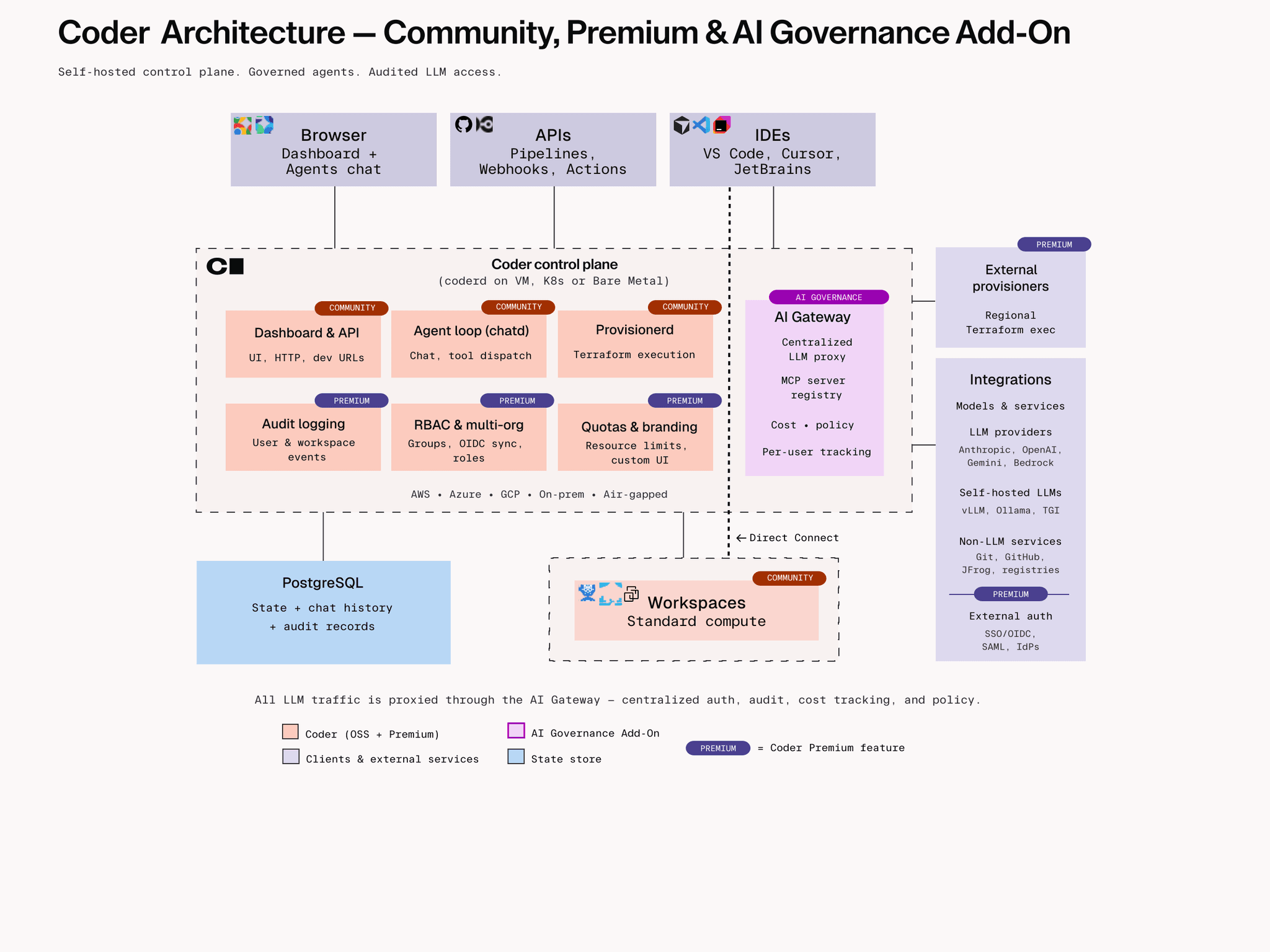
coderd
coderd is the service created by running coder server. It is a thin API that
connects workspaces, provisioners and users. coderd stores its state in
Postgres and is the only service that communicates with Postgres.
It offers:
Dashboard (UI)
HTTP API
Dev URLs (HTTP reverse proxy to workspaces)
Workspace Web Applications (e.g for easy access to code-server)
Agent registration
provisionerd
provisionerd is the execution context for infrastructure modifying providers.
At the moment, the only provider is Terraform (running terraform).
By default, the Coder server runs multiple provisioner daemons.
External provisioners can be added for security or
scalability purposes.
Workspaces
At the highest level, a workspace is a set of cloud resources. These resources
can be VMs, Kubernetes clusters, storage buckets, or whatever else Terraform
lets you dream up.
The resources that run the agent are described as computational resources,
while those that don't are called peripheral resources.
Each resource may also be persistent or ephemeral depending on whether
they're destroyed on workspace stop.
Agents
An agent is the Coder service that runs within a user's remote workspace. It
provides a consistent interface for coderd and clients to communicate with
workspaces regardless of operating system, architecture, or cloud.
It offers the following services along with much more:
While coderd and Postgres can be orchestrated independently, our default
installation paths bundle them all together into one system service. It's
perfectly fine to run a production deployment this way, but there are certain
situations that necessitate decomposition:
Reducing global client latency (distribute coderd and centralize database)
Achieving greater availability and efficiency (horizontally scale individual
services)
Data Layer
PostgreSQL (Recommended)
While coderd runs a bundled version of PostgreSQL, we recommend running an
external PostgreSQL 13+ database for production deployments.
A managed PostgreSQL database, with daily backups, is recommended:
Users will likely need to pull source code and other artifacts from a git
provider. The Coder control plane and workspaces will need network connectivity
to the git provider.
Workspaces and templates can pull artifacts from an artifact manager, such as
JFrog Artifactory. This can be configured on the infrastructure level, or in
some cases within Coder:
If you prefer not to pull container images for the control plane (coderd,
provisionerd) and workspaces from public container registry (Docker Hub,
GitHub Container Registry) you can run your own container registry with Coder.
To shorten the provisioning time, it is recommended to deploy registry mirrors
in the same region as the workspace nodes.
Governance Layer
The governance layer provides centralized oversight and policy enforcement for
AI-powered development within Coder workspaces.
AI Gateway
AI Gateway is a centralized gateway that sits between coding agents and LLM providers such
as OpenAI and Anthropic. Users authenticate through Coder instead of managing separate
provider API keys. All prompts, token usage, and tool invocations are recorded
for compliance and cost tracking.
AI Gateway supports 2 deployment topologies:
Embedded:coderd runs the AI Gateway data plane in the same process.
Standalone: AI Gateway runs outside coderd, as replicas that serve AI traffic and send requests directly to upstream providers.
Standalone replicas hold no durable state. coderd is the source of truth and the only component that writes AI Gateway state to the database.
Each replica maintains a control connection to coderd for Coder API key validation, provider configuration, and AI session recording, and becomes unready when that connection is unavailable.
Agent Firewall is a process-level firewall that restricts and audits network
access for AI agents running in workspaces. It enforces allowlist-based policies
controlling which domains, HTTP methods, and URL paths agents can reach, while
streaming audit logs to the Coder control plane for centralized monitoring.