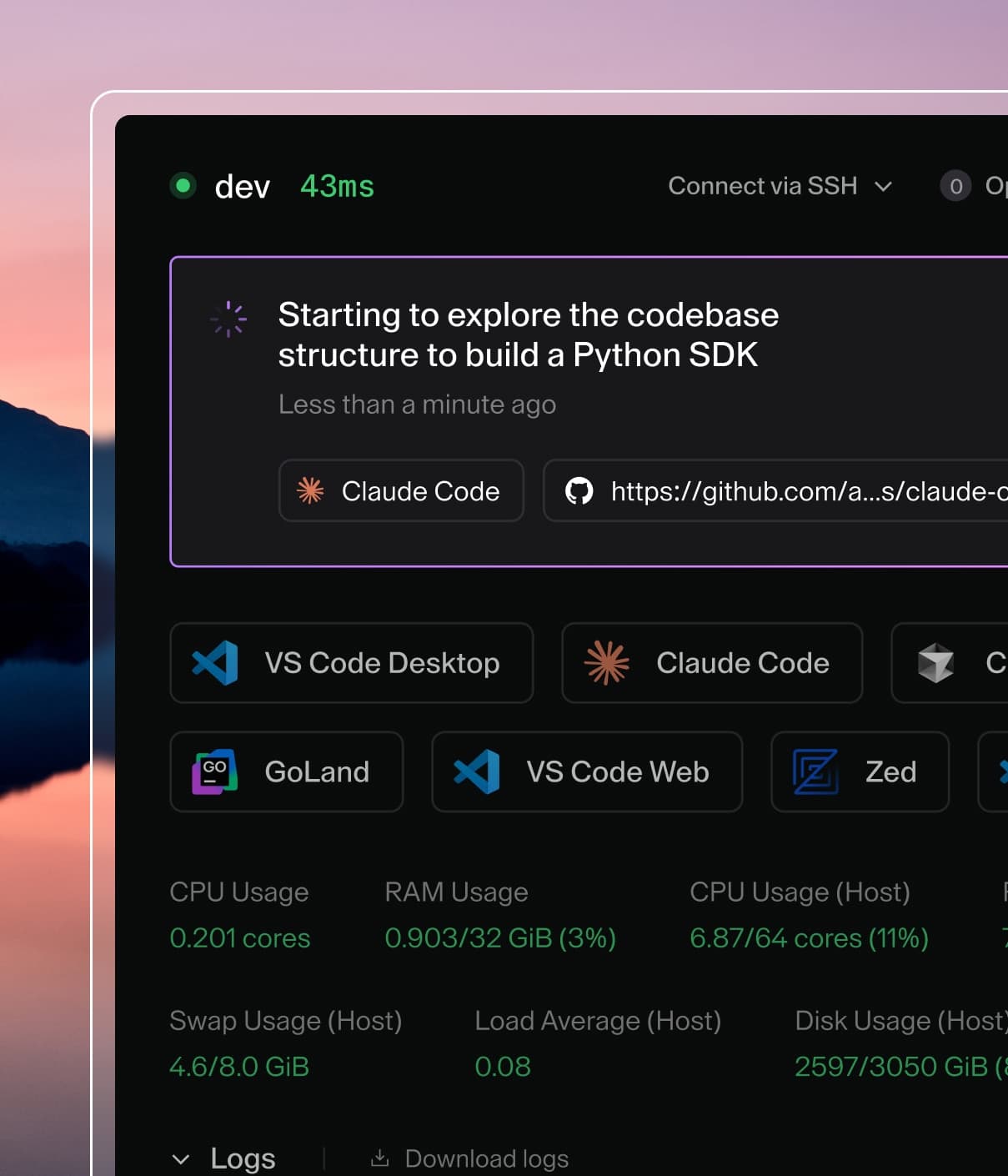
Coder powers secure, scalable development across key industries — automotive, finance, government, and technology — enabling faster builds, tighter compliance, and seamless AI adoption in enterprise-grade cloud environments.
Coder provides Extended Support Releases (ESR) biannually. This guide walks
through upgrading from Coder 2.29 ESR to Coder 2.34 ESR. It
summarizes key changes, highlights breaking updates, and provides a recommended
upgrade process.
Coder Agents was introduced in v2.32, and is the long-term replacement for
Coder Tasks. Coder Agents is a native AI coding agent that runs entirely within the Coder control plane, managing the agent loop, conversation state, and workspace provisioning in one place. This gives administrators centralized control over model access, credentials, and audit trails across every agent session. Coder Agents was made Beta in v2.33.
Coder Agents includes the following high-level functionality:
Supports all major LLM providers
Multi-turn chat
Automatic workspace provisioning
MCP server integration, personal skills, and administrator-managed skills
ACL-based chat sharing across users and groups
Admin-configurable advisor for planning and architecture guidance
Plan and subagent explore modes
Chat debugging
Virtual desktop
Administrators have the following levers to configure appropriate access to various parts of Coder Agents:
Template allow lists for agents
BYOK for users
Cost controls
Configurable chat retention
Automatic chat archiving
Configurable system instructions
Observability via AI Gateway, part of Coder's AI Governance features
Caution
Coder Tasks is officially deprecated in 2.34. It remains supported through the 2.34 ESR support window
but receives no new features. Coder recommends migrating to Coder Agents
and the Chats API now. See the Tasks to Chats migration guide
for API migration details.
AI Gateway and AI Governance
AI Gateway, previously AI Bridge, matured into a broader governance and
observability layer for AI usage. It now supports:
Agent Firewall, previously Agent Boundaries, moved from an early capability into
a stronger governance primitive for AI agents. It can audit and restrict network
access from agent processes, forward machine-readable logs to the control plane,
track usage, and use landjail mode
for environments where changing Linux capabilities is not practical.
Service accounts are a
Premium feature and now integrate with workspace
sharing, user and workspace filtering, organization membership, and role
assignment.
Templates, Prebuilds, and User Secrets
Template and workspace operations received several improvements:
Terraform modules are cached per template version
to reduce repeated downloads and make workspace starts more deterministic.
User secrets can be created, encrypted,
audited, and injected into workspaces.
The dashboard warns about active prebuilds when duplicating templates.
These changes reduce operational surprises for template authors, but templates
that assumed a clean Terraform module download on every build should be tested.
Security and Networking
Coder added several security and networking controls between 2.29 and 2.34:
OAuth2 external auth providers now support PKCE, and unknown providers default
to PKCE unless explicitly disabled.
Secure auth cookies are now enabled automatically when CODER_ACCESS_URL uses
HTTPS.
AI Gateway Proxy blocks CONNECT tunnels to private or reserved IP ranges, while
always exempting the Coder access URL.
Workspace agents can disable reverse and local port forwarding through agent
flags.
Authenticated request rate limiting is keyed by user instead of IP address.
Kubernetes Gateway API HTTPRoute is supported as an alternative to Ingress.
Helm chart probes are more configurable, and Prometheus and pprof addresses can
be overridden through chart environment values.
DERP TLS configuration is wired through the CLI, SDK, tailnet, VPN, agent, and
health checks.
Operations and Scale
Large deployments should now have improvements in database, logging, and
observability behavior. Coder added the following:
Configurable PostgreSQL connection pool settings.
Retention configuration for audit logs,
connection logs, API keys, and workspace agent logs.
dbpurge metrics.
Support bundle improvements.
chatd metrics.
Agent first-connection duration metrics.
A coder_build_info metric.
Coder also removed several deprecated Prometheus metrics, so dashboards and
alerts should be reviewed before the upgrade.
Several expensive queries and write paths were optimized, including:
AI Gateway session listing.
Audit and connection log counts.
Connection log batching.
Provisioner job queue lookups.
Chat streaming.
Coordinator peer mapping.
CLI and Dashboard Enhancements
The CLI and dashboard gained smaller but meaningful workflow improvements:
coder create --no-wait creates a workspace without waiting for startup.
coder logs provides easier access to logs.
coder login token prints the current session token for scripts and automation.
coder support bundle can infer the workspace from the environment.
coder groups list -o json now returns a flat JSON structure.
The dashboard includes user editing, service account management, group member
filtering, role selection during user creation, improved accessibility, and
clearer confirmation flows for destructive actions.
Changes to be Aware of
The following changes introduced after 2.29 might break workflows, require manual
updates, or change administrator expectations:
Initial State (2.29 and before)
New State (2.30-2.34)
Change Required
Terraform modules are downloaded during each workspace start.
Terraform modules are cached and pinned per template version.
Publish a new template version when upstream module changes should apply. Test templates that relied on fresh module downloads. See speed up templates.
Integrations may use experimental AI Bridge endpoints under /api/experimental/aibridge/*.
Experimental AI Bridge endpoints were removed after AI Gateway graduated to stable routes.
Update clients to use /api/v2/aibridge/* routes. Review API consumers again because /api/v2/aibridge/interceptions is now deprecated in favor of /api/v2/aibridge/sessions. See the AI Gateway API reference.
Unknown external OAuth providers did not default to PKCE.
Unknown external OAuth providers now default to PKCE.
If a provider does not support PKCE, set CODER_EXTERNAL_AUTH_<N>_PKCE_METHODS=none. See external authentication.
GitLab external auth required only the write_repository scope.
GitLab external auth now requires write_repository and read_api scopes by default.
Add the read_api scope to your GitLab OAuth application. Existing users must re-authenticate to obtain the new scope. If you set scopes explicitly via CODER_EXTERNAL_AUTH_<N>_SCOPES, add read_api there as well. See external authentication.
--secure-auth-cookie defaulted independently from the access URL.
Secure auth cookies are enabled automatically when CODER_ACCESS_URL uses HTTPS.
Confirm reverse proxies send the correct scheme headers. To preserve old behavior, explicitly set CODER_SECURE_AUTH_COOKIE=false.
SFTP and SCP connections always landed in $HOME.
SFTP and SCP now respect the workspace agent dir setting.
Update scripts that relied on implicit $HOME paths. Prefer explicit absolute paths for file transfers.
coder_agentdir attribute accepted any path without warning.
dir is deprecated and emits a warning. Non-$HOME/~ values also break Coder Desktop file sync.
Set dir to $HOME or omit it on coder_agent resources. The attribute still works in 2.34 but will be removed in a future release.
Pre-2.28 Tasks templates might still exist in older deployments.
The pre-2.28 Tasks template format is no longer supported as of 2.30.
Update Tasks templates to use app_id instead of the deprecated sidebar_app flow.
Tasks is the primary AI coding workflow.
Coder Agents is the long-term replacement, and Tasks is supported through the 2.34 ESR window (into 2026).
AI Gateway injected MCP tools can be used for tool exposure.
Injected MCP tools are deprecated.
Move new integrations toward Coder Agents MCP server configuration or the MCP server flow. See AI Gateway MCP and MCP servers.
AI Bridge is opt-in via CODER_AIBRIDGE_ENABLED (default false).
The toggle is renamed to CODER_AI_GATEWAY_ENABLED and now defaults to true.
The in-memory AI Gateway now starts on every deployment. Set CODER_AI_GATEWAY_ENABLED=false, or the deprecated CODER_AIBRIDGE_ENABLED alias which still works, to keep the old behavior.
AI Gateway providers are configured with CODER_AIBRIDGE_PROVIDER_* or CODER_AI_GATEWAY_PROVIDER_* env vars.
Provider configuration is stored in the database. Env vars seed the database once on first startup, then are deprecated.
After upgrade, visit /ai/settings/providers to verify seeded providers, then remove the env vars. Coderd fails to start if env vars drift from the seeded database row. See AI Gateway providers.
Regular users can read their own AI Gateway interceptions.
Only owners and auditors can read AI Gateway interception data.
Update dashboards, scripts, or user workflows that expected self-service interception reads. This intentionally narrows the RBAC surface.
coder groups list -o json returns the old command output shape.
coder groups list -o json returns a flat structure matching other list commands.
Update scripts that parse this command output.
coder tokens rm deletes token records by default.
coder tokens rm expires tokens by default and keeps records for auditability.
Use coder tokens rm --delete only when the token record must be deleted. Update scripts that expect removed tokens to disappear from token history.
Deprecated Prometheus metrics are still emitted.
Deprecated Prometheus metrics were removed.
Update dashboards and alerts that use coderd_api_workspace_latest_build_total or coderd_oauth2_external_requests_rate_limit_total. Use the replacement metrics without the _total suffix.
Authenticated rate limits are effectively shared by client IP in some deployments.
Authenticated request rate limits are keyed by user.
Review monitoring and expectations for NATed users or shared proxies. Per-user limits now apply more consistently after API key precheck.
coder login can run while CODER_SESSION_TOKEN is set.
coder login errors when CODER_SESSION_TOKEN is set.
Unset CODER_SESSION_TOKEN in interactive login flows. Keep using the environment variable for non-interactive automation.
Workspace starts with new parameters can proceed without an explicit stop in some flows.
Workspace starts with new parameters stop the workspace before starting.
Expect downtime when applying new parameters. Update automation that assumes the workspace remains running.
mode=auto workspace links can silently create workspaces with prefilled parameters.
Users must confirm workspace auto-creation before provisioning starts.
Update Open in Coder buttons, runbooks, or internal flows that expect one-click workspace creation without a consent dialog.
Users with --login-type none are common for automation.
--login-type none is deprecated.
For Premium deployments, migrate automation to service accounts. For OSS deployments, use regular users with password, GitHub, or OIDC authentication. See headless auth.
Terminal commands can be executed from URL parameters without extra confirmation.
The dashboard requires confirmation before executing terminal commands from URLs.
Update runbooks or deep links that expected immediate terminal execution. This protects users from accidental command execution.
Agent SSH port forwarding is always available when the agent allows SSH.
Reverse and local port forwarding can be disabled per agent.
Review templates and IDE workflows before enabling --block-reverse-port-forwarding or --block-local-port-forwarding. See port forwarding.
PATCH /api/v2/templates/{template} accepts value fields for metadata updates.
Template metadata update fields are optional pointer fields in the SDK, and 304 responses were removed.
Update SDK consumers and direct API clients that patch template metadata. Send only fields that should change, including false or zero values explicitly.
External provisioner daemons use the 2.29 provisionerd protocol.
The provisionerd protocol changed for provisioner operations and file upload/download.
Update external provisioner daemons to the matching 2.34 protocol. The protocol reserves removed fields such as stop_modules, exp_reuse_terraform_workspace, and user_secrets, and adds DownloadFile.
Helm chart health probes and observability bind addresses use older chart defaults.
Readiness and liveness probes have enabled toggles and more fields, and Prometheus/pprof addresses are overridable.
Review custom Helm values for probe behavior and observability bindings. Prefer restricting pprof to a local address when exposing diagnostics.
Upgrade recommendations
Note
You can upgrade directly from 2.29 to 2.34. Stepping through intermediate
minor versions is not required.
This upgrade applies 108 database migrations. Coder applies them in order
on startup. Most are fast schema changes, but a few rewrite or backfill
long-lived tables and hold locks while they run. Total time ranges from under
a minute to several minutes, scaling with the size of the tables called out
in Database migrations to watch below.
Take a database backup before upgrading and validate the upgrade in a
staging environment that mirrors production data volume.
Database migrations to watch
The batch runs in order on the first startup of the new version. Most
migrations create new tables or make fast schema changes, but the following
pre-existing tables receive the heaviest operations. Size your maintenance
window for whichever are largest in your deployment:
Tailnet coordination tables (tailnet_peers, tailnet_tunnels,
tailnet_coordinators) are converted to UNLOGGED and rewritten under an
exclusive lock. UNLOGGED tables are not replicated to standby servers and
are truncated on crash recovery. This is intentional, since coordinators
re-register and peers reconnect on startup, but confirm your high
availability strategy does not rely on replicating tailnet state to read
replicas.
users gains a service account column plus check constraints and unique
index rebuilds, held under an exclusive lock. This briefly blocks logins and
API key validation, so the duration matters most on deployments with many
users.
workspace_agents (joined with workspace_builds, workspace_resources,
and workspaces) is bulk updated to soft-delete stale agents left behind by
a pre-2.33 bug. This is typically the slowest step on long-lived deployments
with extensive build history. It is safe, but plan for the time.
workspaces receives full-table updates and new ACL check constraints.
usage_events has a check constraint revalidated and an index added; the
cost scales with retained event volume.
Several of these changes are irreversible, including the users service
account reclassification and the cleanup of user_secrets,
organization_members, and related rows for already soft-deleted users. Take a
database backup before upgrading.
The Coder team recommends taking the following steps when performing the upgrade:
Perform the upgrade in a staging environment first: The cumulative changes
between 2.29 and 2.34 affect AI workflows, templates, prebuilds,
authentication, RBAC, and dashboard behavior. Validate representative
workspaces before production rollout.
Retest templates and prebuilds: Focus on Terraform module caching,
prebuild preset validation, coder_env merging, user secrets, and workspace
starts with changed parameters.
Audit AI Gateway integrations: Update experimental API routes, check
permissions for interception/session data, migrate provider configuration
from env vars to the database via /ai/settings/providers, verify proxy mode behavior,
and review any injected MCP usage.
Plan the Tasks to Agents migration: Tasks remains available during the
support window, but new automation should use Coder Agents and the Chats API.
Update internal docs, templates, and API clients accordingly.
Validate external authentication: Test GitHub, GitLab, OIDC, and custom
external auth providers. Add the read_api scope to GitLab OAuth applications
and have users re-authenticate. Disable PKCE for providers that do not support
it.
Migrate headless automation to service accounts: Replace users created
with --login-type none where possible, and verify CI/CD tokens, template
publish jobs, and workspace automation.
Update CLI parsers, API clients, and scripts: Check coder groups list -o json, coder tokens rm, coder login with CODER_SESSION_TOKEN, SFTP/SCP
destination paths, template metadata update clients, provisionerd protocol
consumers, and any script that depends on terminal command URL execution.
Review networking controls before enabling them: Test AI Gateway Proxy,
private IP restrictions, port forwarding blocks, DERP TLS configuration,
Kubernetes HTTPRoute, and Helm probe settings in environments that use custom
networking.
Tune operational settings after rollout: Review PostgreSQL connection pool
settings, retention policies, dbpurge behavior, Prometheus metrics, secure
cookie behavior, support bundle output, and log ingestion pipelines.
Communicate user-facing changes: Service accounts, Coder Agents, AI
Governance, Tasks deprecation, dashboard confirmations, and workspace parameter
restarts can change user workflows. Share the expected behavior before the
production upgrade.