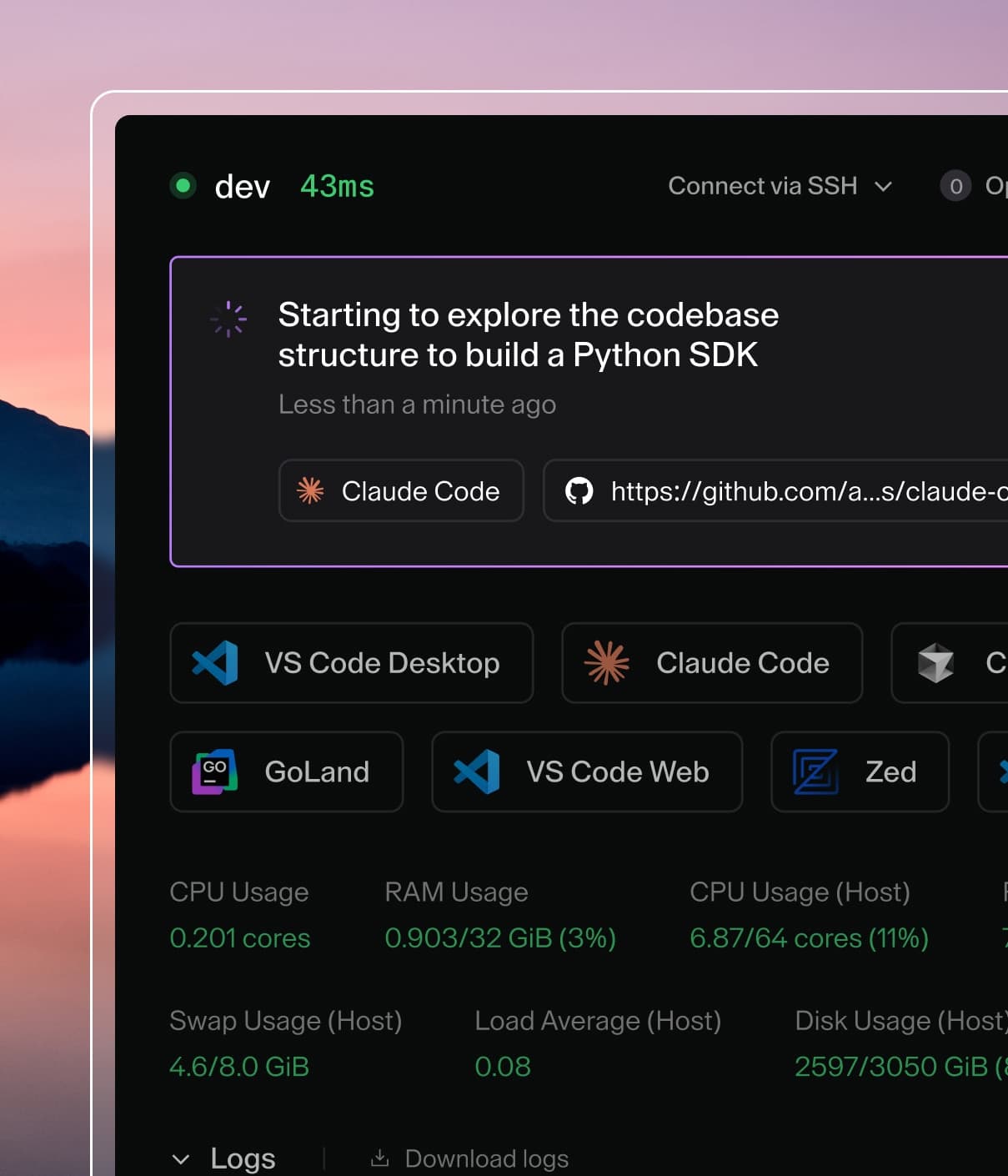
Coder powers secure, scalable development across key industries — automotive, finance, government, and technology — enabling faster builds, tighter compliance, and seamless AI adoption in enterprise-grade cloud environments.
Records a detailed trace of each chat turn for troubleshooting: the
normalized request sent to the LLM provider, the full response, token usage,
retry attempts, and errors.
Off by default. Three layers control whether it runs for a given chat:
Deployment override. Setting CODER_CHAT_DEBUG_LOGGING_ENABLED=true
(or --chat-debug-logging-enabled at server start) forces debug logging
on for every chat. The runtime admin and user toggles become read-only.
Runtime admin gate. With the deployment override unset, the
Let users record chat debug logs toggle decides whether users can opt
in. Configure it under Admin settings > AI > Coder Agents > Lifecycle, or at
GET/PUT /api/v2/chats/config/debug-logging.
Per-user toggle. Users with the admin gate enabled can turn debug
logging on for their own chats from Agents > Settings > General
under Record debug logs for my chats. The endpoint
PUT /api/v2/chats/config/user-debug-logging returns
409 Conflict if the deployment override is active and 403 Forbidden
if the admin has not enabled user opt-in.
Important
Debug logs may contain sensitive content from prompts, responses, tool
calls, and errors. Treat them with the same care as conversation history.
Only the chat owner (or a user with read access to the chat) can fetch a
chat's debug runs through the API. Administrators do not get blanket
access to all users' debug data.
When debug logging is active for a chat, a Debug tab appears in the
right panel of the Agents page (alongside Git, Terminal, and Desktop) for
that chat's owner. The tab lists recent debug runs and lets you expand a run
into its per-step request, response, token usage, retry attempts, errors,
and policy metadata.
Export debug logs
You can export the same captured debug data from the UI:
Navigate to Agents.
Open a chat with debug logging enabled.
Open the Debug tab in the right panel.
Select Export debug logs to download the chat's recent debug runs as JSON, or expand a run and select Export this run to download one run.
The chat-level export includes the full run detail for the runs returned by
the debug run list endpoint. The current list endpoint returns up to 100 of
the newest runs.
API access
The same data is available through the API:
GET /api/v2/chats/{chat}/debug/runs lists the most recent runs
for a chat (up to 100, newest first).
GET /api/v2/chats/{chat}/debug/runs/{debugRun} returns a single
run with all of its steps, including normalized request and response bodies.
Fetch every run returned by the list endpoint and save a chat-level export.
Using the same CODER_URL, CODER_SESSION_TOKEN, and CHAT_ID variables
from above:
Debug runs are stored alongside the chat and are removed when the parent
conversation is deleted (manually, by retention, or by chat purge). See
Data Retention for the conversation retention
controls.